
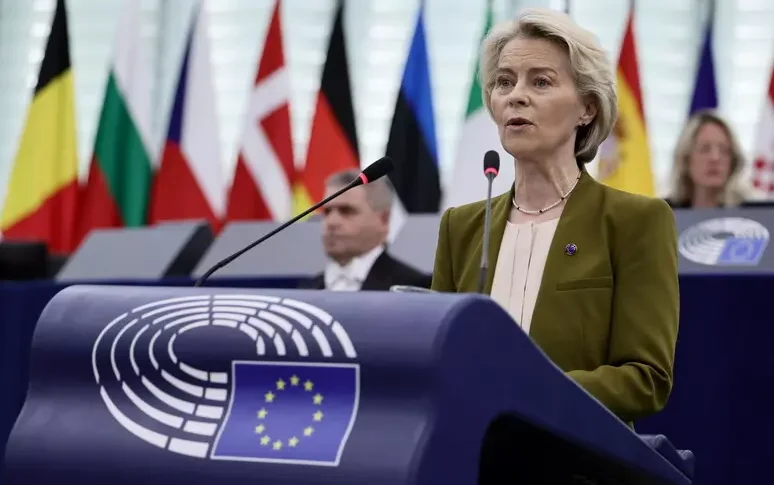
We are not going towards the third world war, ‘but we live in very dangerous times. I will do everything that is in my power to maintain peace and freedom in Europe. This is why we are strengthening our defense skills with so much determination. In an increasingly hostile world, we must do everything possible to safeguard democracy, prosperity and peace ‘. Thus, in an interview with La Repubblica, the president of the European Commission Ursula von der Leyen. ‘The European Union – he explains – is responsible for the single market for its industries, for research and innovation and for SMEs, among which the industrial defense base also includes. We take our responsibilities to protect the union. We have to deal with reality: the world has profoundly changed and you have to prepare to collect the challenges that will place us. This means showing ourselves, our allies and opponents that Europe intends to defend ourselves and is able to do so. And thinking of the multiple initiatives that we have taken – for our energy security, for our promptness to defense – after the invasion of Ukraine by Russia in 2022, we are on the good road. ‘The accidents, in particular what has occurred in Poland, are extremely significant – underlines President Ursula von der Leyen -. If it is true that NATO must remain the fulcrum of our collective defense, it is also true that we need a much stronger European pillar. Europe must be more self -sufficient and independent in terms of safety. For this reason we started the ‘readiness for 2030’ program, with which we intend to fill the ability to capacity, accelerate the procedures and mobilize up to 800 billion euros for the defense industry. We will protect every centimeter of the Europeà Union. ‘To avoid misunderstandings – he adds – the Member States will always be up to the competence of their troops, from doctrine to deployment, for example, and the definition of the needs of their armed forces. We must not forget that 30 of the 32 NATO countries are European. Therefore, by strengthening the European pillar of NATO, we also enhance the military skills of Europe and its ability to defend. ‘Interference with GPS systems has become a daily problem in many regions bordering Russia – says Ursula von der Leyen -. Maritime traffic in the Baltic Sea is constantly affected by disturbances, with an increased risk of collisions. The same goes for air traffic on the Black Sea. Russia seems to be willing to accept that sooner or later there will be fatal accidents. It is a question that we take very seriously, like all the hybrid and IT attacks of Russia in the Union, because these attacks clearly show that the ambitions of Russia do not stop at Ukraine. The only path of Europe towards security and stability passes from a strong deterrence and Credilbine. ‘Europe – he continues – is determined to strengthen its energy safety: we are creating a solid base of energy cleaning internal renewable sources, while reducing, or even eliminating, our strategic dependence on unreliable suppliers. We are accelerating the gradual elimination of Russian fossil fuels and we are creating massive investments in renewable energies produced in Europe, using nuclear power for basic load. Today we already take over 70% of electric energy from low carbon -emissions sources. Only in the first half of 2025 the investments in European wind energy have reached a historical maximum of over 40 billion euros. But energy security does not mean total independence: the prospect of full autonomy from global markets is neither realistic nor desirable. The EU remains interconnected and the imports of oil, GNL and, possibly, hydrogen will continue to be part of the energy mix. In this respect, the United States are a reliable partner and an essential element of our wider diversification strategy. This vision has materialized in the EU-USA commercial agreement. It should be noted that the aggregate numbers mentioned concern a period of four years and do not represent binding commitments. Ultimately it is up to the European companies themselves to decide whether and how much to buy – or invest – in the United States. When asked about how the EU should answer Trump, who asked to impose 100% duties in India and China, replies: ‘The EU will decide independently. The request was born from the interest of the president to increase the pressure on Russia to put an end to the aggression against Ukraine and to induce her to sit at the negotiation table. For this reason I just proposed the 19th package of substantial and large sanctions. Of course we will continue to coordinate our efforts on both banks of the Atlantic and within the G7 and we welcome the efforts made by the United States to end the war in Ukraine. We also know that, in this increasingly complex geopolitical context, we must strengthen the partnerships rooted in the common interest. Think about our relationships with India. As the country assumes an increasingly important role in terms of safety in the Indo-Pacific region, a closer EU-India cooperation is more essential than ever. For this reason we have announced a new EU-India’s strategic agenda, which identifies, among the priorities, the strengthening of mutual defense and security. We intend to conclude a new free trade agreement by the end of 2025, for the benefit of European and Indian companies. Agreements like this strengthen our geopolitical position and put us in a position to achieve our objective. ‘The duties – remember – are taxes. Most economists are of the opinion that will fall on American companies and consumers. Our priority is to ensure that European companies continue to have access to a significant market. Each year the union exports to the United States freight for a value of over 500 billion euros. These are commercial exchanges on which millions of jobs depend. Thanks to an all -inclusive rate with a maximum of 15% our companies will find themselves in a force position compared to the world competitors. We secured the best agreement among all those concluded so far with the United States. And let’s not forget: the alternative would have been a commercial war with our most important commercial partner at a time when Europe is prey to economic upheavals and must face serious threats to its borders. I will never jeopardize the jobs or the means of existence of the personè. “We will be able to reconcile decarbonisation and technological neutrality”, reiterates the president of the European Commission, which adds: ‘The review of CO2 matters, which is an integral part of the act approved by European legislators, will take into account the objective of technological neutrality. The review began before the summer break and, following the public consultation currently underway, an impact assessment will be carried out. I am determined to complete the review by the end of the year. And at that point the former the carriers of interests with which we will discuss will be those of the automotive sector. I am confident that by that date we will be able to guarantee predictability for this important sector.

John
John, founder of Odnako, combined his journalism degree with technical expertise to revolutionize global news consumption. Before Odnako's 2011 launch, he gained diverse experience across the media and tech fields, setting a solid foundation for his mission to provide comprehensive, unbiased news. His vision and leadership have since established Odnako as a trusted, innovative news platform worldwide.