

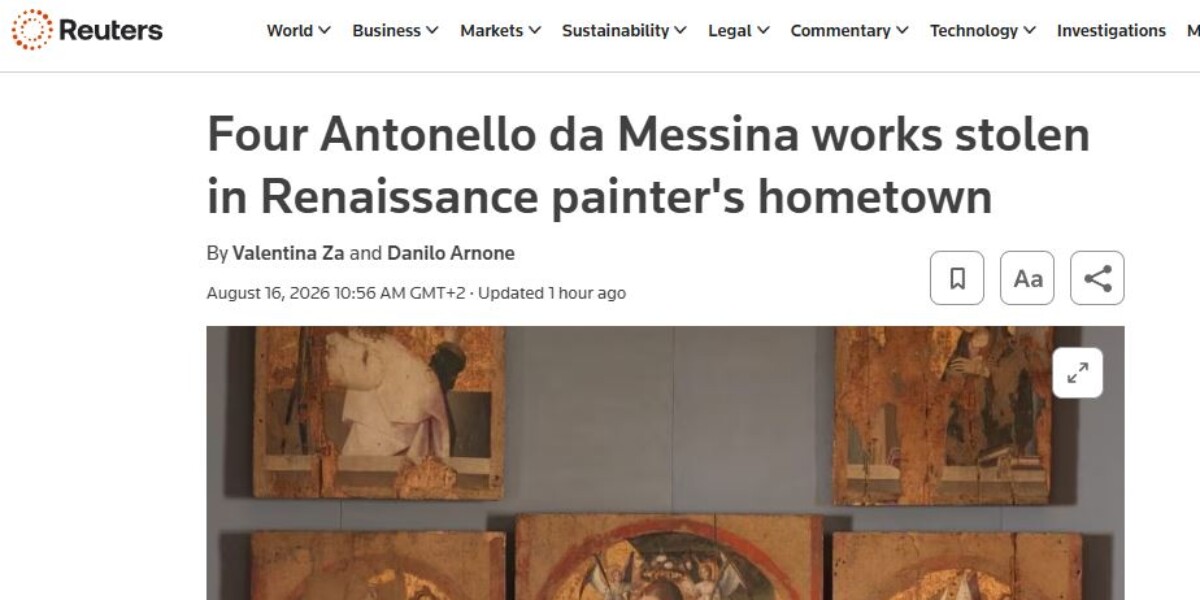
The theft of four works by Antonello da Messina from the MuMe, the «Maria Accascina» Regional Interdisciplinary Museum in Messina, went around the world. The news of the coup carried out on the evening of 15 August, in the hours of the Vara Procession, was covered by Reuters and Associated Press and relaunched by the main international newspapers – from the British Guardian to the Canadian CBC, up to the Singaporean Straits Times – as a loss for European cultural heritage. Three of the five surviving panels of the Polyptych of San Gregorio, signed and dated 1473, and the two-faced panel with the Madonna and Child and the Christ in Mercy, taken from an armored case, were stolen.
The detail that strikes the foreign press
The point on which almost all international reconstructions insist is the same. Reuters highlights above all a symbolic fact: the Polyptych was the only work by Antonello remaining in the painter’s hometown. The CBC reports the note from the Minister of Culture Alessandro Giuli, who spoke of bewilderment and sadness. The director of the museum, Marisa Mercurio, told the Ansa agency that the theft occurred shortly before 10pm and defined the panels as “the business card for this museum”. The municipal councilor for culture Enzo Caruso, quoted by various foreign networks, spoke of “an almost movie-like coup, like at the Louvre”.
Parma’s timing and precedent
Foreign newspapers underline the timing of the incursion, which occurred while the city’s attention was focused on the Vara which had just completed its journey in Piazza Duomo. There is also a contrast with the news from just two days earlier: on 14 August the Carabinieri of the Cultural Heritage Protection Unit had announced the recovery of the three paintings by Cézanne, Renoir and Matisse stolen from the Magnani Rocca Foundation, in the Parma area, on the night between 22 and 23 March. According to an initial reconstruction in Messina, the thieves entered through a secondary door and there were three of them, with their faces covered.
Stealing an Antonello is easier than selling it
The analyzes relaunched abroad focus on the black market. Lynda Albertson, head of the art crime research association Arca, observed in statements quoted by international agencies that such recognizable works are in fact unsellable through legal channels and often end up being passed from one criminal group to another as collateral for other illicit activities. More than one analysis also links the international attention on the artist to the purchase by the Italian State, last February, of Antonello’s Ecce Homo from Sotheby’s in New York. Two of the six targeted panels – the San Benedetto and the San Gregorio Magno – were found a few hours after the theft, abandoned on the external wall of the museum along Viale della Libertà and reported to the police by some passers-by.