

Google Discover

Preferred Sources
“You know that rainy day, child / that my broken heart will never forget”
There are days that are impossible to forget. Days that remain suspended in the memory of those who lived them and which, even decades later, continue to be told as if they had just happened. May 4, 1949 is one of those days: the one in which Grande Torino disappears on the Superga hill, on board a plane that crashes violently into an embankment. That afternoon, Turin didn’t just lose a football team: it lost a symbol, a generation of champions, a piece of its identity. It is from that collective pain that the first verses of “Quel giorno di rain” take shape, a song in which Sensounico don’t talk about the plane disaster so much as the void it left.
It’s 1949 and Grande Torino is much more than a winning team. It is the team that dominated Italian football in the difficult post-war years, the one capable of winning five consecutive championships and giving Italians a reason to dream again. On the pitch there are players who have become legends, almost the entire Italian national team has the garnet color. It is an invincible team, but above all a loved team. On 3 May of that year Torino flew to Lisbon to play a friendly match against Benfica. It’s not just any match: the match was born as a gesture of support towards Francisco Ferreira, captain of the Portuguese team, who is going through a difficult moment. An initiative of solidarity between footballers, even before a sporting challenge. The match ends with a 4-3 victory for Benfica. The next day, the Torino players prepare to return home, to take that flight that seemed like just the last chapter of an away match. No one could have imagined that it would be their last trip.
On the morning of May 4th the plane takes off from Lisbon. There are 31 people on board: the entire Torino team, managers, companions, crew members and three sports journalists. The plane makes a stopover in Barcelona, and then resumes its journey to Turin. But in the Piedmontese capital the weather has worsened: rain, low clouds, strong wind. Visibility is reduced to a few meters.
At 4.55pm the control tower of Turin-Aeritalia airport communicated difficult weather conditions to the pilots. Commander Pierluigi Meroni continues the approach maneuvers. After a few minutes, the last radio message arrives: “Altitude 2,000 metres. QDM on Pino, then we cut to Superga”. A few moments later, the connection is cut.
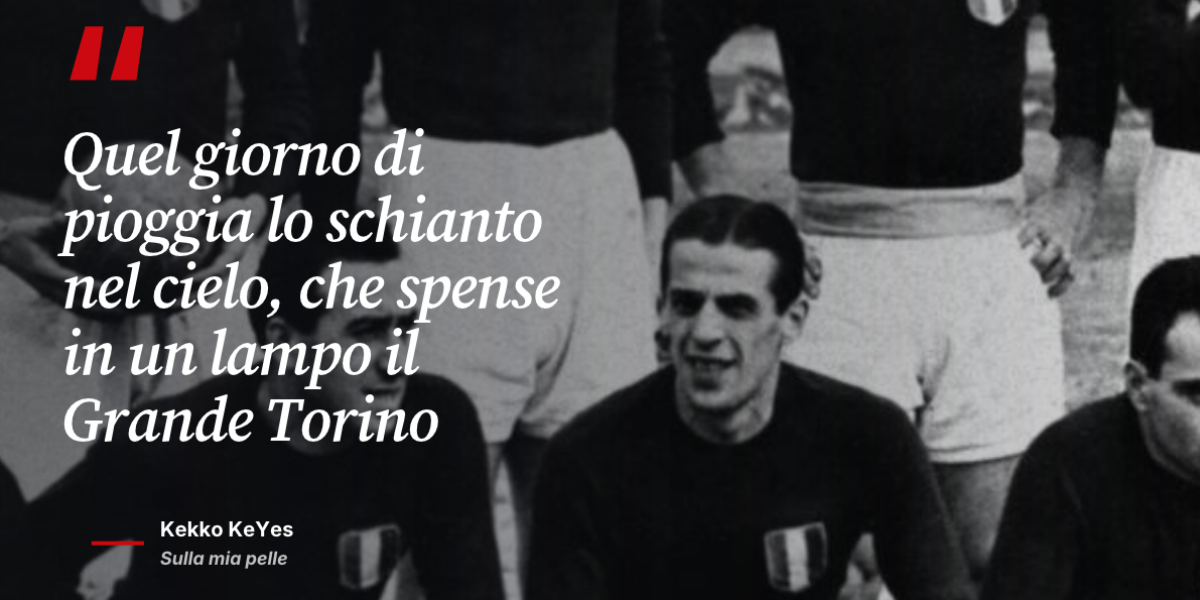
“That rainy day, the crash in the sky / that extinguished the Grande Torino in a flash / that flash that brings the memory of those who are no longer here”
At 5.03pm the Fiat G.212 crashed into the rear embankment of the Basilica of Superga. The rain that accompanies that afternoon in Turin becomes, in Sensounico’s song, the very memory of the tragedy, the detail that continues to resurface every time that story is told. The causes of the accident will never be clarified with certainty, but it was probably a combination of factors: adverse weather conditions, with a strong wind that could have pushed the aircraft off the expected trajectory, poor visibility, which in some areas did not exceed 40 metres, and a possible error in the altimeter, which according to some reconstructions would have indicated a different altitude from the real one. No one is saved: 31 people lose their lives on board that plane.
“That rainy day the room was dense / your expression was formal / your hands raised to your mouth / those swollen eyes of yours were looking at me”
The news arrives in Turin like a crash within a crash. The city stops. Vittorio Pozzo, the former technical commissioner of the national team who knew almost all those players having trained them and worn them in the blue shirt, was called to recognize the bodies of the players. He is the one who has to give a face to that tragedy. On May 6th the funeral fills the streets of Turin. Over 600 thousand people take part in the final farewell: an immense crowd to accompany a team that now belonged not only to the Granata fans, but to the entire country. The championship, however, is not over yet. Torino takes the field with the boys from the youth team and the opponents decide to do the same out of respect. In the end, the championship comes anyway. The fifth in a row.
“Bacigalupo / Ballarin / Maroso / Grezar / Rigamonti / Castigliano / Menti / Loik / Gabetto / Mazzola / Ossola / and for all the Granata hearts that no longer beat”
The piece ends with eleven names that have become eternal. No longer just footballers, but voices tragically shattered by a crash that left no one a chance. Sensounico don’t just tell the story of a sporting tragedy: they tell the story of the moment in which men become memory. Because Grande Torino did not remain in history only for its victories, but because, on that rainy day, an entire city lost something to which it felt deeply connected and which it would never forget.