

“I ask for nothing but the truth”
This is how the song “Sulla mia pelle” by Kekko KeYes opens, a single very short verse that contains the essence of one of the judicial stories that have most marked Italy: the desperate search for the truth. This was the battle of the family of Stefano Cucchi, a young thirty-one year old victim of violence by the carabinieri, who deprived him of his dignity and humanity, leading to the most dramatic consequences. His death, which occurred on October 22, 2009, represents one of the most controversial judicial pages of recent decades.
Stefano is 31 years old, has an older sister called Ilaria and is a surveyor like his now retired father, Giovanni Cucchi. His mother, Rita Calore, is also retired: she was a teacher. The family lives in Rome and leads a simple, ordinary life. Stefano, however, finds himself having to live with profound fragilities. He suffers from epilepsy, celiac disease and anemia and, over the years, developed an addiction to drugs. It is within this complexity, made up of difficulties and contradictions, that the story destined to change his life forever takes place. On 15 October 2009 Stefano was stopped by the police, who surprised him during a drug dealing operation. They searched him and found several doses of narcotics on him, then took him to the barracks.
“And if it were easy to start from scratch / I’m Stefano, I’m 30 years old and I’m a sincere man / I know I’m not a nice guy / but I’m not a monster either”
These verses underline Stefano’s awareness of his weaknesses, although he struggled to fight them. He certainly made mistakes, but it’s true: he’s not a monster. He is a human being with the right to be treated as such, with dignity and respect, a right that was soon denied to him. The judicial case will remember precisely this: his addiction is sadly a page of his life, fragile and complex, but not the measure of his value, and the contested crime cannot justify the loss of an individual’s fundamental rights. The day following the arrest, Stefano appears at the validation hearing with visible bruises, has difficulty walking and can barely speak. The beatings had begun in the barracks: a truth that would emerge only ten years later.
“And I saw those faces in that room / all blinded by hatred and anger / then I didn’t see them and I only saw fog around / until I ended up in the ambulance”
This is the moment in which the authorities violently impose themselves on the young Stefano, the State stops protecting and begins to crush: those who should guarantee the rights become the instrument through which those rights are violated. The judge orders precautionary custody. Stefano Cucchi enters Regina Coeli and for six days the family receives no news. After the hearing, Cucchi’s condition worsened further, until he was transferred to the inmate ward of the Sandro Pertini hospital. Here, he died at dawn on October 22nd. In the days following his death, various causes were hypothesized, including his health problems and alleged drug abuse. The prison staff denies having exerted violence on the young man, but the family does not give up: his parents and sister know that the responsibility lies with someone else.
“And one word is enough / I ask for nothing but freedom”
The word freedom makes space in the text: the one that Stefano saw crumble while suffering a fatal abuse. After his death, the family released photos of Stefano’s tortured body. The images show a deeply distressed, malnourished boy – at the time of his death he weighed only 37 kilos – with a swollen face and a fractured jaw. Those images profoundly change the public narrative of the story. The Cucchi case is no longer just a judicial proceeding, it becomes a collective question about what happened to Stefano while he was in state custody. At this point, it can no longer be ignored. The witnesses begin to speak: some inmates confess to having seen the police officers beat Cucchi, or to have heard him tell it himself.
“Now that time flies / now give us the truth”
Time passes and the truth still seems far away, fueling the fear that the affair could go unpunished. But Stefano’s family has no intention of giving up. Especially her sister Ilaria, who manages to raise awareness and attract public attention to her brother’s case, dedicating herself wholeheartedly to a fight for justice that lasted thirteen years: fifteen trials, three investigations, two rulings from the Supreme Court. At the beginning of the investigation, attention focused on the responsibilities of the medical staff, accused of not having adequately treated Stefano despite his serious condition. Over time, however, the focus of the investigation changes: the theme of the violence suffered while in custody emerges. The turning point came when one of the carabinieri on trial, Francesco Tedesco, accused two colleagues of the beating that took place in the barracks. His statements also reveal the attempt to hide what happened through an altered service note. On 4 April 2022, the Court of Cassation definitively sentenced the carabinieri Alessio Di Bernardo and Raffaele D’Alessandro to twelve years’ imprisonment for manslaughter. On April 7, 2022, the convictions for the misdirections arrived: eight carabinieri involved in the attempt to cover up the truth.
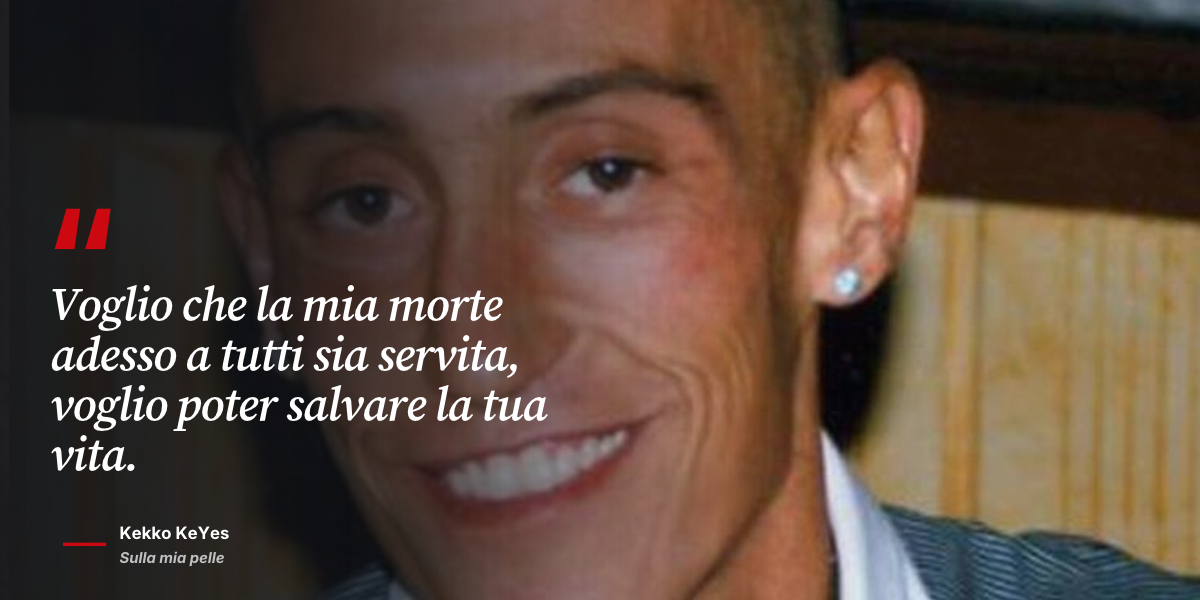
“I want my death now to be of use to everyone / I want to be able to save your life”
Kekko’s song KeYes ends with a strong consideration, which wants to convey the need to remember and make Stefano Cucchi’s story a starting point for the future, so that his death can serve to save the lives of others. Stefano Cucchi was not just a man arrested for a crime. He was a son, a brother, a boy with his own fragilities and contradictions. A person who, for thirteen years, his family tried to restore to collective memory in its entirety. Because before every mistake and every judgement, there remains one thing that should never be questioned: the dignity of a human being.