«This week the Court of Auditors will file the reasons with which it denied the registration of the Cipess resolution. We will thus understand what is missing from that act and make the consequent decisions.” Deputy Prime Minister Matteo Salvini, from Milan, on the occasion of the XXVII edition of “Italia Direzione Nord”, returns to the crucial issues regarding the procedures of the Strait Bridge. If the declared objective during 2025 was to “open the construction sites by July”, then “by September”, then “by the end of the year”, now the time horizon has inevitably been postponed to “the beginning of 2026”. But everything will depend both on the contents of the accounting judges’ report and on the answers that the Government intends to give and on the line that will be decided, i.e. whether to ask the joint sections of the Court to register “with reservation” the resolution of the inter-ministerial committee of last August 6th or whether to return to the Cipess headquarters and radically modify that act, where possible.
Salvini reiterated some concepts repeated several times in recent months. Meanwhile, «to those who say that the project does not exist or was done badly, I want to remind you that it was drawn up with the contribution of hundreds of engineers, architects, geologists, seismologists and experts among the best in the world, and of 22 international universities».
Then, there is the evidently not easy attempt by the Minister of Transport to convince that rebellious part of the North that the construction of the Bridge does not only concern the Strait of Messina, Sicily, Calabria and the “deep South”, but the entire country system. And that, indeed, from this infrastructure, the greatest benefits would go to Lombardy and Lombardy companies. «There is an independent study by Open Economics – recalled Matteo Salvini – which has thought about which Italian regions would be most involved economically and entrepreneurially by the “Bridge mission”: the first Italian region that would gain the most is Lombardy, then Emilia Romagna, Veneto and then Calabria and Sicily».
And then other passages: «In terms of utility, today a freight train crossing the Strait takes 180 minutes, with the bridge operational it would only take 13 or 14 minutes». The stable connection is part of “the European policies to strengthen railway lines” and “is an authentically “green” choice, unlike others”. Furthermore, the Bridge – added Salvini – represents a sign of hope and trust to be given to young people, all those Italian graduates who leave the South and our country to plan and build bridges all over the world. The Bridge over the Strait is a work that has no equal, the “Messina Style” is studied all over the world.”
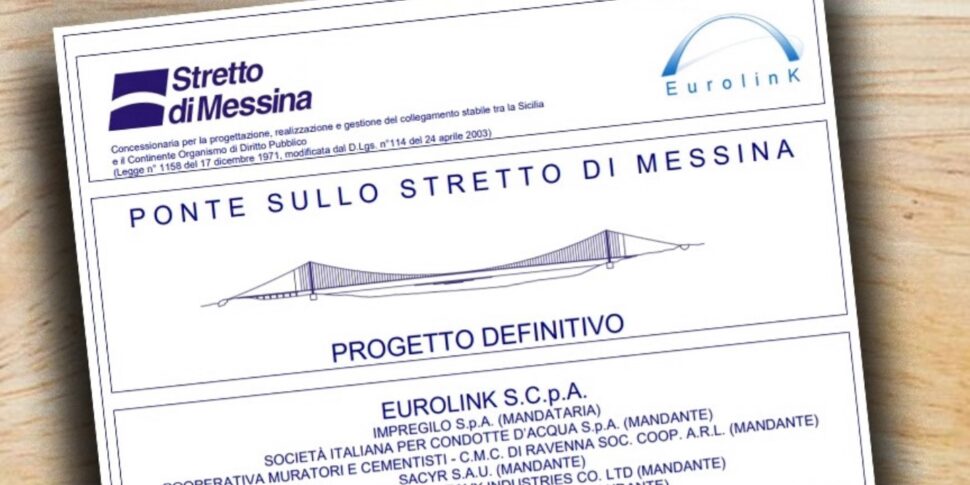
On the reasons of the Court of Auditors, Salvini did not add anything else. Now it’s a matter of days, if not hours. One fact is certain: among the most delicate points are that of the 50% threshold and the decision not to launch a new international tender, instead entrusting the project to the Eurolink Consortium (now led by Webuild) which was awarded the old contract in 2011. It is clear that on this point the Government does not intend to take steps backwards, because it would mean resetting the procedures and starting all over again. The Court effectively relaunched the doubts that had been raised on several occasions by the president of the ANAC Giuseppe Busia. According to the Anti-Corruption Authority, in fact, the Infrastructure Decree set the calculation basis not on the initial value, but on the one updated in the Def 2012, much higher, and this would confirm the fact that the 50% threshold, unlike what was supported by the Government and the “Strait of Messina”, would have been exceeded, for a contract which rose from 5 to 13.5 billion. “There is no clear evidence that the 50% limit has not been exceeded,” the judges write. The Anac, and the Court of Auditors, have asked for clarification on the dialogue with the European Commission, precisely to avoid possible infringement procedures against Italy, in case of violation of community rules on public procurement (as well as on environmental laws and directives).
Furthermore, as underlined by the Court of Auditors itself, «the absence of a unitary executive project, replaced by a phased approach, makes it difficult to estimate the actual economic impact and verify compliance with the cost limits imposed by EU regulations. The Government and the “Strait”, for their part, intend to demonstrate that “interlocution with the EU Commission has always been there and is constant” and that “the community rules have not been violated”. As regards the 50% threshold, “it has not been exceeded, the work variations have little impact, unlike the increase in costs dictated by inflation and the cost of materials which concern all infrastructures designed and built, especially from 2020, the year of the pandemic, to today”.