

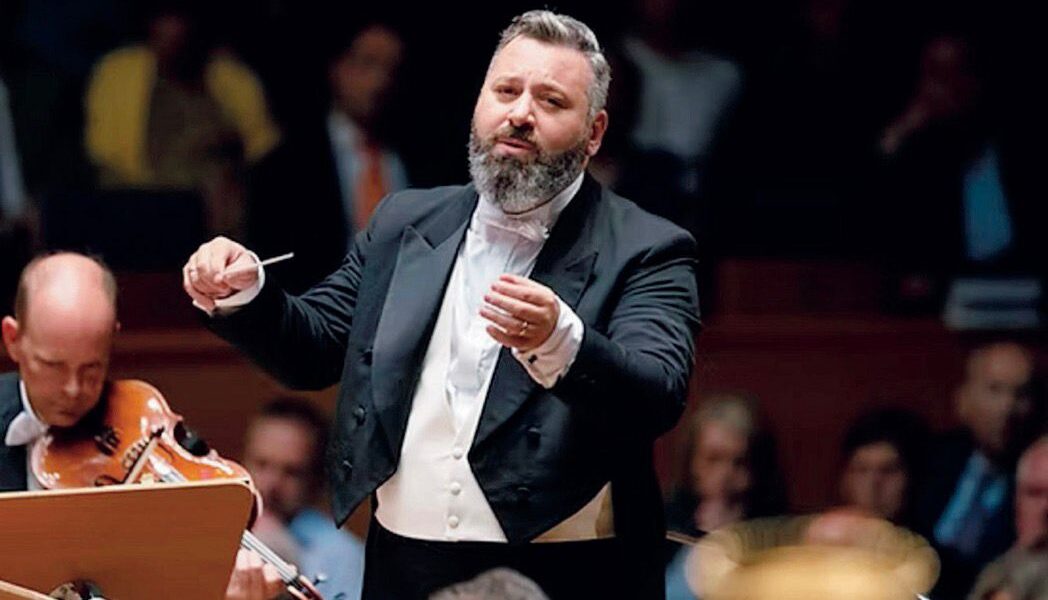
Antonino Fogliani’s clear gesture, charismatic personality and interpretative authority will be missing. The international musical community mourns the death, at just 50 years old and following a long illness, of the Messina orchestra conductor, one of the most appreciated on the symphonic and operatic music scene, a baton of absolute rigor and recognized competence, both on the podium and in his philological and analytical approach to the score, qualities that are increasingly rare today.
Born in the city of the Strait on 29 June 1976 – although resident in Switzerland for many years – maestro Fogliani undertook his composition studies at the “Corelli” Conservatory, then graduating with Francesco Carluccio at the Conservatory of Bologna, a city in which he also obtained a diploma in Piano and a degree in Musical Disciplines. At the “Verdi” Conservatory in Milan he obtained a diploma in orchestral conducting under the guidance of Vittorio Parisi and then specialized at the Chigiana Music Academy in Siena with the great maestro Gianluigi Gelmetti, of whom he soon became a collaborator and assistant. The debut on the podium came in 2001, as part of the prestigious Rossini Opera Festival, with «Il viaggio a Reims»: for Fogliani the beginning of an international career made up of great successes and collaborations with eminent national and international symphonic groups, including the Orchestra of the Accademia Nazionale di Santa Cecilia, the Orchester Philharmonique of Monte-Carlo, the Düsseldorfer Symphoniker, the Gürzenich-Orchester Köln, the Neue Philharmonie Westfalen and the Moscow State Philharmonic Society. Since 2011 he has been musical director of the Rossini Festival in Wildbad and since the 2017/2018 season he has been Principal guest conductor at the Deutsche Oper am Rhein.
The repertoire that maestro Fogliani has studied and explored is truly vast, particularly in the operatic field, contributing to the rediscovery of numerous scores and curating modern first performances, such as for some titles by Saverio Mercadante and Nicola Vaccaj. He arrived at the Teatro alla Scala conducting «Ugo conte di Parigi» and «Maria Stuarda» by Gaetano Donizetti, but Rossini animated his repertoire a lot: with «Moses in Egypt» he conducted at the Teatro dell’Opera in Rome, at the Fenice in Venice he made his debut with «Il barbiere di Siviglia» and at the San Carlo in Naples with «Il Turco in Italia». Alongside his strong interest in Rossini and Donizetti, there is certainly that for Giuseppe Verdi and Giacomo Puccini: over the years he has conducted both the popular repertoire of the Cigno di Busseto and the more “patriotic” one of the first period, while he has tackled the most appreciated titles of the Lucchese genius, from «Gianni Schicchi» to «Madama Butterfly», up to «Turandot».
It is impossible to retrace the entire career of Antonino Fogliani.
A career that illness had abruptly interrupted and which the maestro had resumed just recently. Despite having canceled the commitments that saw him as the protagonist at the Puccini Festival in Torre del Lago – where in August he was supposed to conduct “Madama Butterfly” and “La Bohème” – he was expected at the Deutsche Oper in Berlin on 6 September for “Tosca”. However, it is even more significant to remember the collaborations with the Teatro Vittorio Emanuele in Messina, where he directed several New Year’s concerts as well as the «Butterfly» in February 2010, directed by Stefano Vizioli. And the Theater Authority emotionally underlined in a note the “great void that his passing leaves in the world of music and in the city community, to which the Maestro has always remained deeply linked”. Also noteworthy is the relationship with the «Corelli» Conservatory, in which Fogliani held his first position as teacher of orchestral exercises and for whose orchestra of students and teachers he signed the musical direction of «Il Signor Bruschino» and «L’opportunity fa il ladro» by Rossini, also at the Vittorio Emanuele. His teaching activity had then led him first to the Conservatory of Trieste and from 2021 to the “A. Scarlatti” Conservatory of Palermo, which in a note mourns his premature death, remembering him as an “artist of extraordinary talent”.
A highly cultured man, an omnivorous reader, a disruptive personality that emerged very clearly in his way of approaching Italian melodrama, both in his impulses and in his singing, and appreciated by orchestra professors and the musical institutions with which he worked. The world of art music loses a demanding and passionate performer. Messina mourns one of its most illustrious sons.