

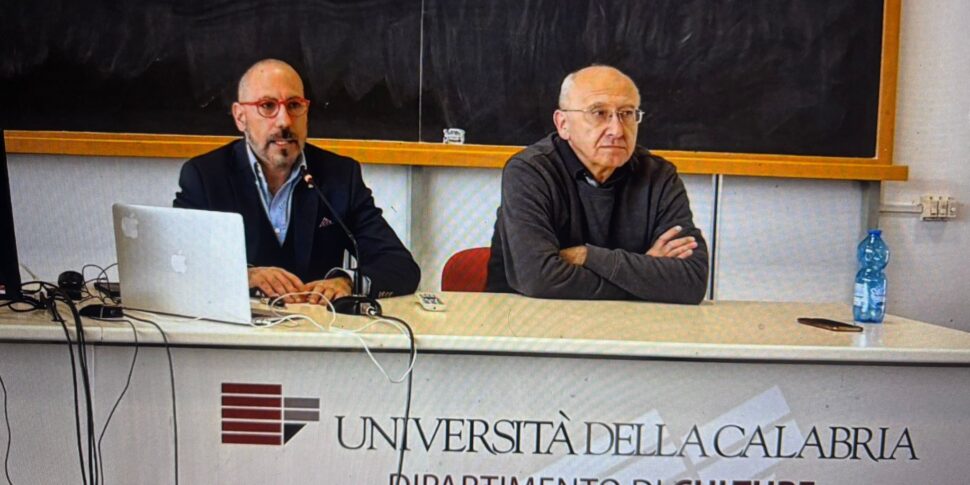
With “Don’t interfere. The blood of priests on the altar of the mafia”, Marcello Cozzi delivers to the public one of the most necessary and courageous texts of contemporary anti-mafia. Yesterday afternoon, the volume was presented in the Solano classroom of the University of Calabria, in the presence of 200 students enrolled in the Anti-Mafia Pedagogy course, as part of a seminar dedicated to the role of the Church in combating mafia culture.
The Lucanian priest was introduced by Giancarlo Costabile of DiCES. Don Marcello is also coordinator of the “Don Peppe Diana” Institute for Research and Interdisciplinary Training on mafias of the Pontifical Theological Faculty of Southern Italy in Naples, San Tommaso section. “Don’t interfere” is not just a book of memories, nor a simple catalog of stories: it is an act of restitution, a call to civil and ecclesial responsibility, an exercise in truth in a country where too often the mafias are perceived as external, separate phenomena, “other than us”.
Cozzi, who has always been involved in supporting crime victims and in social anti-mafia, creates a work that is at once denunciation, testimony and spiritual meditation. The title, Don’t interfere, recalls the mafia injunction that has spanned decades of criminal history: don’t get in the way, don’t disturb the power, don’t defend the weak, don’t break the logic of control. It is the phrase that the mafias repeat to anyone who dares to challenge their rule, and that these priests – normal men, often unknown – have broken with the strength of the Gospel. The heart of the book is a long gallery of priests who chose to “interfere”: men who, living their pastoral mission on a daily basis in difficult neighbourhoods, in abandoned suburbs, in towns marked by mafia blackmail, have embodied the Gospel as a practice of liberation.
Some are well-known names – Don Pino Puglisi and Don Peppe Diana above all – but many others are forgotten figures or never really known. Cozzi brings them back to light, restoring dignity to existences that too often rhetoric, or worse, silence, had obscured. In these pages Sicily, Calabria, Campania, Puglia are intertwined, each with its own face and its own wounds.
The strength of the book lies right here: in the refusal to create “heroes”, but in the desire to bring out real people, priests who made mistakes, feared, resisted, loved. “Imperfect” figures, but luminous in their evangelical coherence.
Cozzi does not construct an apologetic story. Alongside the courageous witnesses there is the shadow of ecclesial silences, ambiguities, institutional timidities. The Church emerges as a space of light, but also as a place crossed by fragility: isolated parish priests, overly prudent bishops, communities divided between fear and addiction. This is not to accuse, but to show how difficult – and courageous – it was for some priests to break the network of complicity and silence that the mafias were able to build even in the territories of faith.
“Do not interfere” is also a profoundly theological text in the most vivid sense: faith as flesh, as a relationship, as a gesture. Cozzi speaks of a “lived Gospel”, made not of abstractions but of daily choices: defending a boy, refusing the blessing of a boss, denouncing a drug dealing place, breaking the logic of favor, protecting a witness.
In a time in which the word “martyrdom” risks being relegated to ancient centuries, the book brings it back to the contemporary: martyrdom as loyalty to justice, as responsibility, as love for one’s neighbor at the cost of one’s life. “Do Not Interfere” is a necessary book. Necessary for the Church, because it forces it to deal with its own recent history. Necessary for civil society, because it shows how justice is not an abstract concept but a daily choice. Necessary for those who study mafias, because it illuminates an area that is still too little explored: the relationship between faith and criminal power.

Find out more in the digital edition
To read everything, buy the newspaper
or download the digital version.