

The future of humanity, for Ben Bova, begins in front of a window. Not in New York nor in Geneva, but in Messina. The Italian edition of his «The Condemned of Messina» (1972) immediately encapsulates the conflict of the book: «The President General (…) stopped in front of the large windows overlooking the city. There was little to see of Messina Antica. The original city, with its old churches and houses dazzlingly white under the violent Sicilian sun, had been swallowed up by the glass and metal towers of the world government.” Ancient Messina has been “swallowed up” by the new world order; the leader of the planet watches without hearing. Power sees the city, but does not listen to its noise: the complexity of the world becomes a panorama behind insulating glass. The image is enough to reopen an almost forgotten novel.
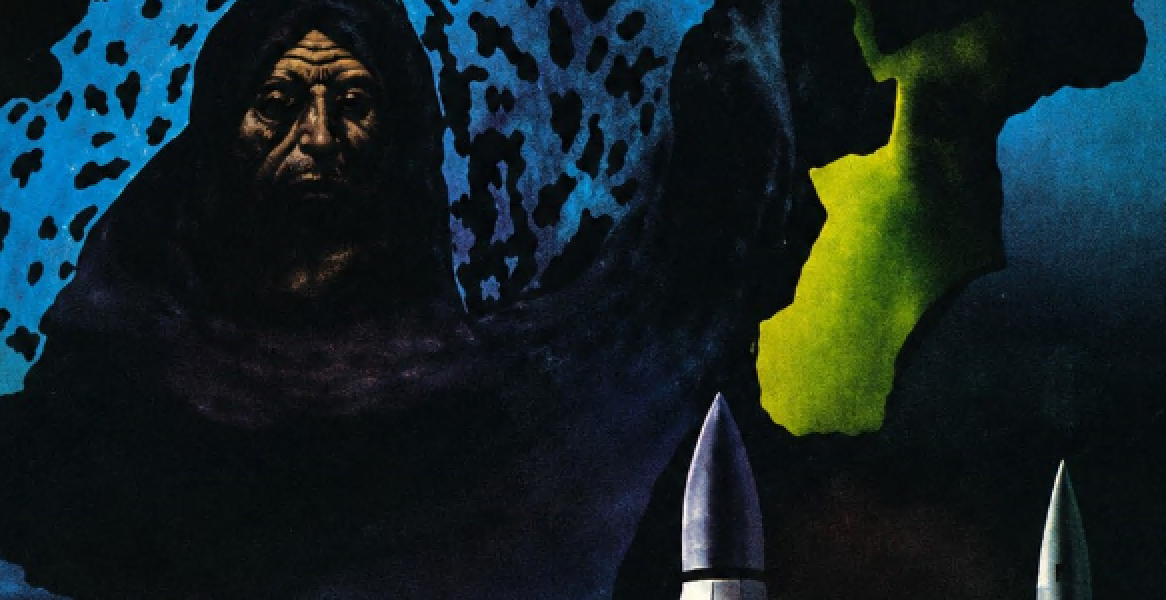
«Exiled from Earth» was released in the United States in 1971, while Bova took over the editorship of the famous science fiction magazine Analog. On 17 September 1972 Mondadori published it as no. 601 of «Urania», translated by Bianca Russo, with the cover by Karel Thole: blue Sicily and green Calabria become a hallucinated landscape, separated by a cosmic fissure. The Italian title, «The Condemned of Messina», shifted the emphasis from the exile to the place that decreed it: the city is not the background, but the moral center of the story.
In the 22nd century, twenty billion inhabitants are pressing on an exhausted planet and gangs are roaming the metropolises. For thirty years the World Government of Messina has avoided collapse. It is not a bloody tyranny, but a reasonable administration, convinced of protecting humanity from itself: “The price we must pay for stability is progress.” The threat is genetic engineering: the rich could engineer stronger children and divide the species into biological castes. With the laboratories closed, scientists and families are condemned to an orbital station. Among them is Lou Christopher, a programmer in research. Having escaped arrest, he passes through New York at war between gangs, then is taken to Messina, where Minister Kobrin explains the decree. Bova narrates with clear speed: chases, double games, an intelligent and affectionate gorilla, a clandestine laboratory, secret weapons and a coup d’état. The equation between order and freedom affects bodies and the possibility of staying together.
Bonnie Sterne, Lou’s colleague and girlfriend, therefore counts. When he reappears, she warns the police to save him from worse dangers: a betrayal born of the cure, a mirror of the system. She follows him to the island and to the station, but rejects a life transformed into punishment. She returns to Earth knowing she won’t see him again. Their love is broken between two freedoms: Lou chooses the future, Bonnie a present not absorbed by a project. Lou transforms the orbital prison into a generational spaceship for Alpha Centauri: exile becomes exodus. But the ark saves a few thousand people and leaves twenty billion in administered peace. By choosing the imperfect world, Bonnie questions whether a future that demands all of existence is truly liberation.
The Convicts of Messina retains a clear relevance. Today it is natural to replace “genetic engineering” with “artificial intelligence”. Different technologies, same political question: who decides which research is too dangerous, with what mandate and under whose control? Autonomous weapons, biological manipulation, digital surveillance and climate present the dilemma again: every threat may require a limit; every limit can become a power interested in lasting.
In 2025 Peter Thiel dedicated four conferences to the Antichrist and the katechon, “that which holds back” the end of the world. In his provocation, the contemporary tyrant could offer himself as a guarantor of “peace and security”, evoking technological Armageddon to obtain planetary power and stop science. The Government of Messina anticipates the scheme by more than half a century. Bova, however, grants the rulers proof of success: the catastrophe has not occurred for thirty years. Peace and security are there; the reason why it was worth guaranteeing them is missing. Scientists are not tortured, but deprived of tomorrow.
However, the novel does not become a manifesto against every rule. On the island of coup minister Bernard, uncontrolled research produces biological weapons, blackmail and violence. If Messina is the brake that risks becoming a regime, Bernard’s island is the accelerator that has become an arsenal; the spaceship is the secession of the competent, the escape of the best from a humanity deemed irrecoverable.
To the question “who defends us from those who want to stop everything?” Bova adds another: who defends us from those who don’t want to stop anything? Here the old «Urania» meets Magnifica Humanitas, the encyclical of Leo XIV. Asking for a “disarmed” AI does not mean freezing knowledge, but subtracting it from the exclusive logic of power and entrusting responsibility to people called to answer for the consequences. Between absolute moratorium and race without constraints there is no arithmetic compromise, but the work of transparent, revocable institutions, aware that they do not have the last word on humanity.
So: why Messina? Bova doesn’t explain it. Biographical suggestions remain – the surname coincides with that of the Greek village of Aspromonte and the first wife was called Rosa Cucinotta – but they are only clues. More convincing is the symbolic geography set in motion by the novel, intentionally or not. In the Strait, order does not coincide with immobility: Scylla and Charybdis are two dangers between which to pass. Ulysses does not choose the best monster and does not stop: he governs the course. The city of the whirlpool becomes the capital of the order. The government towers rise between two lands, above the fault that in 1908 destroyed any illusion of stability. There is no mention, not even in this dystopian novel, of a “bridge”: it would take away the meaning of the place.
But Messina also knows an order different from the single command: in June 1955 the conference of the six countries of the Czech Republic relaunched European integration towards the Treaties of Rome. Not a world throne, but an architecture of mutual pacts and responsibilities. Real history shows that it is possible to build beyond states without abolishing plurality and control. And there is Colapesce. The young man who descends into the abyss finds a cracked column in Sicily and remains to support it is the opposite of the palace of Bova: not the power that imposes the sacrifice from above, but the one who holds back the collapse by taking on the weight.
For this reason «The Condemned of Messina» surpasses its inevitable futurism. He did not foresee a machine, but the shape of our fears, entrusted to a quick and popular story that unites the fate of the planet, the death of a love and the choice of a city.
I discovered it while I was writing my book «Sicily is a feeling» for Touring. Journey to the edge of the Strait”, and gave me a new perspective, canceling the temptation of nostalgia and opening the field to the imagination capable of interpreting the future of mankind starting from our coasts.
The 1972 twist asked: Is the decree of world order ruthless or merciful, necessary or criminal? Bova doesn’t respond, and that’s his credit. Between the whirlpool and the rock you don’t choose once and for all: you navigate. If the capital of the world is Messina, it is because no other place can say with the same naturalness that order is not immobility, but a common crossing, always in need of correcting the course.