

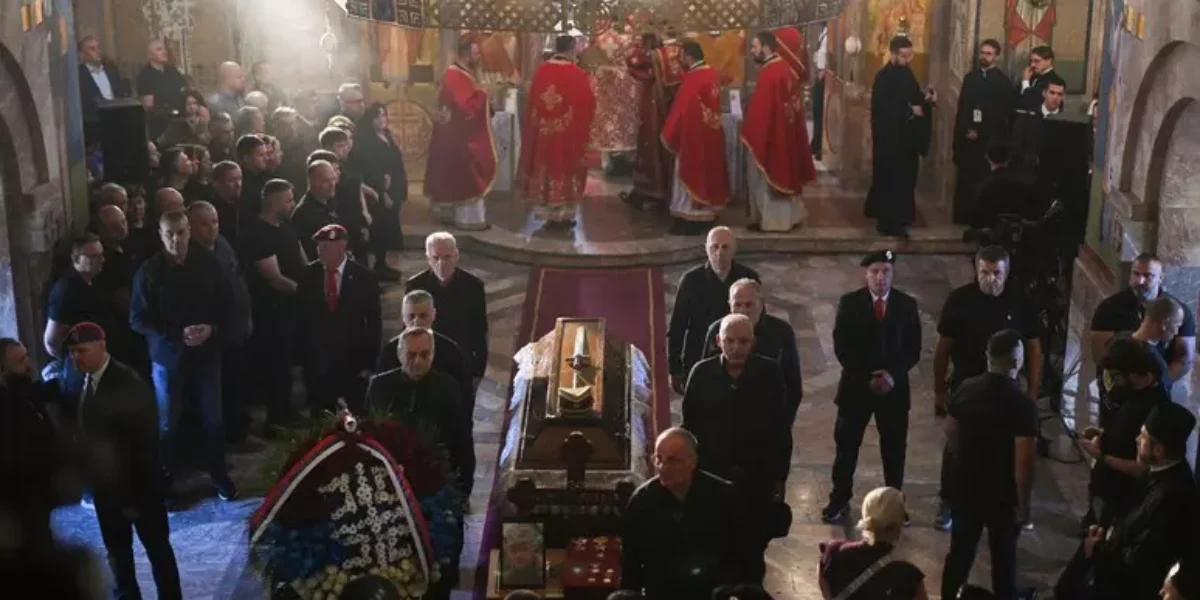
The funeral of Ratko Mladić, the ‘Butcher of the Balkans’, affects Serbia’s already difficult path towards the European Union.
The images of the mass tribute in Belgrade, with Serbian ministers, soldiers and senior officials, unleash the anger of EU leaders: they are “shocking”, they contradict European values and Brussels is already “evaluating” the consequences. Meanwhile, tension is growing in the Balkans: Bosnia-Herzegovina expels two Serbian diplomats and reduces its diplomatic presence in Belgrade to a minimum, while Foreign Minister Elmedin Konaković warns: “If I could, I would immediately interrupt diplomatic relations with Serbia”.
The political judgment came from the highest levels. Commission President Ursula von der Leyen and European Council President Antonio Costa described the support and presence of senior Serbian officials at the funeral as “deeply regrettable”. What happened, they warned, demonstrates “the inability to face a dark chapter in Europe’s recent history” and “contradicts the values” of Serbia’s path towards the EU. “The public glorification of convicted war criminals, as in the case of Ratko Mladić during his funeral, compromises the reconciliation process”, added the President of the European Chamber Roberta Metsola. There can be no revisionism, denial of the genocide or honor for the perpetrators, warned High Representative Kaja Kallas: “Serbia’s path towards the EU requires an unequivocal commitment to fundamental European values and historical truth.”
The point is both the size of the ceremony, with at least 16,000 people between church, procession and cemetery, and the level of official presence. At least six Serbian ministers were present at the funeral, including the heads of Defense and Justice, the son of President Aleksandar Vučić, Danilo, state and police leaders, representatives of the Republika Srpska and the Russian ambassador in Belgrade. The rite was officiated by the patriarch of the Serbian Orthodox Church Porfirije. Among the crowd, according to Radio Free Europe, there were veterans of the special units, former militiamen, members of the Red Berets, pro-Putin motorcyclists sanctioned by the EU and USA and figures of the Serbian far right. A mosaic in which representatives of the State, nationalist and extremist circles found themselves paying homage to the former Bosnian Serb general, convicted of genocide, war crimes and crimes against humanity and who died in The Hague while serving a life sentence. Sarajevo withdrew almost all Bosnian diplomatic personnel from Belgrade and then expelled the Serbian military attaché and the advisor to the representative of the BIA, the Serbian secret service. The request for sanctions also comes from Bosnia: Bakir Izetbegović, leader of the Democratic Action Party, asked the EU, the United States and the international community for personal measures against the Serbian state, defining Mladić’s celebration as “a serious warning for all of Europe, not just for the Balkans”.