

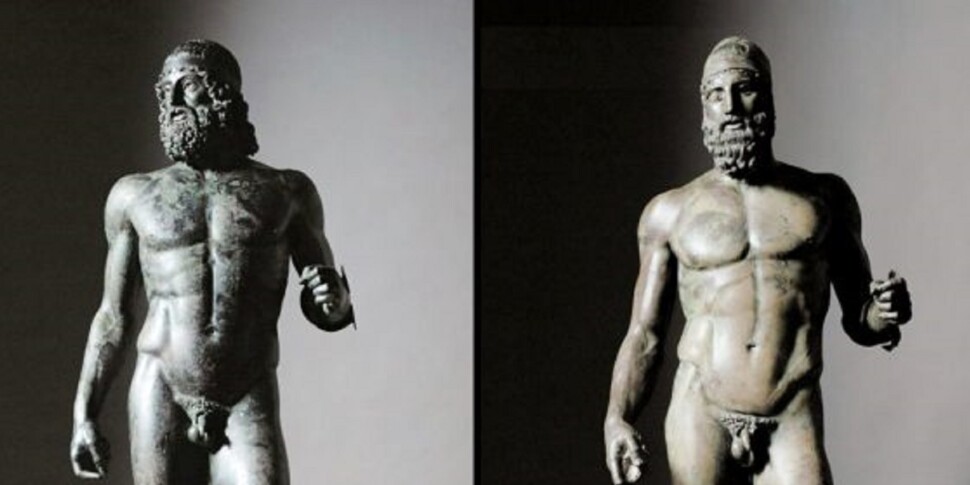
New reply on the Riace Bronzes issue, after the position taken on the return of the hypothesis of the discovery of the statues in the waters of Brucoli, in an article published by the Italian Journal of Geosciences. Signed by the coordinators of the research group, prof. Rosolino Cirrincione, professor of Petrology, and prof. Anselmo Madeddu, health director of the ASP of Syracuse and professor of Epidemiological Methodology, both at the University of Catania, we receive and publish:
«The somewhat polemical tone of the article signed by Professor Castrizio entitled “The Bronzes from Syracuse? An unlikely hypothesis”, published in your newspaper on November 11th, forces us to request the right of reply with necessary clarifications.
It is not clear on what assumptions Professor Castrizio, having neither the authority nor the authoritativeness, sets himself up as the sole holder of knowledge by branding as unfounded the recent study published by 15 scholars from 6 universities in a prestigious international scientific journal, the Italian Journal of Geosciences (IJG), which hosts only studies of the highest scientific profile through the well-known filter operated by reviewers who check all aspects of the research, validating its reliability step by step. scientific. It is worth starting out that Professor Castrizio is a numismatist, and therefore represents only one of the countless disciplines necessary to study the complex case of the Riace Bronzes, where the research group that published the study is made up of archaeologists, geologists, historians, paleontologists, marine biologists, experts in metal alloys and corrosion patinas, underwater archaeologists, experts in marine hydrodynamism, precisely because such a complex case requires a multidisciplinary scientific approach. Furthermore, Prof. Castrizio appears to be making criticisms without even having read the substantial article that appeared on IJG at all, as demonstrated, for example, by his passage on welding sands, where he states that the disputed study concerns the welding of the restored arm of statue B, whereas instead the comparison concerns the welding of statues A.
Furthermore, the numismatist writes that geochemical investigations on clays have no scientific basis because they should be carried out by specialists, forgetting that he is speaking to professors of geology and the academic world of the Italian Geological Society. And who should be the specialists involved in the geological study of the lands if not the geologists themselves? Castrizio, then, is surprised that in the publication there are interpretations of an archaeological nature and not just of a geological nature. And why shouldn’t they be there given that the object of the study is the Riace Bronzes, and among the 15 scholars there are also well-known archaeologists? It appears paradoxical, then, that the numismatist brands the part of the study dedicated to the paleontological analysis of marine concretions as unreliable, asserting that this part would have been superseded by the dated considerations of a presumed expert, forgetting that this part was carried out by paleontologists and marine biologists of clear academic fame who today have rather proven the unfoundedness of the aforementioned considerations. It is also curious that Castrizio asserts, still unfoundedly, that images of the Bronzes taken from his studies appear in the IJG publication, whereas in reality there is no connection with the reconstructions of the Bronzes developed by his visual designer Autellitano. The reconstructions of the Bronzes present in the IJG study were developed independently with special artificial intelligence programs starting from the current images of the Bronzes and from the Syracusan coins depicting the head of a leader with the korinthie kyné, of whose depiction Castrizio cannot claim to be the exclusivist. Moreover, given that the reconstructions are not inspired by fictional subjects but by two real statues, it is obvious that they must all look a little similar to each other, otherwise we would have drawn something else.
Finally, Castrizio defines the bibliography of the study as small and dated, but is contradicted by the numbers, given that it consists of 127 bibliographic entries, which reach up to the year 2025. In conclusion, overlooking any consideration regarding Castrizio’s thirty-year hypothesis, we limit ourselves to inviting the professor from Reggio to respond to our scientific study through a reply in refereed scientific journals, rather than on Facebook or other social networks, specifying from now on which we do not intend to replicate in other possible interventions except in the most appropriate scientific forums.”