

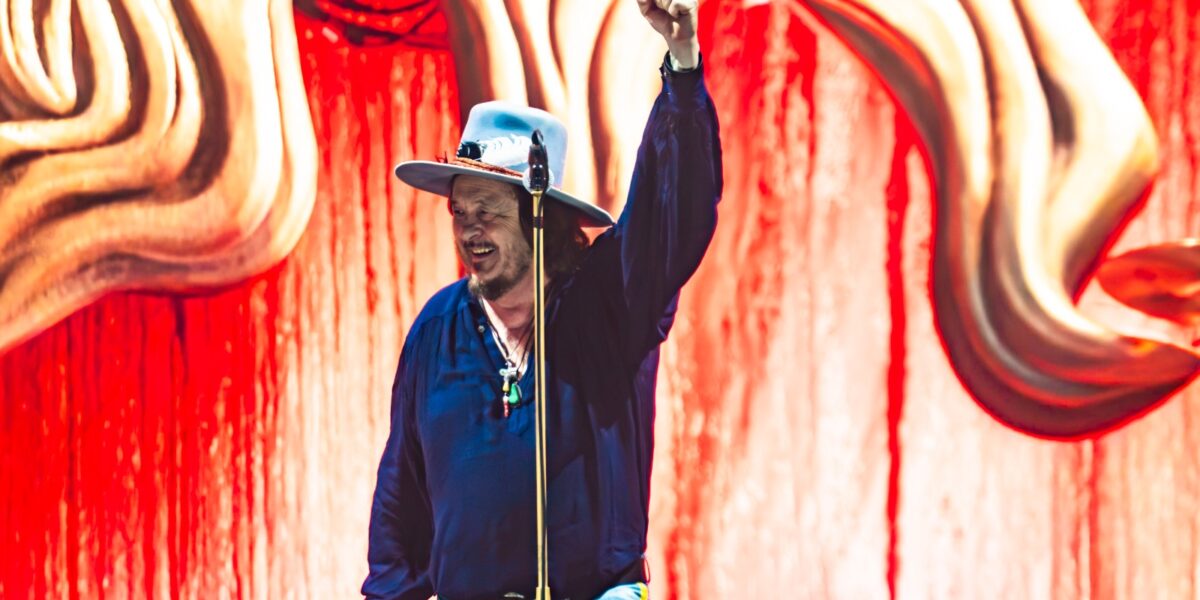
A renewed combination between major events and the Gazzetta del Sud. This year too, as for a decade now, our editorial group will offer ten of our readers the opportunity to attend the show and meet one of the great artists of Italian music, in a meet & greet that will take place shortly before the concert. After the meetings of previous years with Jovanotti, Laura Pausini, Ligabue, Negramaro, Pooh, Pinguini Tattici Nucleari, it will be the turn of Zucchero once again who will be in Messina on Tuesday. Here are the questions that allowed readers to win the competition and Zucchero’s answers.
1) I loved that adolescent solitude of your first albums. After 43 years I still remember every word of “Un po’ di Zucchero” and “Zucchero & The Randy Jackson Band’s”. The search for discontinuity from other Italian singers, the great compositions (not always included), the trips in search of expatriate artists (see Corrado Rustici). How much of that little boy with red cheeks and a beret pulled down over his forehead who sang alone sitting on the bench in the port is hidden behind the thick beard and top hat of a magician of international music? Is young Zucchero across the street from the current one? (Santino Di Salvo)
«Maybe today I wear a beard and a hat, but the one who writes songs is still that boy who listened to Ray Charles, Otis Redding, Joe Cocker and dreamed of America. I wasn’t trying to do what other Italian singers did. I was looking for blues, soul, another language. Many didn’t understand it.”
2) Zucchero, your music has the rare ability to unite the deepest blues with the roots of our land. As a pianist, I wonder: is there a piece in your repertoire that, every time you play it, instantly takes you back to a specific childhood memory, as if it were a time machine? (Maria Di Lorenzo)
«More than a song, I would tell you a record: Chocabeck. My whole childhood is in there, my roots. There is Roncocesi, there are my grandparents, my father, the smells of the countryside, the Sundays of the village. It’s a record born from memories. The title itself comes from a word my father used to say: Chocabeck the beak that makes noise because there is nothing inside. These are images that I have always carried within me.”
3) Few people are aware of the numerous mutual quotes that you and Bugelli exchanged in each other’s songs, almost like a fun game of references between idioms and popular wisdom. How much do you miss your minstrel friend, a year after his passing? (Ivan Fiorillo)
«There was a particular understanding with Bugelli. A word, a way of saying, a phrase in dialect was enough between us. He was a person from another era: a great lover of nature, his simplicity and genuineness were an enormous wealth.”
4) “If you had to give a little ‘sugar’ to today’s world, what do you think is missing most: kindness, time or listening? Which of these and why?” (Silvana Tranchina)
«Perhaps today there is a lack of listening. Everyone talks, everyone writes, everyone has something to say. But few really listen. When you listen to someone you are already giving them a part of your life.”
5) Is there any song from your repertoire that you have ever regretted writing? Or maybe, in hindsight, would you have liked to give it a different meaning in the lyrics or in the music? In summary, have you ever written a bad song that you wouldn’t do again today? (Filippo Cannuli)
«Every song belongs to the moment it is born. The songs tell who I was. If I changed them, it would be like changing my story.”
6) In your songs the sacred and the profane, devils and holy water stoups, irony and desperation always dance together. Sicily is a land that lives on this identical contrast: grandiose religiosity and totally carnal passions. Have you ever felt a little at home in this open-air “theatre”? (Sara Salvo)
«I feel at home in Sicily, it is a land full of contrasts, like the blues. Every time I return to Sicily I am greeted by irony, authenticity and a genuine embrace.”
7) You have collaborated with the greatest legends of world music, from Miles Davis to Bono: what is the most absurd or funniest anecdote that you have never told anyone? (Nora Puleo)
«1990. I was in Verona on tour with Gold, incense and beer. I had convinced Ray Charles and Dee Dee Bridgewater, great voice, to come on stage with me. The appointment was at four. Hours pass and not even a shadow of him. He arrives at seven. We don’t have time to rehearse, so we lock ourselves in the dressing room with a cassette player and a piano. He’s listening to Like the Sun Suddenly. He was hearing it for the first time. With one hand he follows the chords on the piano. And then he sings about it. He does it three times, it’s wonderful. “See you on stage” he tells me, leaving the dressing room. Well, he’s heard it three times, will he remember the words with so little time to try? I couldn’t hide that I was a little perplexed. The time comes to sing the song. I start with the first verse, we knew nothing about him. Luckily I didn’t announce it. Impossible to learn a piece three times. Five seconds later I see him enter, phlegmatic. He sits at the piano and, very calmly, starts with his part at the right moment. A perfect execution. I was ecstatic, I sang and I was almost hallucinating. He was the greatest singer in history. When Ray Charles opened his mouth, inside there was passion, energy, joy. Anger and sadness.”
8) If you hadn’t been successful in the musical world, what would your path have been? Would you have always looked for your “place in the world” in the artistic world? Do you ever think about what your life would have been like without music? (Giuseppe Russo)
«I probably would have been a farmer, or a vet. I would have stayed in the countryside. Music changed my life.”
9) If you could leave only one song for posterity and all the others disappeared which would you choose and why? (Davide Santapaola)
«How do I choose… If I were really forced to make a choice, I would say “Diamond” because inside there is life, my land, my childhood. If a song manages to survive over time it is because it talks about something that belongs to everyone and I believe that “Diamante” has this strength.”
10) You talked about how a book on the pain of living was fundamental in overcoming a complex phase, marked by depression and panic attacks. How has that experience influenced your creative process and your songs? (Francesca Maria Parisi)
«That period taught me that we must also accept pain. That book helped me understand that I wasn’t the only one experiencing certain feelings. Since then I have tried to tell the truth, the beauty that surrounds me but also anxieties and melancholy. The melancholy and irony of the blues.”