

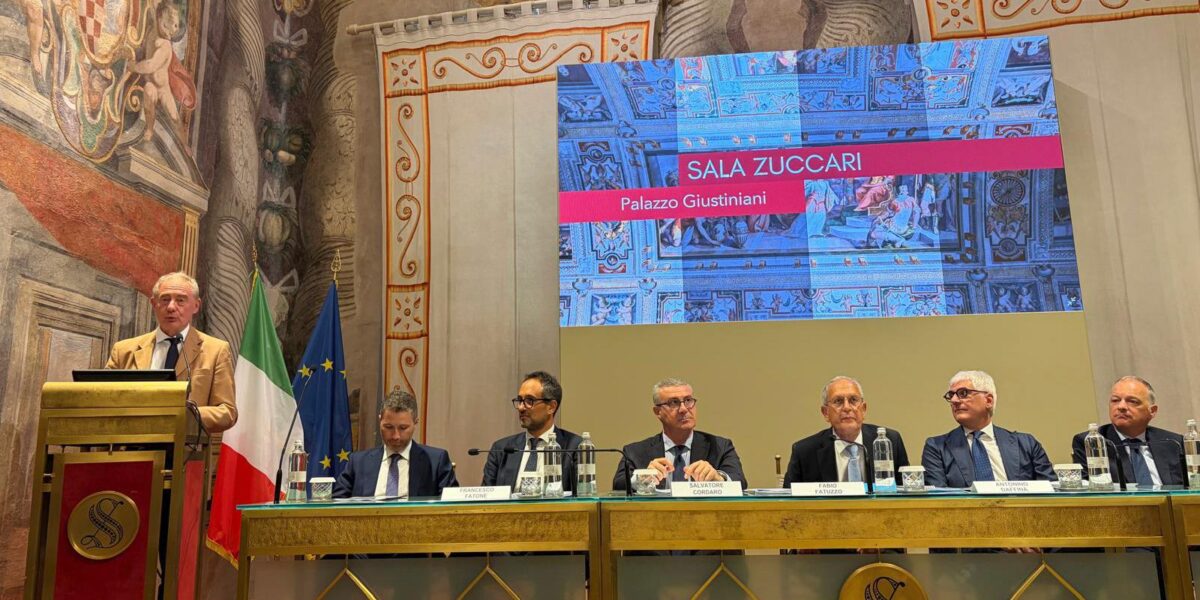
Three years of activity to transform designs that have been on hold for some time into tenders, contracts, construction sites and works that are actually available for the territories. This is the budget presented by the Single Extraordinary Commissioner for the purification and reuse of waste water, Hon. Prof. Fabio Fatuzzo, during the conference held in the Zuccari Hall of Palazzo Giustiniani, in Rome, on the initiative of Senator Gianni Rosa.
The meeting brought together representatives of the Government, Parliament, the commissioner structure, the academic world and the territorial administrations, outlining the framework of the interventions developed in Sicily, Calabria, Basilicata and Campania to overcome European infringement procedures and promote the reuse of purified water.
Taking part in the work were, among others, the president of the Senate Ignazio La Russa, the ministers Adolfo Urso, Gilberto Pichetto Fratin and Nello Musumeci, the undersecretary of Culture Giampiero Cannella, the senators Gianni Rosa and Salvo Pogliese, the sub-commissioners Salvatore Cordaro and Antonino Daffinà, the implementing body Riccardo Costanza and the representatives Vincenzo Belgiorno for Campania and Francesco Fatone for Basilicata.
Urso: «Transforming wastewater from a cost to a resource»
The Minister of Business and Made in Italy, Adolfo Urso, underlined the acceleration achieved in the last three years by the commissioner structure compared to previous managements. He therefore highlighted the strategic value of reuse not only for the environment and agriculture, but also for the industry, innovation and competitiveness of the country.
In a context marked by climate change and the development of technology-intensive sectors, such as data centers, the availability of safe water represents a truly invisible infrastructure for manufacturing, agriculture and essential services.
The challenge, he explained, is to transform wastewater “from a cost to a resource, from waste to a competitive advantage”, reducing the pressure on natural basins. Finally, Urso expressed full support for the Commissioner’s mission, recognizing “the excellent work done” in the construction of collectors, sewerage networks and purification plants.
Pichetto Fratin: «Italy reuses only 5-6% of waste water»
The Minister of the Environment and Energy Security, Gilberto Pichetto Fratin, recalled the need to make the national water system more efficient. Management fragmentation, with 2,391 managers and around a thousand businesses operating in the economy, has over the years produced inefficiencies, multiplication of costs and strong territorial disparities.
Italy, he recalled, recovers just 400-500 million of the approximately ten billion cubic meters of waste water produced every year, equal to 5-6%, compared to percentages close to 40% in other large European countries. Reuse is therefore essential for agriculture, industry, energy and data centers. Pichetto Fratin also thanked Fatuzzo for overcoming critical issues, appeals and delays, also recalling the resolution of the complex Catania affair.
Musumeci: «Purified water is not a choice, but a necessity»
The Minister for Civil Protection and Maritime Policies, Nello Musumeci, reiterated that the reuse of purified water “is no longer a choice, but a necessity”, together with desalination, especially in territories affected by water scarcity.
Recalling the case of Sicily, Musumeci highlighted the cultural resistance and costs that still hold back reuse and desalination, as well as the limited capacity to collect rainwater, only used for a share of 11-12%.
The minister invited local administrators and water service managers to invest in the systems and to promote wider awareness outside the institutional buildings, hoping for the continuation of the work of the Commissioner and his team.
Fatuzzo: «We have recovered works that had been stagnant for years and imposed a different pace»
In his speech, Commissioner Fabio Fatuzzo reviewed the work started in 2023 together with the sub-commissioners Antonino Daffinà and Salvatore Cordaro and the implementing body Riccardo Costanza. At the time of the settlement, he recalled, numerous interventions had been stalled for years, with incomplete designs, administrative delays and documentation that was not always easily reconstructable.
The case of Palagonia is emblematic, where a project that had been inactive since 2012 was recovered and brought up to tender. «The first thing we did was to set a different pace», explained Fatuzzo, recalling the need to counteract the delays of designers and companies and to guarantee, for each intervention, truly dedicated personnel, means and workers.
According to the Commissioner, checks on the technical, organizational and economic-financial capacity of operators should be strengthened for all tenders, regardless of their amount. In fact, even a small-sized project can have a decisive impact on the life of a community that has been waiting for an efficient purification system for years.
Fatuzzo reiterated the principle of reciprocity between public administration and economic operators: on the one hand timely payments and available resources, on the other rigorous compliance with contractual deadlines. The Structure has committed the existing sums and made the mature interventions financeable and payable, limiting extensions only to truly exceptional cases.
Among the organizational actions carried out include the replacement of some sole managers of the procedure who were overloaded with tasks, the identification of figures more present in the territories, the activation of agreements with various universities, the creation of an organic archiving system and the strengthening of expropriation procedures. It was also necessary to adapt planning and economic frameworks to the new price lists and cost increases; the 350 million euros allocated by the Sicilian Region made it possible to cover a significant part of the major financial needs.
Ample space has been dedicated to the reuse of waste water. “Throwing away purified water means wasting an indispensable resource,” said Fatuzzo, proposing the gradual introduction of dual water networks in new buildings: one pipe for drinking water and a second for civil uses that do not require quality intended for human consumption, such as street washing, irrigation of green areas, drains and fire prevention networks.
In the long term, according to the Commissioner, technological development could also allow potable reuse, provided that very high quality standards are guaranteed and a cultural and information path is launched that primarily involves schools.
«We must build a different relationship with water, based on saving and protecting its quality», concluded Fatuzzo, indicating as the final objective the protection of the sea and the Italian coasts, the environmental improvement of the territories and greater tourist attractiveness.
Cannella: «We need a cultural leap against waste»
The undersecretary for Culture, Giampiero Cannella, underlined the need for a “cultural leap” in water management, based on the fight against waste, the reuse of purified water and the diffusion of dual networks.
The problem, he observed, does not only concern the availability of the resource, but also the ability to collect, channel and use it efficiently. The technical work of the Structure must therefore be accompanied by information and awareness, preparing citizens also for the future prospect of potable reuse.
Cannella also expressed appreciation for Fatuzzo, Cordaro and Daffinà, defined as figures chosen for their competence, experience and concrete ability to guide complex processes, and hoped for continuity in the commissioner’s action.
Cordaro: «Eighteen works delivered to western Sicily»
Sub-commissioner Salvatore Cordaro illustrated the results achieved in western Sicily. In the Agrigento district, the new purifier, the sewerage networks and the interventions in Favara, Porto Empedocle and Ribera have allowed a reduction in the European fine estimated at approximately 770 thousand euros.
Cordaro also recalled the re-contracting of the Tre Fontane sewerage system, which had been out of operation for four years, and the closure of a 19 million dispute with a settlement of less than one million. Agreements, control rooms and protocols with Prefectures, ANAC, Region, ANCI and Superintendencies have supported the acceleration of procedures and the prevention of criminal infiltration.
“In three years we have delivered 18 works out of the 44 on which we are working and around 20 more are in the pipeline”, he declared, recalling that several plants are already set up for reuse, including Castelvetrano, intended to serve the pipelines of agricultural consortia.
Daffinà: «In Calabria interventions worth around 350 million»
Sub-commissioner Antonino Daffinà reported that, in just over two years, almost all of the Calabrian interventions were tendered or executed, for a value of approximately 350 million euros.
Among the main works is the 145 million program for Reggio Calabria, intended for the capital and the entire southern territory. The first works were delivered in recent weeks and the timetable foresees a duration of approximately two years.
Daffinà thanked Fatuzzo for his trust and ability to listen and the institutions that collaborated in finding the resources. «Improving purification does not only mean overcoming European infringements, but increasing the quality of life and enhancing seas and territories», he concluded.
Costanza: «A structure comparable to large public companies»
Engineer Riccardo Costanza, implementing body, defined Fatuzzo as “the commissioner of commissioners”, underlining the complexity of a structure that manages over one hundred works, with amounts ranging from one million to more than 600 million euros and critical technical, expropriatory, bureaucratic and judicial issues.
Investments, he recalled, impact the quality of the sea and coasts, health, tourism and the economic system, generating jobs and specialized skills in the southern territories. Among the symbolic results of the three-year period he cited the start of construction sites in Calabria, the planning and financing of the Palermo water scheme and the unblocking of major works in the Catania area.
La Russa: «Hope is called Fatuzzo»
Closing the proceedings was the President of the Senate, Ignazio La Russa, who recalled in a personal tone the difficulties of water supply in Sicily, saying that he still uses water collected in the traditional cistern and recalling how many solutions announced over the years have been slow to arrive.
«Hope is called Fatuzzo», he stated, highlighting the Commissioner’s ability to rely on qualified professionals, serious projects and technical skills. Pragmatism, he stressed, can achieve more than just policy statements. Finally, La Russa recalled that water is an essential good and hoped that the work of the Structure would continue to produce concrete results for territories and citizens.