

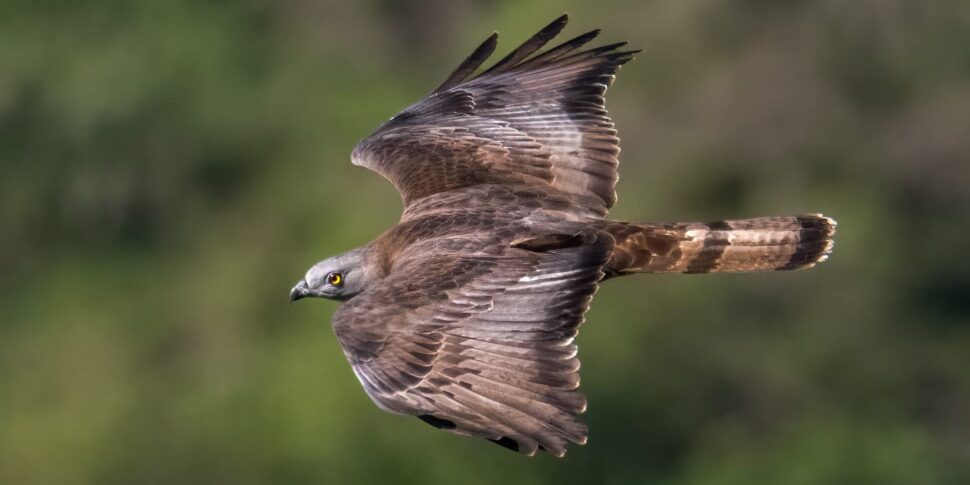
The Strait of Messina once again confirms itself as one of the most extraordinary natural stages in Europe for the migration of birds of prey. During the 43rd international study field, the numbers collected demonstrate the vital importance of this biological corridor: from the beginning of the season (15 March) to today, 57,000 specimens have been registered.
Migration numbers
The monitoring, promoted by the Mediterranean Association for Nature (MAN) and EBN Italia in collaboration with WWF, LIPU and Legambiente, has allowed the identification of 23 different species among the 38 historically observed in the area so far.
Among the protagonists of this passage we find:
– Honey buzzards: 50,000 specimens.
-Marsh harriers: 2,500 specimens.
-Black kites: 1,100 specimens.
-Rare and threatened species: specimens of Egyptian Vulture, Pallid Harrier, Lesser Kestrel, Imperial Eagle and Spotted Eagles (greater and lesser) have also been sighted.
A challenge for survival
The journey of these birds is an epic and risky undertaking. Before reaching the Strait, migrants must cross over 2,700 km of desert (Sahara and Sahel) and 148 km of sea in the Strait of Sicily. These hostile environments can prove lethal in the event of adverse weather. The Strait of Messina represents a crucial intermediate stop towards nesting sites in Eastern, Northern and Central Europe. The protection of this flow, which includes a total of 328 recorded species (including nocturnal ones), is considered fundamental for the maintenance of avian populations on an international scale.
From the “tradition” of poaching to international protection
Until a few decades ago, this route was plagued by systematic poaching, often erroneously justified as “tradition”. Thanks to the law enforcement activity that began in 1981 and the constant presence of volunteers from 19 different countries (including the USA, Japan and Singapore) who have guarded the Peloritani Mountains since 1984, the situation has radically changed. Although the danger persists in new areas or in wind conditions that push the birds of prey towards inhabited areas, there has been a profound cultural change and a growing sensitivity towards these animals.
The success of this protection initiative is the result of cooperation between associations and law enforcement agencies. Particular thanks were given to the SOARDA of the CITES Carabinieri, to the CITES of Catania, to the Regional Forestry Corps, to the Metropolitan Police and to the Municipal Police for their constant commitment against illegality, including fowling and the use of night decoys. Today, with 43 years of scientific data continuously collected, the Strait of Messina is no longer just a migratory route, but a global symbol of biodiversity conservation