

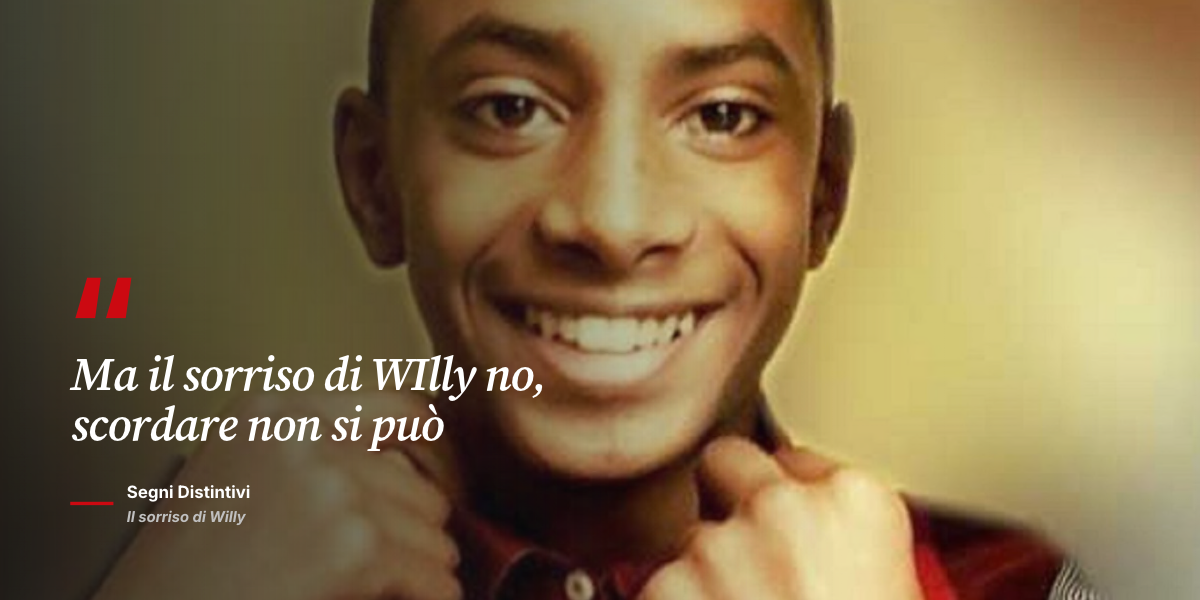
“But not Willy’s smile, you can’t forget it”
These are the words that close “Willy’s smile”, a song that the duo Segni Distintivi dedicated to the tragic story of a twenty-one year old who lost his life following a ferocious, violent and unjustified beating. His name was Willy Monteiro Duarte, and it was his attempt to rescue a friend that cost him his life.
It is the evening of September 5, 2020, it is Saturday, and as often happens at the weekend, Willy is in the company of some friends in Colleferro, in the province of Rome. Like them, other groups of young people are found near the same place and, among these, some friends of the Bianchi brothers, known for being aggressive subjects and already known to the police. It is around 3 am when Willy, together with his friend Samuele Cenciarelli, decides to end the evening and return home. The two then head towards the car to leave, when Willy notices a fight in progress between two boys and recognizes one of them, his former classmate Federico Zurma.
But where did the dispute originate? It all started when Mario Pincarelli, a friend of the Bianchi brothers, had addressed unwanted compliments to a girl. Zurma, a witness to the scene, was then involved in an argument with Pincarelli and his friend, Francesco Belleggia. After a rather aggressive verbal confrontation, the latter hit Zurma, causing him to fall down the stairs. It is from this moment that the rapid sequence of events that leads to the death of young Willy is triggered: the friends of both become closer and the discussion turns into a group quarrel. Willy, having recognized his friend Federico, decides to approach to try to break up the fight, defending him. The situation degenerates when a car is heard arriving at full speed: it is Marco and Gabriele Bianchi who, having previously left with some girls, return to the area after being called by their friends. Since their arrival, the argument takes a decidedly more violent turn: the two brothers, professional MMA fighters and already involved in beatings and fights in the past, are known in the area for their violent nature. The Whites run out of the car and make space among the crowd, pushing and hitting until they find themselves in front of Willy.
“Beat angrily because there are people watching you / assert yourself and be feared”
Here, according to the testimonies of those present, Gabriele Bianchi hits the young man with a kick at chest level, causing him to crash into a car and then fall to the ground. The second blow would have been launched by his brother Marco, while Willy is still on the ground.
“Hit harder so you look like a real tough guy / show your muscles, punish the kid / but not Willy’s smile, you can’t dishonor it”
Samuele Cenciarelli approaches his friend in an attempt to defend him, but is himself hit with a kick to the throat. From that moment, in less than a minute, poor Willy would have been brutally and repeatedly beaten by Marco and Gabriele Bianchi, Mario Pincarelli and Francesco Belleggia, until he lost consciousness.
“He strikes with the pack who alone are nobody / he sinks his blows into the frail body / but not Willy’s smile, you can’t break it”
Willy is on the ground, gasping for air, struggling to breathe and even having convulsions. At this point the group of White brothers has left, and the people on site approach in an attempt to help Willy. Unfortunately, however, there is nothing that can be done: the blows received prove fatal, and Willy dies tragically at the age of 21. The four responsible for the beating were accused first of manslaughter, then of voluntary manslaughter. Marco and Gabriele Bianchi are sentenced to life imprisonment, while Mario Pincarelli and Francesco Belleggia are sentenced to 21 and 23 years of imprisonment respectively.
Willy’s death also left a mark on the legislative level. In fact, it was precisely following the Colleferro drama that Daspo Willy was born, a measure introduced in 2020 to combat violence in nightlife venues. The provision was created to prevent other young people from suffering the same fate as Willy, preventing those who have been the protagonists of violent episodes from frequenting the same clubs and other meeting places in the area for a certain period.
“Whether it’s an angel, a bird or a kite / it flies higher from all my oppression / I try to reach it but I can’t hold eternity”
The song thus returns to Willy, imagining him far from the violence that surrounded him that night. And perhaps it is precisely here that the song takes on its deepest meaning: comparing two completely different ways of understanding strength. That of the pack, exhibited through aggression and overwhelm, and that of Willy, much more silent, which manifests itself in the simple yet great gesture of stopping to help a friend. Willy wasn’t there to prove he was stronger than someone, he intervened because he saw someone in difficulty. And this is where the most painful contradiction told by the song lies: the violence of those who wanted to demonstrate their strength ended up extinguishing the life of those who, that night, had shown the most authentic form of courage. Even though violence took his life away, Willy remains that genuine and innocent boy that everyone remembers, with that smile that will never be forgotten, the victim of an injustice that has outraged the entire country.