

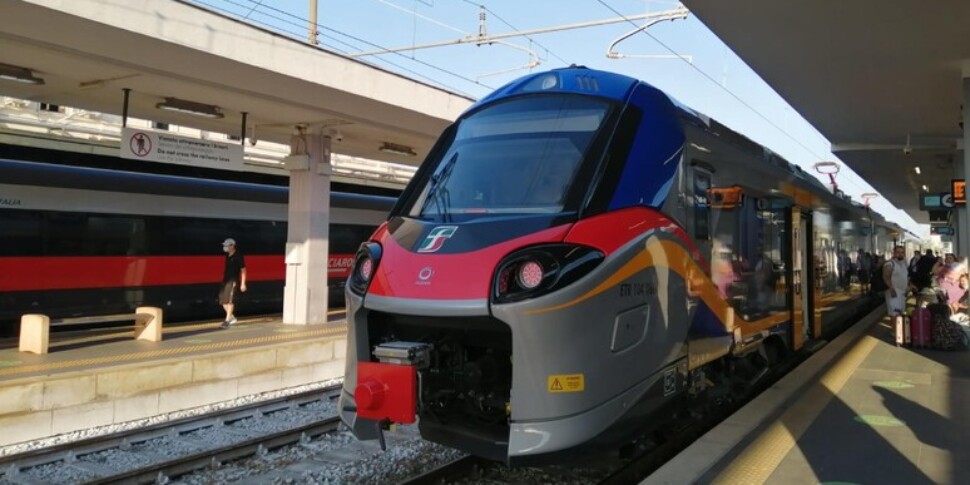
The FS group manages about 17 thousand kilometers of railway lines with over 1,600 tunnels, 23,000 bridges and viaducts and 2,200 stations. An infrastructure that has accompanied and accompanies the country’s economic and social development, and that constantly requires maintenance and enhancement.
In addition to carrying out maintenance interventions for the renewal of the existing network, the FS group is engaged in the creation of new railway lines to eliminate the infrastructure gaps still existing between North and South and to support more capillaries to the high speed network, which until today He saw his main development in the Turin – Milan – Rome – Salerno axis. Among the works in progress is the Brescia-Verona-Padova and, to enhance the South, the completion of the Naples-Bari line, the new Salerno-Reggio Calabria link and the infrastructure development of Sicily to benefit from the AV system are included From Palermo to Milan.
Strategic works
RFI is engaged in the creation of 44 strategic works, 26 of which financed with PNRR funds. Among these:
Brescia-Verona-Padova, which will allow to increase the high-speed, regional and goods transport offer along the Milan-Venice horizontal director, guaranteeing a better separation of traffic flows with consequent reduction in travel times and increase in the frequency of the trains;
Napoli-Bari, the first and most advanced work in Southern Italy, whose realization will allow you to travel from Bari to Naples in 2 hours in Rome in 3 hours, and also connect Lecce and Taranto to the capital in 4 hours;
there Salerno-Reggio Calabriaa passenger itinerary and strategic goods for the connection between the north and south of the country, with interventions that will guarantee greater accessibility to the railway system and the possibility of developing new travelers along the north-south axis of the peninsula, for benefit also of connections to and from Sicily.
Investments railway infrastructure
Investments are essential to guarantee a fully functional and efficient network. They amount to 10 billion euros, for the year 2024, those of the Italian railway network, an economic value driven by maintenance (for 30%), by the technological enhancement of the network and the investment on the stations. The goal also scored for the technological upgrade of 700 kilometers of railway lines.
While operating in a context characterized by a number of construction sites and an unprecedented amount of investments, the FS group is engaged in the study of specific initiatives aimed at improving performance, guaranteeing a balance between the development needs, the maintenance of the quality of the service and safety of passengers and workers.
Construction sites
The railway network is at the center of an unprecedented revolution, an acceleration of the modernization plans made possible thanks also to the PNRR funds which, as known, provide for rigorous respect for the times.
The goal is to raise the network efficiency standards to guarantee an increasingly modern, integrated, accessible, performing, reliable and fast infrastructure for the transport of passengers and goods.
To date, 1,200 construction sites per day are open, 500 of which dedicated to ordinary and extraordinary maintenance activities of the network and about 700 for new works. These works are essential to achieve the objectives of the PNRR and make the railway network more modern, efficient and safe. The active construction sites were 983 in 2020, 1,001 in 2021, 1.016 in 2022, 1,000 in 2023, 1,200 in 2025.
To increase is the economic volume of the works under construction, this proves the Booster effect due to the PNRR. In addition, the greatness and complexity of the construction sites themselves are increased.
To deal with the evolution of construction site activities, a longer interruption model has been passed, in periods of lower traffic, which allows you to carry out more activities at the same time and with a better relationship between created discomfort and benefits. In 2023 160 thousand interruptions were managed, in 2025 there will be 345 thousand.
As regards the AV/AC network, for example, in the coming months the following interruptions are planned which however preserve the mobility of people and adequate volumes of offer from trains:
The AV/AC Milano-Bologna line: 11 August-17 August, 7-day line interruption for the renewal of the deviatei in the Castelfranco-Fenza section;
The AV Florence line – Rome: August 11 – August 22, 11 -day line interruption for extraordinary maintenance interventions of the infrastructure in the Orvieto South – Closed Nord route;
The AV/AC Verona line – Vicenza: 5 August – 25 August, 21 -day line interruption for the construction of the new AV/AC line between Verona and Vicenza and the crossing of the Vicenza station.
High speed but not only, given that during the summer season there will be several regional sections affected by works on the railway lines. These include the Battipaglia lines – Potenza, Milan – Genoa and the Genoa node.
At the same time, the Italian railway network information and communication campaign (FS group) on the construction sites scheduled for 2025 has started. The campaign aims to inform passengers in the stations, through traditional media and the RFI website, also thanks To a dedicated section, to reach citizens and stakeholders in a timely and widespread way.
Through a QR code it is possible to reach a web page that reports the progress of the work in progress and the useful information to plan your trip in the event of line interruptions.
The campaign has already affected the interruptions of Lazio, the Rome-Florence AV line, the Adriatic line and the Tyrrhenian. In these days, however, the passengers of Liguria is reaching, where the campaign is dedicated to the enhancement of the lines in the Genoa node that will allow to separate regional and metropolitan traffic from long -distance and goods, with the possibility of increasing the frequency of trains. In Lombardy, however, the campaign is dedicated to the infrastructure and technological enhancement interventions of the freight corridors along the international directors, the reconfiguration of the Bergamo node and the renewal of some stations.
The optimization of the offer
To reduce the congestion of some railway lines, the FS group is engaged in the study of specific initiatives aimed at optimizing the offer.
Since 2009, the year of the launch of the high speed service, the number of trains that travel the network every day is significantly increased, passing from 188 trains to 2009 to 400 in 2024.
The Milan-Rome axis, in particular, constitutes one of the most busy high-speed sections at European level, with over 150 daily connections.
The entire AV service has two complexities: on the one hand the pressure on the railway network and on the stations, on the other the interconnection between high -speed network and conventional network.
As a consequence, the network is congested and traveled in the same trains from high -speed, intercity and regional trains. On the very direct Florence-Rome, for example, about 340 trains per day circulate, of which at least 260 AV, 35 IC and 45 of the regional and, in the node of Rome alone, more than 1,500 pass daily.
The AV network intersects in different points with the conventional one, in particular at the stations, favoring the exchange, but increasing the probability of non -compliance with travel times.
The only station in which the AV and conventional flow are distinct is currently Bologna, where the separation between regional transport, intercity and high speed allows non -interference and optimal management.
In Roma Termini, however, the circulation is more congested. To lighten the pressure on the hub it is necessary to optimize flows also using other stations from the Rome node, such as Tiburtina.
After Covid there was a resumption of demand by passengers, increasingly oriented to travel with green means. At the same time, the start of the works financed by the PNRR involves the need to intervene on the network, with consequent planned interruptions of the service. All these elements make offer remodeling of the offer.
RFI, in accordance with railway companies and stakeholders, identified a first series of traces remodeling measures on the entire national system starting from the AV network.
In particular, the FS group is following three lines of action:
reduce the congestion of stations and main lines, distributing the flow of trains homogeneously in the different stations of the nodes;
separate flows and reduce interference, maximizing the effectiveness of the lines;
Reviewing the railway slots, with the limitation of traffic peaks in the critical bands.
The goal is therefore to better use all the stations along the Milan-Roma-Napoli dorsal, as the high speed system originally provided. Works such as the subtrofing of Florence, line doubling interventions and technological enhancement are all functional to improve circulation management.