

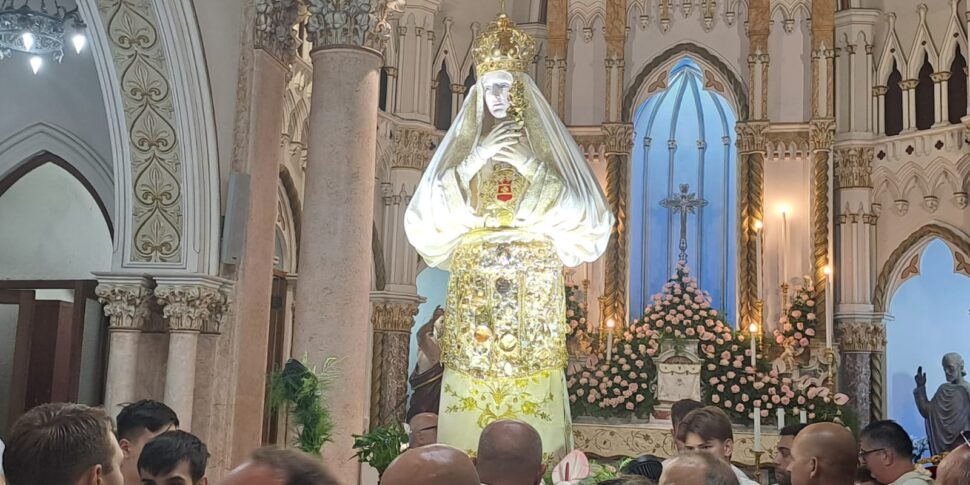
For the Messina, the simulacrum of the Madonna della Mercede is always linked to the Easter festival of the Spampanati, that is, the meeting of Jesus risen with Mary on Easter Sunday. However, few know the religious tradition of the title that the Spanish Virgin dressed in white and adorned with gold door, as well as the church of via Tommaso Cannizzaro, owned by the homonymous confraternity Maria Santissima della Mercede in Valentine’s Day. After about a century, the community was able to celebrate it on the day of its solemnity, on September 24, bringing the artistic simulacrum through the neighboring streets into procession.
A milestone so desired and achieved thanks to the commitment of the renewed brotherhood led by the extraordinary commissioner Fortunato Marino with the rector of the Church Father Gianfranco Centorrino. It was Archbishop Giovanni Accolla to preside over Mass, a celebration participated by a large representation of confraternities coordinated by the diocesan interconfratern center. Accolla underlined the urgency of vivifying religious traditions and devotion by contextualizing it in the commitment of faith he translates into space of proximity and charity. A moment of great joy for the Messina who accompanied the procession with the white and blue candles.
Proud bearers, many, even very young like Dalila Cavalli, 17 years old, who thus continues the overweight tradition of family and of the Emilian father in particular that in the church of the Mercede. The title derives from the possession that the product fathers had from 1595, although the small building existed even first as Santa Maria di Piè di Grotta. According to Samperi, this ancient name is linked to the revered painting, depicting the Madonna della Pietà in the face of the Grotta del Sepolcro di Christ.
The religious enlarged the Church and placed on the main altar an image depicting the appearance of the Madonna in S. Pietro Nolasco and S. Raimondo di Pennafort, founders of the order of goods, always close to Christians in danger of losing faith and discarded, detainees, orphaned children and exploited. Subsequently they placed the statue of the Spanish Virgin, known for the encounter with the risen Christ of Easter day in the so -called “spampanati” procession; Destroyed after the earthquake, the church was reconstructed in 1934 and entrusted to the Confraternity.