

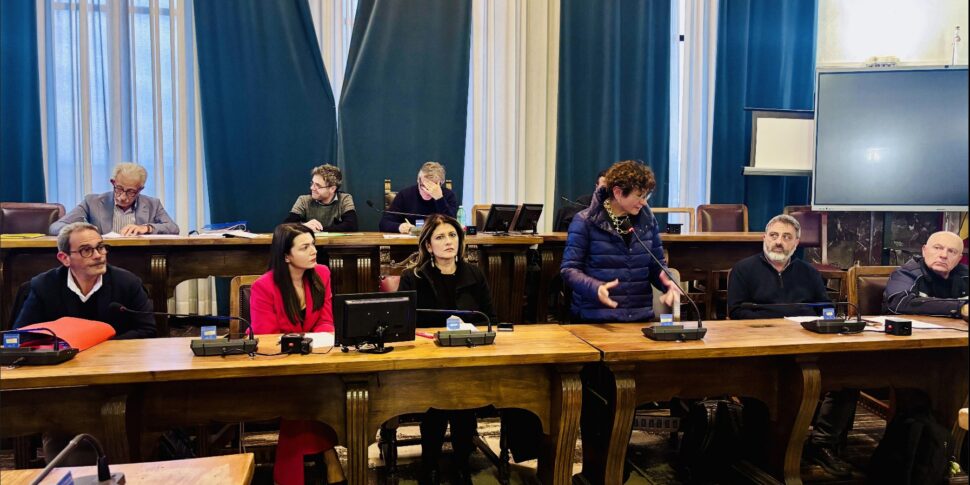
Almost two weeks ago, in the session of the Social Services commission on 2 December, very serious content (episodes of child prostitution in gambling halls, crack cocaine abuse among very young people) was alternated with controversy, to the point of inducing the director of Caritas, Father Nino Basile, and the former childhood guarantor, Angelo Fabio Costantino, to leave the room. Yesterday afternoon, in the extraordinary session of the city council resulting from that debate, Father Basile, away due to commitments, and Costantino, intentionally not invited by the Prime Minister, were missing.
However, the comparison turns out to be long and with some noteworthy ideas. The superintendent Leon Zingales isn’t even there, but the professor is there representing the provincial school office. Filippo Alessi, who provides new data: «Explicit school dropout, therefore dropout, in the province is in sharp decline, between 0.1 and 0.2% for the 2023-24 school year. For the municipality of Messina there are institutions including the center that have 0%, the figure increases in the villages, in some neighborhoods defined as at risk, however always under control. But let’s not rejoice over these data, even a single teenager out of school is a failure for us.”
Another idea worthy of further investigation is offered by the guarantor of childhood and adolescence, Giovanni Amante: «I am in close contact with the ASP and it is emerging that there are many children whose families have not yet indicated the pediatrician of free choice. We are talking about thousands of children.” News that opens up many food for thought.” Amante, who clears himself of a few stones (“it seems that attacking the guarantor has become a sport”), returns to the topic of child prostitution: «I heard about it for the first time in mid-October, after a meeting in the prefecture. If I had elements to make a report I wouldn’t shy away from it, if crime news exists it should be reported in the appropriate places.” He then proudly talks about the project started in the Gazzi prison: «The children of prisoners are special to me, we have been working on it for months and we have arrived at the approval of a type of activity that will allow families, in addition to interviews, to meet at some specific moments of the year. Today (yesterday, ed.) was the first one, for Christmas.”
It is the councilor for social services, Alessandra Calafiore, who claims that the plans launched by the Municipality «take into account an overall strategy. Over the years we have proceeded to constantly strengthen the social service, with contractualized professionalism. Social service that constantly interfaces with the Prosecutor’s Office and the Juvenile Court, the dialogue is continuous. But every issue can only be addressed if there is a great alliance between all the subjects involved, from institutions to families. And the Prefecture plays a fundamental role.” The councilor for youth policies Liana Cannata is along the same lines: «We consider young people not only as recipients, but as an active part of the projects». And beyond the issue of dispersion, “too little is said about the phenomenon of social withdrawal, for example hikikomori”. Kids who go to school, but then “exclude” themselves from society.
Various ideas emerge from the debate in the chamber. From the group leader of the Fratelli d’Italia, Libero Gioveni, (“there is a lack of socio-educational centers in the northern area, and then enough with the dormitory areas, this is where the discomfort begins”) to Alessandro Russo of the Democratic Party: “If there is school dropout, if there is an incredible increase in gambling, if many young people gamble and families cannot afford it, then it is right to ask ourselves how this money is obtained, hence the increase of thefts, hence the increase in child prostitution. Caritas is raising the alarm about this, this is the question we must ask ourselves: the projects exist and they are welcome, but do they manage to satisfy the social needs of this city?”.
In the same vein Cosimo Oteri (Lega), from whose proposal yesterday’s session was born: «Asking for a report on what has been done does not mean saying that nothing has been done, but that more could be done, perhaps focusing on the areas where there is the greatest need».