

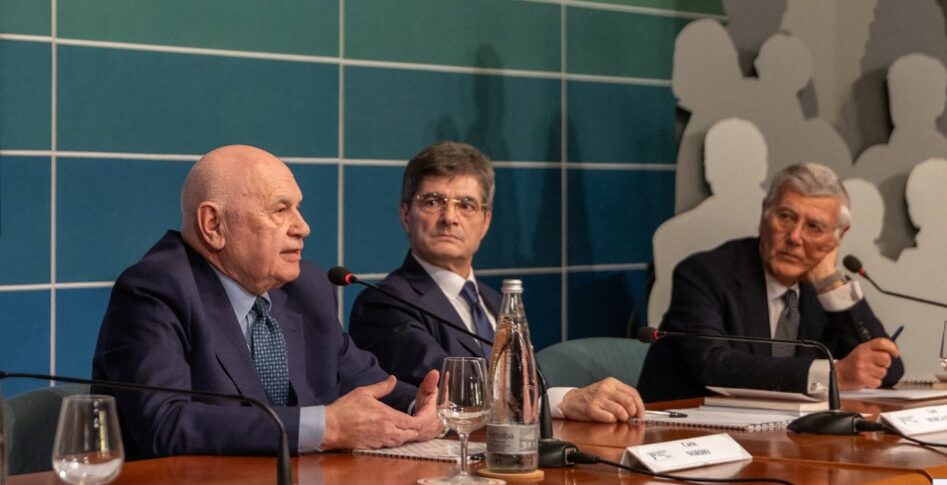
A few weeks before the referendum on justice on 22 and 23 March, the issues of reform were at the center of a meeting in Messina with the Minister of Justice Carlo Nordio, guest of an event organized by the Bonino Pulejo Foundation. The presentation of Nordio’s book “A new Justice” was an opportunity to delve deeper into some aspects of the reform and the reasons for the yes vote. In dialogue with the director of the Gazzetta del Sud Nino Rizzo Nervo and the director of the Giornale di Sicilia Marco Romano, Minister Nordio discussed various topics of the reform.
The meeting was opened by the president of the Lino Morgante Foundation who highlighted how the objective of these events is to be “a contribution of ideas”. Also present was the Undersecretary for Relations with Parliament Matilde Siracusano: “We have a duty: to tell the truth. Because in recent weeks we have been hearing an impressive amount of falsehoods, shamelessly repeated by the ‘no’ committees and by members of the ANM. Falsehoods that must be clearly denied” states Siracusano, who continues “First lies: this reform serves to subject the judiciary to the government, to put the prosecutor under control of the executive. False. Second lie: the reform undermines the independence of the judiciary. Not only is he uncivilised.
Lower the tone
During the meeting, Minister Nordio made an invitation to avoid controversy: «I was a magistrate, the toga is never forgotten, I have always maintained that the debate should have been held exclusively on the contents, without apocalyptic tones, there was a moment in which unfortunately the tones became heated, there was a providential and welcome suggestion from the Head of State to lower the tones and keep the arguments relating to the contents, that’s what I’m trying to do. Unfortunately on both sides there are exaggerations, I think it is useful to keep the discussion in civil terms.”
Risk of desertion at the polls
«There is less affection on the part of citizens at the polls, I hope that the turnout will be as high as possible, it is quite a difficult matter to explain to citizens but it can be done in clear terms. This reform is not against anyone nor, politically, in favor of anyone.”
Why the reform
«When our founding fathers wrote the Constitution they did it with the penal code in mind which then changed after 40 years. When the code came into force it was understood that careers must be separated because it is the logical consequence of the innovation desired by Vassalli: this is the technical reason why the separation of careers for 40 years has become a necessity, in my opinion, logical and legal rather than political.”
Political interference
«In my ideal world the judiciary must not criticize the political merit of laws and politics must not criticize the merit of sentences. Unfortunately, these things have happened over the last 30 years. Luckily in Italy there is alternation. If politics must free itself from this limited sovereignty then today the Center-Right will free itself and tomorrow the Center-Left, in any case, politics will have freed itself from this interference. This will benefit not only today’s government but also tomorrow’s.”
High Disciplinary Court
«What scares me today is that there is cohesion between voters and elected officials because the judges who are part of the disciplinary section are elected by those who will be judged tomorrow and this is not a good message of impartiality for the citizen. This “do ut des” constraint is not normal in the jurisdiction. It is unacceptable that a disciplinary judge was elected by the same people who will be judged tomorrow. It is inevitable that this bond, more or less unconscious, re-emerges especially when it is expressed in belonging to the so-called currents”.
The draw
«The magistrates, who will be even greater in number than they are today with respect to political representation, will be drawn from a pool of magistrates with twenty years of experience. By definition they are all good and well-prepared, it is not pretended that they do not have political ideas, but what scares me now is that there is a current bond between the voter and the elected.”
The prerogatives of the prosecutor
«In our reform the public prosecutor will continue to have the judicial police at his disposal and to enjoy the same guarantees of independence and autonomy of the judge as stated in the art. 104. The point that will instead work in favor of the prosecutor himself, with the separation of the two superior councils of the judiciary, will be the fact that he will be better prepared. The prosecutor must not abandon the culture of jurisdiction, he must learn to do what he should be: not a super policeman but a magistrate who, in the guarantees of legality, knows how to give the directives of the investigations”.
The currents
«I have faith in the impartiality of the judiciary, I have no faith in the current structure of the relationship between ANM which is a union, CSM and ten thousand-odd magistrates who are penalized by this situation. I have no doubt that those who hold top positions are suitable people for the position they hold, but there are just as many good magistrates who have the same requirements to hold those positions and cannot do so because they do not have a current connection. When this reform is fully understood, it will be liberating for magistrates because they will be able to hold those positions even if they do not have a current connection.”
The war
«I don’t question whether it alienates the electorate or not, it would be disrespectful to mix the two things given the tragic event. The most important thing is that the war ends as soon as possible in the best way for everyone. I believe it is a shame that there is a lack of interest in voting which is the maximum expression of democracy. I hope that there will be as much participation as possible.”