

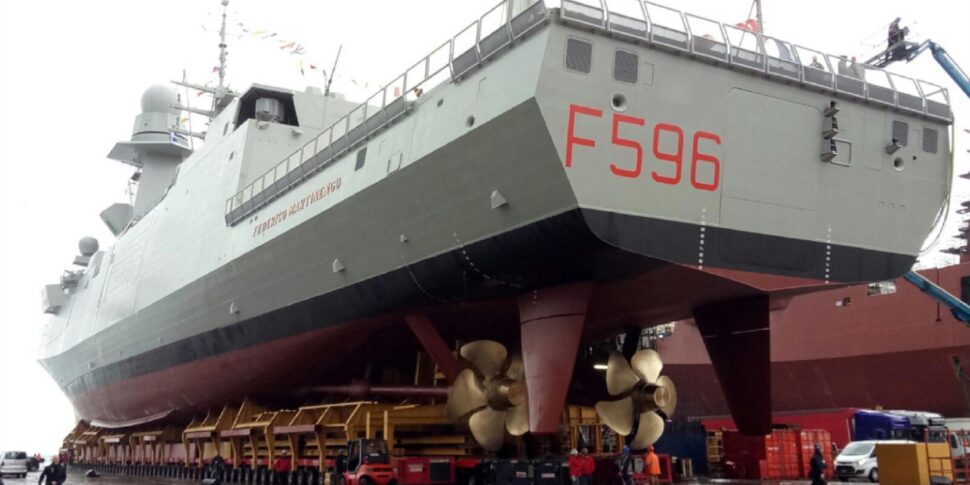
A crew of over 160 men from the Italian Navy is ready to head towards Cyprus on board the missile frigate Federico Martinengo, to defend the island from attacks coming from Iran or Lebanon: they will be able to spot any drones or rockets with the radar up to about two hundred kilometers away while the Aster missiles, active within a hundred kilometres, could neutralize the threats.
This is a type of operation that is not new for Martinengo, which last year concluded its commitment to the European mission Eunavfor Aspides in the Red Sea, returning to the naval base of Taranto after having protected merchant traffic from threats from the Houthis in Yemen.
The new mission, however, already announced by the Minister of Defense, Guido Crosetto, will take place as part of an all-European structure in coordination also with Spain, France and the Netherlands, which will send their ships. The urgency is to prevent the escalation in the Middle East, which has in fact extended to the territory of the European Union, from spreading further. In the skies of Cyprus – which hosts strategic military infrastructure – several drones were neutralized, one of which last March had reached the British military base and hit the landing strip, which in the previous days would also have been indicated for the use of US fighters.
Episodes like this had already triggered a first chain of aid: Greece moved a Patriot system battery to the island of Karpathos, in the eastern Aegean, while Spain and Great Britain were the first to send ships to Cyprus. The Italian Martinengo – one of the most advanced assets of the Italian naval defense – is equipped with anti-aircraft and anti-ship missiles, cannons and torpedoes. It can also accommodate helicopters and is equipped with sophisticated radar and sonar systems. But it is not the only support that Italy will provide: the aid to the Gulf countries announced in recent days remains on the table, for which there is an ongoing reflection precisely due to the constantly changing scenarios.
Moving the powerful Samp T surface-to-air defense system to Kuwait or the Emirates is not an easy operation and it will be necessary to understand whether, with a progressive reduction of the Iranian arsenal, its use will prove necessary or other tools will be needed. The use of the Italian-French anti-aircraft would then require a team of at least seventy people specially trained and capable of operating in the various stations, from the command station to the radars up to each launcher.
Other devices, such as stingers or drones themselves, may not require personnel to be sent. However, Rome has radar and a series of electronic intelligence tools available through the satellite network. Meanwhile, the emptying operations continue from the Ali al Salem base in Kuwait, hit again after the first attack last Saturday, without any significant damage being recorded to the two Italian F2000 fighters present: “Only shrapnel projections”, assure well-informed sources. A partial evacuation has already been arranged for days, with a movement of 239 Italian soldiers towards Saudi Arabia: of the 321, 82 will remain.