

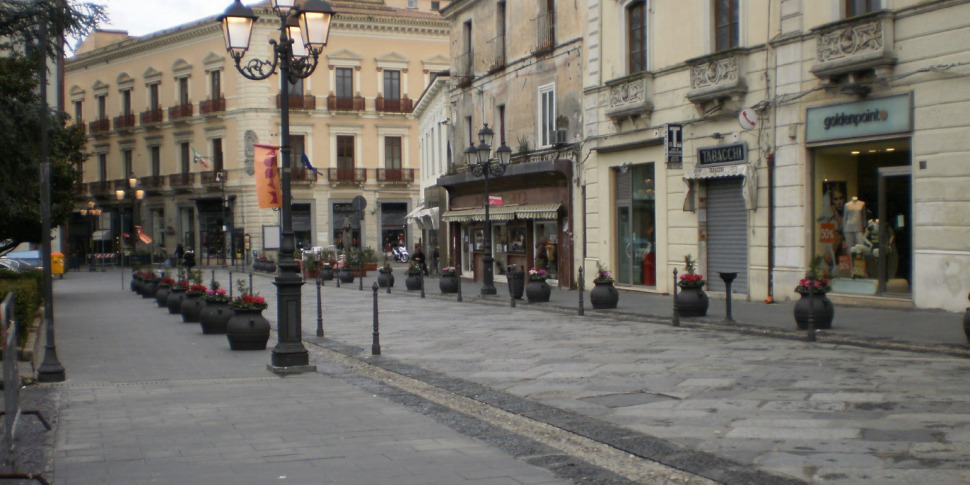
“In Catanzaro the problem of empty shops and progressive commercial desertification is now there for all to see. In an attempt to address the issue, the municipal administration has convened a table with some organizations of property owners and commercial tenants to discuss a possible territorial agreement that favors subsidized rents for economic activities in the city centre, in particular along Corso Mazzini.
The initiative, presented as an attempt to relaunch urban commerce, is based on the truly singular idea that the reduction of rents can encourage new openings. However, this very premise reveals the main limitation of the intervention: the belief that the trade crisis depends mainly on the level of rents.” This was stated in a note by Sandro Scoppa, president of Confedilizia Catanzaro e Calabria.
The root causes of commercial desertification
“It is a simplistic reading – according to Scoppa – which ignores much deeper causes. Commercial desertification is the result of much broader economic and social transformations: changes in consumption habits, expansion of e-commerce, shift of flows towards shopping centres, reduction of the population in historic centres, fiscal and bureaucratic burden on businesses. In this context, imagining that the problem can be solved by intervening on fees risks being an illusion.
It is no coincidence that the meeting called by the Municipality was not attended by Confedilizia Catanzaro, which also historically and significantly represents real estate ownership both at a national and local level. The association has in fact declined the invitation, a choice which appears anything but marginal if we consider the role it has played for decades in representing owners”.
The crux of local tax breaks
Again according to Scoppa, “the distance also arises from a fundamental misunderstanding. There is talk of “tax breaks” that the Municipality could grant to encourage lower rents. In reality, these instruments do not exist or are extremely limited. The Municipalities’ margins for fiscal intervention are in fact very limited and do not allow for truly incisive policies on commercial rents.
The demonstration is there for all to see. In the housing sector, where the system of agreed rents exists, many Italian municipal administrations have envisaged further local tax reductions over time to encourage the use of this instrument. Confconstruction Catanzaro has also asked the Municipality of Catanzaro several times. But these requests were never accepted.”
The role of national legislation and municipal limits
“The only real existing relief – Scoppa specified – is the one provided for by State law: the 25% reduction of the IMU on properties rented with an agreed rent contract, introduced by national legislation. A measure that does not depend at all on the choices of individual Municipalities. It is therefore difficult to imagine that today the municipal administration could suddenly implement significant fiscal instruments for the commercial market. The reality is that such levers are not available to it”.
Market dynamics and attractiveness of the territory
But, again according to Scoppa, “the problem is even deeper. Even if such tools existed, this would not be the most effective way to address urban desertification. The commercial real estate market cannot be guided by institutional agreements or attempts to direct prices from above. Prices arise from the meeting between supply and demand and reflect the economic vitality of a place.
A shop opens where there are customers, flows of people, accessibility, services and conditions favorable to the business. If a historic center loses residents, urban functions and economic attractiveness, no fee policy will be able to reverse the process.”
Proposals for a real relaunch: urban planning and bureaucracy
“The role that a Municipality can really play is another, and mainly concerns urban planning and construction policies. It can make it easier to recover unused properties, reduce bureaucratic constraints, encourage changes in use, simplify renovation procedures, improve accessibility and urban services. That is, it can create the conditions so that investing becomes convenient again.
However, when politics tries to intervene directly on prices or to build agreements to orient the market, it often ends up discouraging precisely those owners and entrepreneurs who should be the protagonists of urban rebirth”.
Beyond institutional tables
“Cities – concluded Scoppa – do not come back to life thanks to institutional discussions. They come back to life when the obstacles that prevent people from investing, working and living are removed. And it is probably for this reason that those who historically represent real estate ownership have preferred not to participate in an initiative that risks moving the problem without addressing its real causes”.