

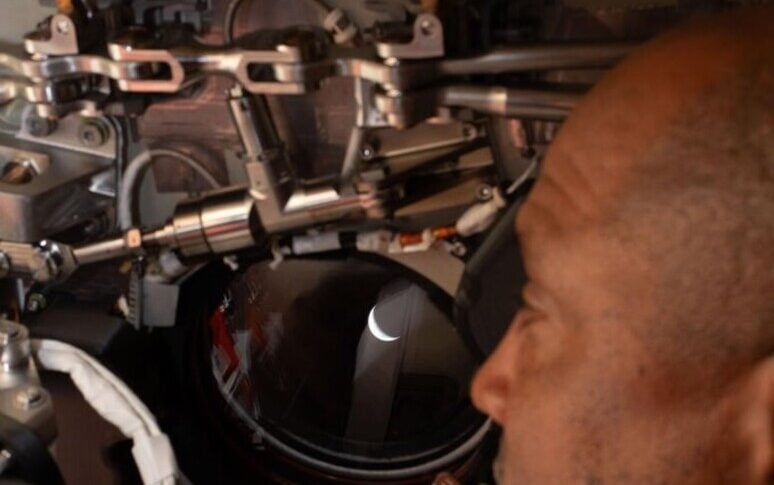
It was Moon Day, the most awaited of the Artemis II mission, with the breaking of the record for the greatest distance from Earth ever reached by a manned spacecraft: the close passage of the lunar surface and the direct observation of the far side of the Moon. On the Orion shuttle, astronauts Reid Wiseman, Victor Glover, Christina Koch and Jeremy Hansen achieved the first record, beating the record for the greatest distance from Earth previously held by the crew of the Apollo 13 mission.
On Monday, April 6, at 7:02 pm (EDT), the four astronauts aboard the US space agency’s Artemis II mission, according to NASA, made history by reaching the distance of 252,756 miles (about 406,000 km) from Earth. This milestone means the Artemis II crew was 4,111 miles further away than the Apollo 13 mission achieved in 1970.
Astronauts have asked permission to name two lunar craters. They proposed Integrity, the name of their capsule, and Carroll, in honor of Commander Reid Wiseman’s wife, who passed away in 2020.
The preparations for the long day that around 1 Tuesday 7 April brought the Artemis II astronauts to the close pass with the Moon began very early, around 7.00 am Italian time, when the engine of the European Service Module (ESM) turned on to refine Orion’s trajectory towards the Moon. “Hello, Artemis 2, I’m Apollo astronaut Jim Lovell. Welcome to what was once my patch”: was the wake-up call from astronauts, recorded by the Apollo 8 pilot in 2025, shortly before he died. “It’s a historic day and I know how busy you will be, but don’t forget to enjoy the view.”
The astronauts also performed a new test of pressure suits, custom-made and called OCSS (Orion Crew Survival System), capable of guaranteeing survival for up to six days. They are fundamental both during the dynamic phases of flight, for example during launch and re-entry, and in the event of cabin depressurisation and after ditching. The astronauts wore them to check both their tightness and freedom of movement, for example when sitting on the shuttle seat and for eating and drinking. The day continued with preparations for the observation of the lunar surface, which occupied them for approximately seven hours. There are 35 points to study and photograph, including the sites where the Apollo 12 and Apollo 14 missions landed. There is also the Eastern Sea, a crater with a diameter of over 900 kilometers which is located on the border between the visible and hidden sides of the Moon and which will be completely illuminated when Orion passes. On the far side of the Moon, the expected communications blackout occurred with the NASA control center in Texas, which resumed about 40 minutes later.
“As we fired up the engines headed for the Moon, I said we were not leaving Earth, and that’s true,” astronaut Christina Koch said when contact with Earth was reestablished. “We will explore, we will build spacecraft. We will return. We will build science bases… We will inspire, but we will always choose Earth.” The astronauts observed, in particular, the Hertzsprung crater, with a diameter of approximately 600 kilometers. It is during this period that Orion is expected to make its closest approach to the lunar surface, at 6,550 kilometres. A little later they witnessed an eclipse because the Moon obscured the Sun.
At 3.20 Italian time the observations of the lunar soil are completed and at 8.25 (Italian time) Orion will exit the sphere of influence of lunar gravity: it will be the beginning of the return journey to Earth. The Artemis II crew is scheduled to land off the coast of San Diego at approximately 8.07pm (local time) on Friday 10 April.
Trump to astronauts, “You have made history”
US President Donald Trump called and congratulated the astronauts of the Artemis program orbiting the Moon for making “history”, telling them that they had “made all of America really proud, incredibly proud”, according to AFP reports. “You are truly pioneers of modern times, all of you,” Trump said, before starting an interview of sorts with the three Americans and the Canadian engaged in a historic 10-day mission around Earth’s natural satellite. “You have a lot of courage doing what you are doing,” Trump said, praising NASA’s first lunar flyby in more than 50 years. “America will be second to none in space and in everything we do, and we will continue to lead this entire journey to the stars, this incredible journey to the stars,” Trump said.
The president then asked them a series of questions, as reported by AFP, in particular what the dark side of the Moon was like and what it felt like to lose communications with Earth during that part of the space flight. “I said a little prayer, but then I had to continue,” Artemis commander Victor Glover responded. “I was actually recording scientific observations of the far side of the Moon.” The president added that he had spoken with Canadian leader and hockey legend Wayne Gretzky about joining the “neighboring” country in the space mission. Canadian Space Agency astronaut Jeremy Hansen thanked Trump for America’s “space leadership” and called the initiative a “mutual goal benefit”https://gazzettadelsud.it/articoli/mondo/2026/04/07/la-missione-artemis-ii-compie-il-flyby-intorno-alla-luna-trump-call-gli-astronauti-avete-fatto-la-storia-ffd08117-f840-49be-9c38-bbd63f73eead/.”A nation that leads as (the United States) and creates and sets great goals for humanity that involve other countries, it’s really incredible,” Hansen said, adding, “Canadians are very proud to be part of this program.” Trump concluded the phone call by inviting the astronauts to the White House. “Congratulations, everyone. See you in the Oval Office,” he said.