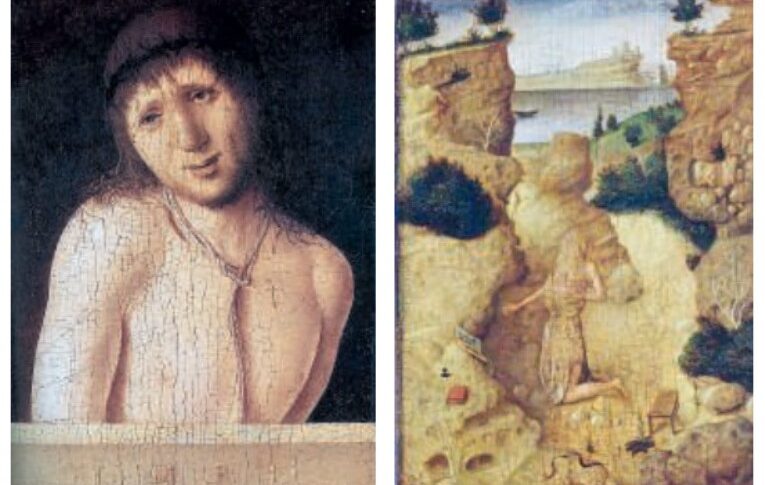
More than an open race. While in mid-February in Messina intellectuals, civil society, but also the Order of Architects and even the Order of Doctors were asking for Antonello’s work to return “home”, the decision had already been taken far from the Strait and its expectations. Without appeal.
And the winners were not the large museums – the Uffizi Gallery or the Capodimonte Museum, as had also been hypothesized – but an institution outside the dominant tourist circuits, just like the MuMe of Messina: the National Museum of Abruzzo in L’Aquila (MundA). A museum that did the simplest and most decisive thing: move in time, with a detailed technical report sent to the General Directorate of Museums of the Ministry of Culture.
Thus, while the public debate was taking shape, the Ministry had already purchased the opistograph panel – “Ecce Homo” on the recto and “San Girolamo penitent” on the reverse – permanently allocating it to L’Aquila. On 21 February the MundA announced that it was ready to welcome it, while the general director Massimo Osanna claimed the choice as part of a strategy to valorise places “less included in large flows”. Messina out of the picture, therefore. And not for lack of legitimacy, but for a game played elsewhere and with other rules.
However, now that the city dreams of another possible Antonello, attributed by the art historian Mauro Lucco, at auction in Paris on 16 June, it is worth understanding why L’Aquila won.
The director of MundA, Federica Zalabra, explains the criteria for the choice: «The Management – she says – assigned us the work on the basis of an evaluation that took into consideration various factors including the designation of the city of L’Aquila as Italian Capital of Culture 2026, the fact that the Museum was still without a masterpiece and, from a historical-artistic point of view, that the work fits coherently into the story of the fifteenth century in Abruzzo. As we were able to illustrate with the report sent to the management, the territory of Abruzzo in the 15th century was a hub between different figurative cultures including those coming from the Kingdom of Naples where Nordic painting was masterfully synthesized by Antonello”.
A complex motivation, which intertwines political opportunity and the construction of a coherent cultural narrative. Zalabra also insists on the symbolic value of the operation: «The assignment of the masterpiece to the L’Aquila Museum also takes on a strong symbolic value: years after the earthquake, the city has undertaken a path of reconstruction that is not only material but cultural, reaffirming the role of heritage as an instrument of memory and future. In this sense, the exhibition of the work in the context of the National Museum of Abruzzo becomes a tangible sign of rebirth and restitution, capable of speaking both to the local community and to a national and international audience. In the context of “L’Aquila Italian Capital of Culture 2026″, the painting by Antonello da Messina is thus configured as a powerful emblem: a work that combines artistic excellence, public responsibility and vision, strengthening the image of the city as a place of resilience, dialogue and high culture”.
Art, therefore, also as a tool for urban and identity regeneration. The museum, still marked by the 2009 earthquake, is in the midst of a rebirth: «Starting from 2016, explains Zalabra again, the Museum has been the subject of complex consolidation and restoration works, with a first reopening on 20 December of the spaces on the ground floor and first floor of the south-eastern quarter of the Castle, with the new museographic layout of the works from the 9th to the 16th century». And the project is far from over: «The archaeological section, the works from the seventeenth century to contemporary art, will progressively find their place, according to an already defined museum project which envisages, by the end of 2027, the delivery and installation of the second floor, returning the entire historical block to the museum». Within this design, the Antonello already has a precise location: «In the fifteenth century room, exactly room 9 on the first floor – specifies the director who took care of the new organization and the museological project – together with the works of the Master of San Giovanni da Capestrano and Andrea Delitio».
A dialogue constructed around the table, where however – the director implicitly admits – the distance remains evident: «Antonello’s extremely high quality has no equal in contemporary Abruzzo production, but the sources of inspiration are partly the same, particularly those of Northern European origin, and Flemish in particular».
The work, in fact, dated around 1465, can be traced back to the period in which the artist perceived the influence of Flemish painting with particular intensity. Despite (or, perhaps, precisely because of the contrast with) its small size (around 20 by 15 cm) it is a concentration of emotional strength of universal value. It will be exhibited in a display case designed specifically by Studio Guicciardini & Magni, which handled the museographic project, and created by the leading company Goppion.
It will arrive in L’Aquila between the end of May and the beginning of June. But it is on his fate that the clearest passage comes: «He remains at MundA forever, he is part of our inventory at OPS number 2800».
A statement that also cools the hypothesis, put forward by Osanna himself, of circulating the work in other museums. Zalabra clarifies: «We will evaluate loans starting from 2027, not in the year of the Capital of Culture». Translated: first the Eagle, then – perhaps – the rest. In short, there is time for Messina.
A story that has just ended and leaves a fact that is difficult to ignore: when the administrative machinery moves ahead of schedule, the public debate risks becoming just background noise.