

Add the Gazzetta del Sud as a source
Showcasing the complexity of the founder of art history together with the complex political, artistic and cultural reality of 16th century pontifical Rome gives a measure of the level of the cultural project curated by Alessandra Baroni at Palazzo Caffarilli (Capitoline Museums). «Vasari and Rome», promoted by Roma Capitale, open to visitors until 19 July (Gangemi catalogue), does not need exhibition artifices to tell in just four rooms, corresponding to as many sections, the profound bond between the city of the popes and the famous painter, architect, set designer and biographer of the sixteenth century.
Over seventy works including paintings, drawings, engravings, letters and sculptures, with a path that rigorously follows the artist’s Roman stays.
The first section reconstructs the arrival of the young Vasari in the 1530s, following Cardinal Ippolito de’ Medici, and his insertion into the circles of the Florentine community. It is a cosmopolitan Rome, still marked by the wounds of the Sack of 1527, but crossed by an extraordinary cultural vitality, capable of attracting artists and intellectuals from all over Europe. In this context, networks of fundamental relationships are developed, between meetings, construction sites and intellectual exchanges, also for the future elaboration of the famous Lives of the artists who lived between the thirteenth and sixteenth centuries, from Cimabue to Michelangelo Buonarroti. The early works on display clearly show Raphaelesque and mannerist influences, but also highlight expressive limitations: Christ Brought to the Tomb (1532) and the Nativity (1538) reveal an updated language, sometimes cultured, but not always capable of achieving emotional depth or stylistic autonomy.
The second section follows the consolidation of his career at the court of Cardinal Alessandro Farnese (1542-1546), a decisive moment for his success. Alongside portraits of notable quality, such as that of Paul III by an anonymous artist from the Lombardy-Veneto area, derived from the famous painting by Titian, or that of Cardinal Farnese attributed to Perin del Vaga, Vasari’s painting often appears less incisive, especially in direct comparison with more gifted masters. Even for the most successful works, such as the Resurrection created together with Raffaellino del Colle (ca. 1545), the Resurrection of Christ (1550) and the Portrait of a Gentleman (ca. 1540-1550). However, the solidity of the method and the design care with which the artist tackles the great decorative undertakings, in particular that of the Sala dei Cento Giorni in the Palazzo della Cancelleria, clearly emerges. Letters, notes and drawings—including the splendid Head of Hilaritas—document a careful and structured creative process.
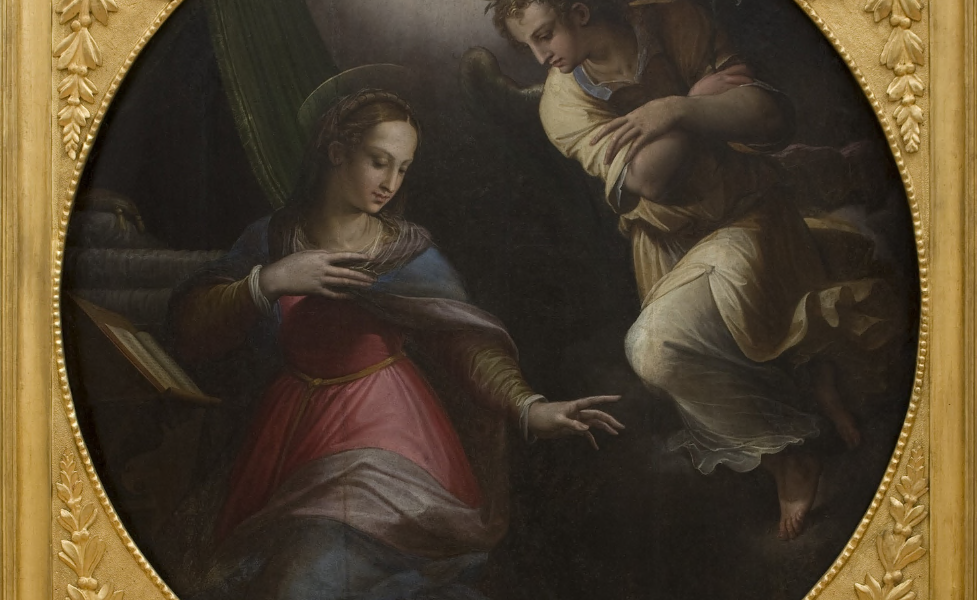
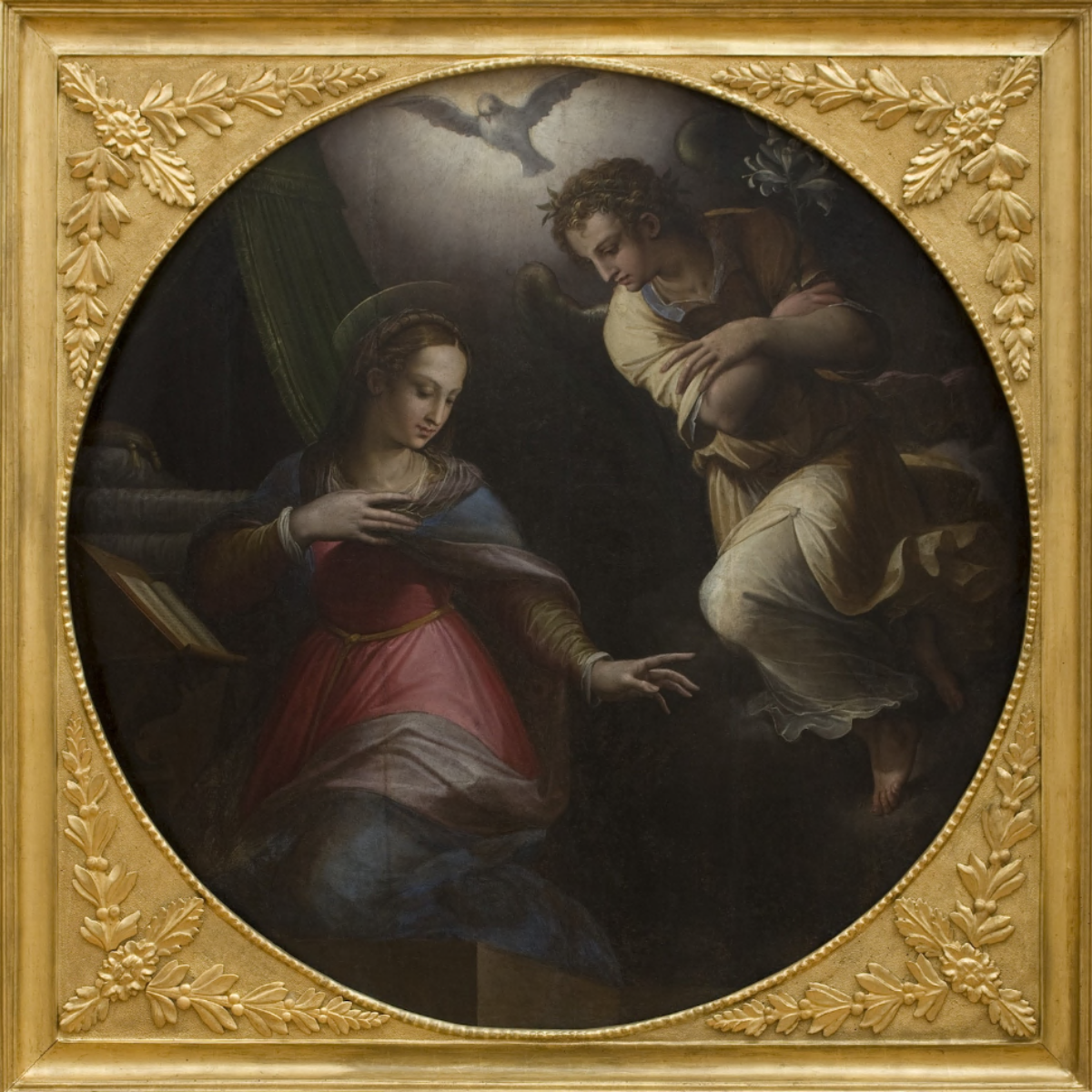
The following two sections accompany the definitive rise of the artist: the “workshop” of the Lives, the relationship with Michelangelo – the theoretical fulcrum and unsurpassed model of the “Modern Manner” – and the papal commissions, up to the great works in the Vatican for Pius V. Here in particular the exhibition offers an interesting scientific contribution, precisely reconstructing the executive processes and bringing together, for the first time in centuries, some paintings from the original furnishings of the chapel of S. Michele in Vatican, or the tondo with the Annunciation, an important loan from the Hungarian Móra Ferec Museum in Szeged, and the two panels with the Evangelists Matthew and John, from Livorno, thus providing a more complete picture of Vasari’s late Roman activity.
Overall, however, the path confirms the relative weakness of Vasari’s painting in direct comparison with the great contemporary masters. The Raphaelesque quote in the Nativity in the first section fails to match the poetic strength of the model, while works placed in dialogue – such as a sheet by Giulio Romano – capture the visitor’s gaze with greater immediacy. Otherwise, the real strength emerges in the graphic production. The drawings on display reveal an inventive quality, an expressive freedom and a freshness that are rarely found in paintings, confirming the primacy of drawing theorized by Vasari himself as a direct form of the idea.
In this sense, the exhibition also implicitly enhances his pioneering role in drawing collecting, exemplified by the famous Book of Drawings, fundamental in the construction of a visual memory of art. However, the valorization of the Lives appears less convincing, as they are present almost marginally in the exhibition itinerary, despite their founding role in the history of Western art. Placed without particular emphasis, they end up being overshadowed by the other works in the fourth and final room, missing the opportunity to underline their historical and theoretical weight.
In the end, however, the exhibition manages to surprise. Late works such as Christ in the Garden (1571) and especially the Annunciation (1570-1571) restore a more complex and nuanced image of the artist. In the latter, the reversal of roles between Virgin and archangel introduces an unexpected psychological tension: it is not Mary who is the hesitant figure, but the angel himself, caught in an almost defensive posture. It is a surprisingly modern image, capable of communicating with contemporary sensibilities. And it is precisely in this final gap, in undermining consolidated judgments, that the curatorial project reaches its most convincing outcome.