

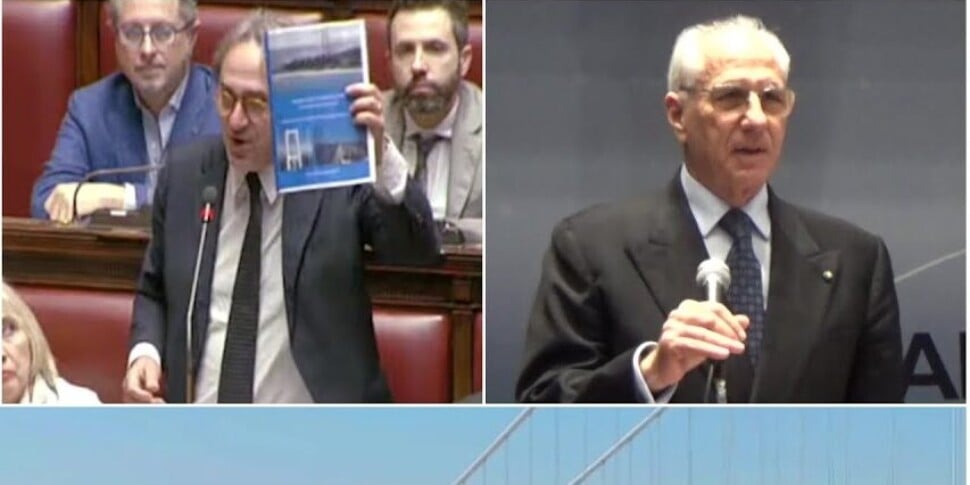
The political and financial clash is ignited around the construction of the Bridge over the Strait of Messina. At the center of the controversy are the budget of the company responsible for carrying out the work, the composition of the staff and the repayment of over 12 million euros in European funding.
Bonelli’s attack (AVS): “Inverted pyramid and 12 million to be returned to Europe”
The attack comes from Angelo Bonelli, deputy of the Green and Left Alliance and co-spokesperson for Green Europe, who harshly contests the management of the Stretto di Messina company:
«Salvini must return 12 million euros to Europe for the design of the bridge. The balance sheet of the Strait of Messina tells much better than Salvini’s propaganda what the Bridge over the Strait is today: not a response to the problems of the South, but an expensive corporate machine, built around a useless and harmful work.
The figure is absurd: out of 116 employees, 89 are managers or executives and only 27 are office workers. In just one year the staff increased by 32 units, but the growth mainly concerns top management figures. This is not a normal operating structure: it is an inverted pyramid paid for with public money.
Making the situation even more serious is the exception to the ceiling of 240 thousand euros for salaries in public companies, introduced by the majority. A tailor-made exemption, which allows some managers of the Strait of Messina to exceed that limit, while the cost of personnel continues to grow. Meanwhile, the same company will have to return 12.375 million euros to the European Union because the delays in the approval process did not allow it to respect the times foreseen for the activities financed on the executive design of the railway part of the work. It is the heavy bill that Italians pay for a project carried out with propaganda, coercion and announcements.”
Ciucci’s reply (Ad Stretto di Messina): “Strategic choices, recoverable EU funds”
The response from Pietro Ciucci, CEO of the Strait of Messina, was not long in coming, defending the company’s actions at ANSA, underlining how the company is responsible for carrying out the work “in compliance with all Italian and European regulations” by parliamentary and government mandate.
Salaries and staff chapter
Regarding personnel and top management compensation, Ciucci specified:
Origin of the staff: «The employees of Stretto di Messina come almost entirely from Anas and other companies of the Ferrovie dello Stato Italiane Group, under the secondment regime and maintaining the economic treatment of the seconding companies».
Ceiling on the remuneration of the Board of Directors: «The remuneration for the Board of Directors and in particular for the President and the CEO have been set within the limits set by the so-called “ceiling on remuneration” defined by the laws in force».
The exemptions for managers: «The exemption from the cap on compensation, provided for by law only for employees of the Strait of Messina, currently concerns two high-profile managers and responds to the need to ensure that the company has the right professionalism for the construction of a project such as the bridge over the Strait of Messina and, therefore, to be able to carry out dialogue, negotiation and control at the highest levels towards all the Italian and international subjects involved in the construction who can count on first-level organisations».
The question of the 12 million Europeans
Regarding the return of community funds, the CEO spoke of a strategic and temporary choice linked to the new times of the project:
«As regards the return – which we believe may be temporary – of the European contribution, in March of this year, taking into account the new timing for the start of the works, it was the Stretto di Messina company itself that started the procedure for requesting early termination.
The Grant Agreement, signed on 11 October 2024 with CINEA (Climate, Infrastructure and Environment Executive Agency) of the European Commission for the European co-financing of approximately 25 million euros, is aimed at covering 50% of the executive design costs of the railway infrastructure of the Opera, which should have been started by April 2026.
The new approval process for the bridge project could be completed by the end of summer 2026, thus being able to start the construction phase in the last quarter of the year. In this context, the early termination of the Grant Agreement allows the Strait of Messina to participate again in the next European CEF (Connecting Europe Facility for Transport) tenders, taking into account that the European judgments that had determined the victory with the highest scores in the 2024 tender remain completely unchanged, relating to the collective interest of the Opera and its ability to impact the four objectives of the TEN-T corridors: cohesion, efficiency, sustainability and increased benefits for users”.