

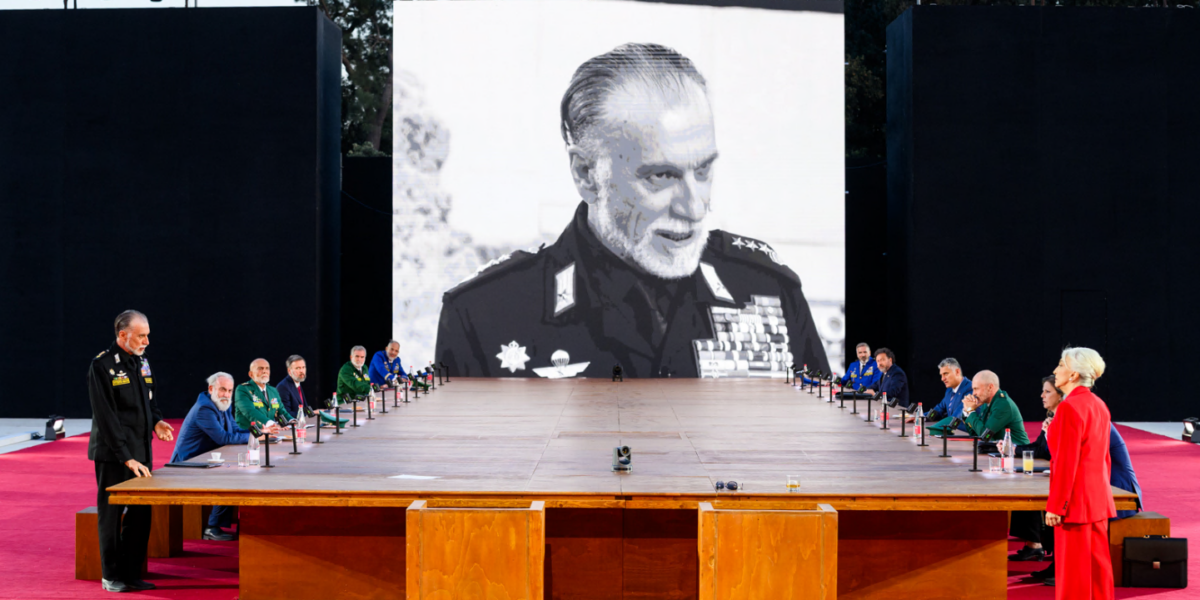
It lies between the situation room and the War Council. It immediately makes us think of tables in our present: those where peace is negotiated while still shooting at each other. Those in which we ask ourselves: but outside here, where we see everything on a thousand screens, will the war really be over? While in the background we can all hear the sounds of war. On the day of the premiere, in the Greek Theater of Syracuse, for the 61st season of Inda, of Aeschylus’ «Persians» – an exceptional document: the oldest of the surviving tragedies (472 BC) – other voices were added, those of a demonstration, at the gates, for the tortured Palestinian people: the present is never outside the theatre, which is always a space of humanity reflecting on itself. Even more so if the direction (on the beautiful and shrewd translation by Walter Lapini) is by the Catalan Àlex Ollé, one of the founders of La Fura dels Baus, subverters and re-founders of the theatre.
The scene is the gigantic table of the War Room, dominated by a screen on which the live shots of two operators flow (but in reality we do not notice them: in our world they are the arm and the mechanical eye, taken for granted and scotomized from the field of vision). We follow the comings and goings of hostesses and secretaries with the carpets preparing the arrival of the choir: the elderly dignitaries are a handful of very high officials and diplomats. The uniforms full of insignia and the dark clothes are so many codes and functions (costumes by Lluc Castells). On stage there is not only the aristocracy of the power of Persia 2500 years ago – Persia defeated by the Greeks at Salamis which does not yet know that it is: the genius of Aeschylus is to reflect on the vanquished to found the ethics necessary for the victors (that hubris, the arrogance that marks the boundary of the human, is always lurking, and undermines us) – but every gigantic and pyramidal system of imperialist power, unique and multifaceted: the chorus is atomised and fragmented, broken into single dramatic units, each choir member has his own “part” of the whole. And we follow them and recognize them, as they take the floor, in close-up on the screen, more individuals than ever (and all excellent: Marco Maria Casazza, choir leader, and Francesco Biscione, Fabrizio Bordignon, Nicola Bortolotti, Rosario Campisi, Francesco Migliaccio, Giovanni Nardoni, Antonello Cossia, Stefano Quatrosi, Michele Cipriani, Rosario Tedesco and Elena Polic Greco, the only woman, as always in the control rooms…).
There is a direction of the images on the screen – in a mellow black and white that seems a bit Istituto Luce, a bit reportage – which mixes with the direction of the scene, lively and polychrome. And we, users of screens, digital people, suddenly realize that we are following that succession of faces on the screen and we almost have to force ourselves to look at the scene too, to bounce from one vision to another, composing the truth through the different angles of the story. It is the truly brilliant idea of this staging, which takes us into the heart of our world, but crowding it with the questions of every world, the ethical questions of all time, posed since Aeschylus: where does the power come from? How tragic is its excess for the people? To be the democracy that it is, how much does Athens have to dodge the Xerxes who want to take it over, from the outside but also from the inside? And the many Athens of today come to mind, the imperfect Athens (that democracy is a continuous self-correction) in which populist parties praise the Xerxes. Or the immeasurable winners who continue to exterminate the vanquished…
Through the screen we will see in the foreground the queen mother Atossa (a powerful, regal Anna Bonaiuto, trepidatious for the fate of her son and tormented by dreams but also inflexible, even hateful incarnation of Reason of State), who will have to listen to the words of the Messenger the chronicle of the defeat of the powerful army of Xerxes. Powerful and numerous, but it could do nothing against the city which “the value of its men” – free and not subjects – made “impregnable”. And the Messenger, gradually bent by the defeat he recounts, has a cardinal role: the one that brought fortune to the young Vittorio Gassmann in Syracuse in 1950 and which today once again shows the adamantine talent of Giuseppe Sartori, who in Syracuse (where he has done many things, especially a masterful Oedipus) is singularly married to the genius loci, to the perennial that literally becomes a new body every time.
The longest applause was for him, then for the “No to war” banner that appeared at the top of the steps and finally for the “testimony” that closed the show: one of the three modern “inserts” (the short monologues of a war widow, Virginia Giannone; of a veteran, Gabriele Antonio Esposito; of the mother of a fallen man, Simonetta Cartia) which carry the voices of the true “vanquished”. Because the true losers are also the last of the winners. And these “inserts” are perhaps the most delicate and controversial point of the directorial choices, destined to animate the debate. But the purpose of every act of pure theater is also this…
The table of the War Council (set design by Alfons Flores), center of the scene, becomes the tomb of King Darius, to whom Atossa addresses (the sacredness of that fragment is beautiful, supported by the hybrid, grave and percussive music of Josep Janou): Darius’ ghost is Alessio Boni, making his debut in Syracuse, made up to appear, on the screen, as a disturbing shadow, a disturbance of the line. The king is more “reasonable” and moderate than his “impetuous” son, whose sin of arrogance he recognizes. But without delegitimizing it.
Third metamorphosis: the table is the floor of the military room on which the geographical map of the world is spread out. That world that the powerful trample on: Xerxes (an effective Massimo Nicolini) does it physically, returning as a defeated but not as a deposed king. Indeed, an example of arrogance punished, but without undermining its power: in the end the table will be set for the refined dinner of mother and son, safe among the privileges of luxury (because this is what imperialist tyrants do: they toast at the back of the people they sent to their deaths). Beware of power and its excess, because it knows how to relegitimize itself and be reborn from every ash: little has changed since Aeschylus.
It runs until June 28th; then to Pompeii from 10 to 12 July.