

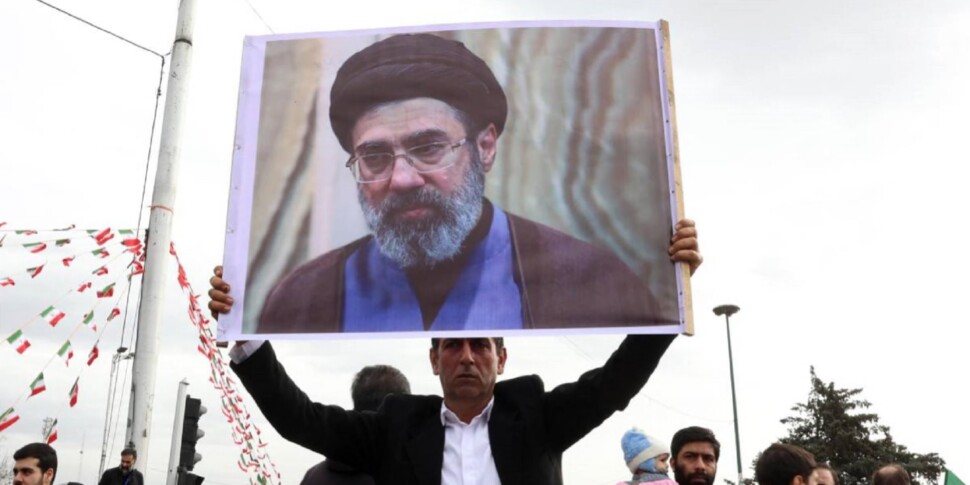
The Supreme Leader of the Islamic Republic, Mojtaba Khamenei, is said to be very serious and could die soon. Yet another revelation comes from sources close to the Tehran government while Khamenei has never appeared in public, or even on video, since he was named after the killing of his father Ali, shot to death on February 28 in a raid by the United States which marked the beginning of the ongoing conflict.
While rumors have been circulating for months that Khamenei was seriously injured and disfigured during the same attack that killed his father and other family members, according to sources reported by Iran Wire – an Iranian information portal based abroad – rumors are persistently circulating at the highest levels of the Ayatollah regime according to which Mojtaba is in extremely critical conditions. “It would not surprise us to learn the news of his martyrdom soon,” said one of the sources, while since he was appointed Supreme Leader, during the month of March, Khamenei has never met any member of the Iranian government, with the exception of President Masoud Pezeshkian, who in May declared that he had had a meeting lasting a few hours with the leader which took place in a cordial atmosphere. A version recently cast into doubt by an exclusive from ‘Iran International’ – the TV channel for Iranian dissidents based abroad – according to which the meeting in May with Pezeshkian took place in the dark in a secret location in Tehran, lasted only a few minutes and the Iranian president was not even able to recognize Khamenei or shake his hand. Speculation about the Supreme Leader’s precarious health conditions were also fueled by the fact that the leader’s only statements came in written form, distributed by the official media. Pezeshkian himself stated that at the moment it is “very difficult” to communicate with Khamenei, “but his presence is a great strength for us.”
The delicate negotiations with Oman on Hormuz
The mystery over the Iranian leader’s health conditions is taking place while Iran has been involved in the conflict with the United States for months and is currently involved in delicate negotiations with Oman to try to find an agreement and formalize a route for commercial ships through the Strait of Hormuz. A situation in itself critical while Pezeshkian, a president who represents the reformist and moderate wing of Iranian politics, seems to find himself increasingly in difficulty with the hawks of the Islamic Revolutionary Guard Corps, the heart of power of the Islamic Republic, especially after the Iranian president signed the memorandum of understanding with the United States on June 17. Also according to Iran International, already at the end of May Pezeshkian had submitted an official letter of resignation to Khamenei’s office, stating that his government had been excluded from the most important decisions during the war and that the most intransigent factions of the Pasdaran had taken control of state affairs. A conflict that has recently also emerged on a public level, due to the statements of Mohammad-Bagher Kharrazi, a high prelate whose sister is married to Khamenei’s brother, according to which Pezeshkian had threatened to resign 28 times and Khamenei would have warned that his next resignation will be accepted. A reconstruction that was denied by Pezeshkian himself, who denied his intention to resign, promising to remain in power to serve the country and defining the accusations as “completely false, fabricated by those who aim to attack national unity”.