

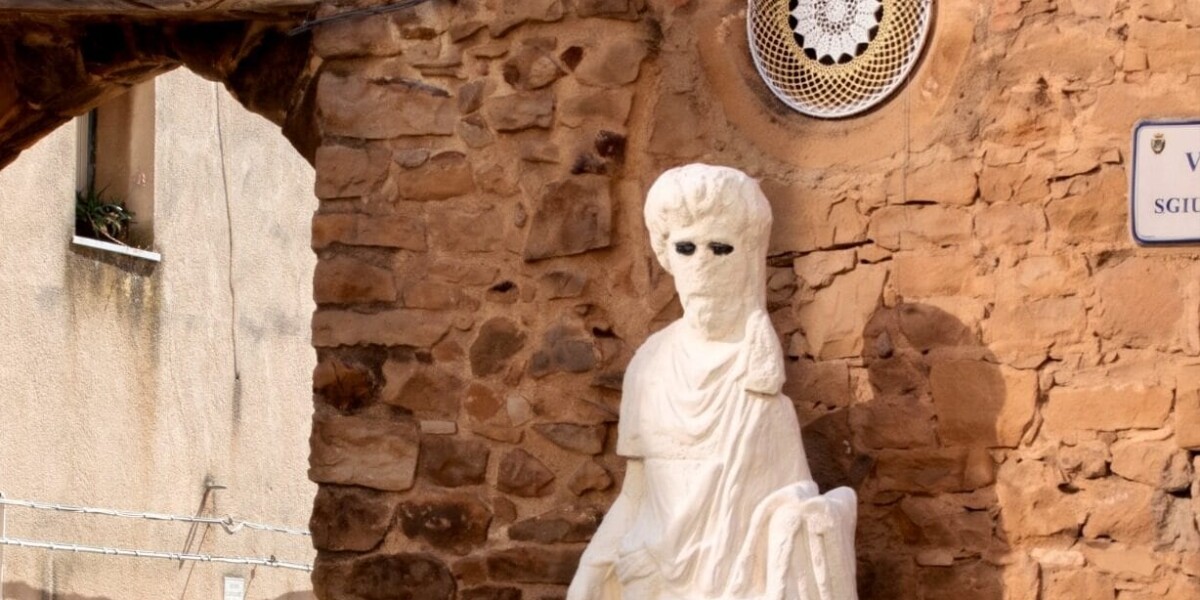
FACTUS – CONTEMPORARY ART FESTIVAL TUSA presents ANTIQUARIUM. Site-specific artistic production project for the Tusa (ME) area. An installation by Daniele Franzella in the historic center of Tusa and a personal exhibition by the artist at the Archaeological Site of Halaesa Arconidea
The latest edition of Factus – Festival of Contemporary Art, created Antiquarium: an artistic production intervention that connects the historic center of Tusa (a city with a profound tourist vocation) with the archaeological site of Halaesa Arconidea (one of the most significant archaeological heritages in the Mediterranean), intertwining contemporary art, archaeological heritage and public space.
The project was carried out within the PNRR, promoted and organized by the Tusa Nero su Bianco cultural association chaired by Alfonsina Bellomo, by Factus with the artistic direction of Michelangelo Calderone and Salvatore Giacomo Notaro, and by Santo Di Salvo, in collaboration with the Municipality of Tusa and the Archaeological Park of Tindari and with the patronage of the Riso Museum of Palermo.
The installation by Daniele Franzella
Antiquarium has produced a new contemporary installation site specific by Daniele Franzella inspired by an ancient statue that inhabited various spaces in the town and which is now kept in the city’s Antiquarium Museum. The original statue portrays the Roman magistrate Claudius Pulcher, who lived around 90 BC, and for many years was placed in the center of Tusa, where the new sculpture is now located. Franzella’s work offers a contemporary vision of Pulcro by collecting fragments of the past and restoring the ancient figure’s eyes, made of ceramic with a surprising effect. The monument preserves recognizable traces of the ancient model – naturalism, the realism of the portrait, the legacy of Greek sculpture and the celebratory function – proposing itself as a new presence that provokes a reflection on the processes of transmission of images, on the practice of replication and on the relationship between authenticity, memory and invention.
The ideal relationship between Tusa and Halaesa Arconidea
Located at the ancient gateway to the historic center in Largo Notarile, the sculpture establishes an ideal relationship between Tusa and Halaesa Arconidea, mending the link between the contemporary city and its archaeological landscape. The work neither celebrates the past nor reconstructs it; rather it reactivates its interpretative potential, making public space a place where history continues to be reread and shared.
On display in the archaeological museum until 20 September
The intervention in the urban space is accompanied by an exhibition by the same artist set up in the rooms of the archaeological site of Halaesa Arconidea until September 20, to tell the genesis of the entire creative process curated by Alessandro Pinto, in a dialogue between archeology and contemporary art, past and present, broadening the reflection on the relationship between archeology and contemporary artistic practices.
The reactions
“Ours is a historic municipality that originates from the ancient city of Halaesa Arconidea dating back to the 4th century BC. As an administration we pride ourselves on having strongly wanted to re-evaluate the archaeological site, with stubbornness. Thanks to the collaboration of the French university of Amiens we managed to make great discoveries. And today the universities of Oxford, Messina and Palermo are also collaborating in the excavations. Thanks to the choice to make culture the axis of development of Tusa, we have entered the Pnrr Borghi, within which we were able to carry out various interventions: 3 co-working stations in Tusa, Castel di Tusa and Halaesa, smart benches for working or charging the phone in front of the sea, the collaboration with Factus for the Antiquarium project, accommodation to host university students who come here to work on the archaeological site in an abandoned and unused former convent. Overall, 12 projects have been financed by the Pnrr and we are proud of it”. Thus Angelo Tudisca, mayor of Tusa.
“The first three editions of Factus used the form of artist residencies with students from the Academy of Fine Arts of Palermo. This year’s edition focused on the ancient Roman statue depicting Claudius Pulcher, located for a long time within the town. The idea of proposing a contemporary statue that started from that sculpture, reinterpreted it and placed it where tradition wanted it to be, near the Gate, seemed like an operation that could build a bridge between Tusa, Halaesa and the future represented precisely by contemporary art” (Michelangelo Calderone, artistic director Factus).
“Art is made of survivals as the German art historian Aby Warburg postulated. The Antiquarium project is the realization of this idea with respect to the figure of Claudio Pulcro whose statue from the Roman era was moved several times: initially placed near the medieval gate of the town, it was relocated at the beginning of the 20th century to the center of the main square, on a monumental fountain, after 1950 transferred to the Town Hall and finally placed in a museum at the Antiquarium of Tusa, where it is still preserved. A statue documented by the watercolor created by Jean Houel in 1777, now preserved in the Hermitage Museum in St. Petersburg. A replica was also created a few decades ago, now exhibited along the tour of the archaeological site of Halaesa. The attempt of the Antiquarium project is to reinterpret this figure in the present and in the light of this history, through contemporary art” (Alessandro Pinto, curator of the Antiquarium project).
“It is not a copy but a reinterpretation that is made of fragments just as its history is fragmented. The eyes are a present and an important detail that is missing from the original statue and signify a lively look at the citizens and the history of this place. Confronting the finds of Halaesa was a unique experience for me” (Daniele Franzella, artist).