

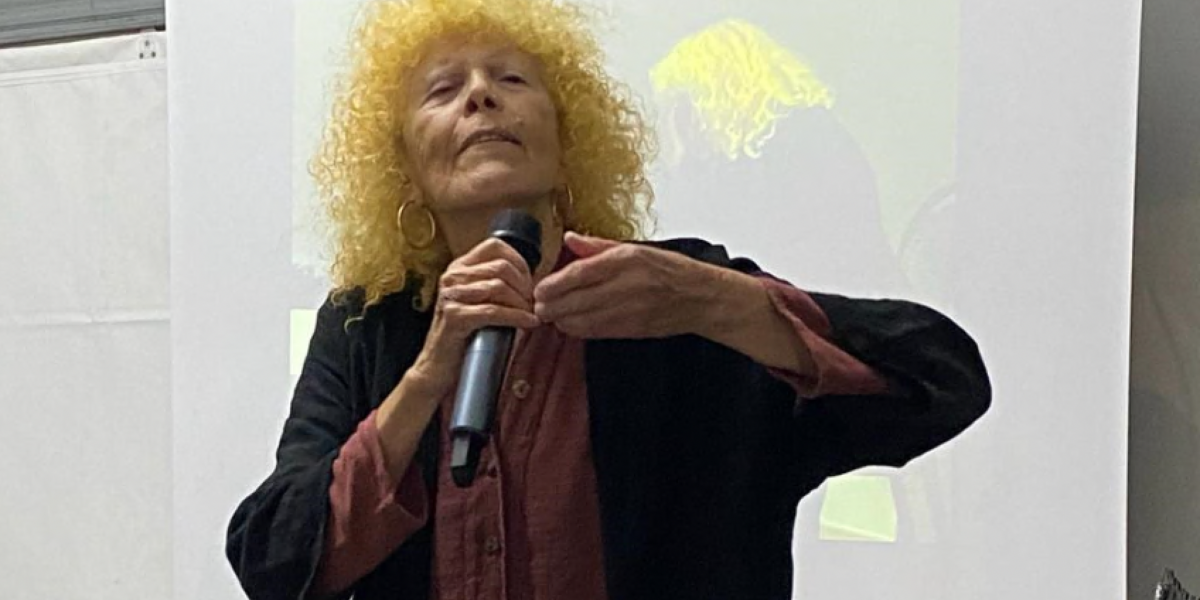
She passed away suddenly, on the threshold of 80 years of age (she would have turned 80 on January 7th). An illness in the night, the rush to hospital in Rome. Unfortunately useless. Carla Tatò left like this, she also improvised in the last of her scripts, where the words written with her moved with new and different rhythms. I happened to write that she “doesn’t act, but plays the words”. And it’s true: listening to the poems in his “interpretation” was a mystical experience. The words danced, they were thunderous and then quiet, overflowing and insinuating, they created dreams and proposed reality, they led to adventure and then to solitude, they were all possible life that became sound and also rhythmic movement.
It was a thunderous and meditative tom-tom, an eruption that transformed until it became static and vice versa. All with great respect for the metric, solicited and tense (to infinity? it seemed so), because she lived in the concrete ideality of “always lived theater and never acted life”. This too was the fruit of an existence that since 1973 had been lived in total symbiosis with Carlo Quartucci, the great director from Messina, authentic father of Italian theatrical experimentation (who passed away on 31 December 2019): «I met Carlo – he told me – when he was moving with his white truck, which brought the theater to the villages throughout Italy, and I with my red Harley Davidson. I got on his truck with the motorbike and he got on the Harley.” Thus was born the theatrical myth of Carlo and Carla, accompanied by the inseparable Moby on duty (a dog who bore the name of the whale, protagonist of Melville’s novel, which Quartucci had filmed for Rai), a now historic adventure.
Carla Tatò, born in Rome in 1947, was the daughter of Antonio, an intellectual and important exponent of the PCI, and of Erminia Romano, the first orchestra director in Italy. Before meeting Carlo she was already a well-known actress, having worked in several Carmelo Bene shows and then, in a very important experience, with Gian Maria Volontè. With Dacia Maraini he founded the Blue Company in Rome and the neighborhood theater in Centocelle. He had also shot some films with directors such as Marco Bellocchio, Mario Monicelli, Carlo Di Carlo and Dario Argento and participated in the television version of Luca Ronconi’s “Orlando furioso”. The meeting with Quartucci, which took place in the RAI studios in Turin, changed her life, from then on she was involved in a theater where what was happening on stage was always more important than anything, not everything that had been prepared or that would follow. Creation was at the service of the moment, and vice versa.
After the long journey of «Truck» (of which evidence remains in the TV film of the same name), there was the new and exciting adventure of «La Zattera di Babele», first in Genazzano, in the province of Rome, and then in Sicily, in Erice. «We worked – he told me – with imagination, reason, the ability to get to the bottom of things, instinct, intuition and a critical spirit. Instinct and intuition seem to have been lost, today everything seems planed, but I want to fight so that these very important human characteristics regain their central place.” And it’s true, he tried until the end, entrusting an immense heritage of papers, videos, images and props to the University of Tor Vergata (in collaboration with the Municipality and the Pro Loco of Genazzano, the town where Piazza Carlo Quartucci exists) and to the Dams of the University of Messina. His idea was to create, both in Lazio and in Sicily, a permanent laboratory capable of conveying artistic experiences from all over the world. Because his theatrical reality was always “in progress”, the result of a unique experience in Italian scenic history, in which artists and intellectuals of every category had participated: Jannis Kounellis, Giulio Paolini, Roberto Lerici, Germano Celant, Giovanna Marini, Luigi Cinque, Mimmo Cuticchio’s puppets and many others.
In this long and composite itinerary, Carla Tatò, creator rather than actress (she said: «Whoever knows me knows that I am not an actress, but a narrator», however, apologizing, I prefer «creator»), has passed through important, I would say – without any emphasis – historical characters, such as Nora Helmer of Ibsen’s «A Doll’s House» (overwhelmed by Carlo and Carla who «doted on the scene») or Von Kleist’s Penthesilea, presented in various European countries. In Palermo, in 1994, she even played Frederick II in «Ager Sanguinis», a show written by Aurelio Pes for the 800th anniversary of the emperor’s birth.
Carla (who in 2023 received the «Shadow of Dionysus» theater prize at NaxosLegge) came to Sicily for the first time in 1974, for a show in the Rai studios in Catania (other times!): «We stopped in Messina – she told me – and Carlo showed me around far and wide. He wanted to show me all the places of his childhood and adolescence. He loved his city very much, but we had to wait until 1993 to be called (by Mariano Rigillo, ed.) to act in Vittorio Emanuele with “Tamerlane the Great”, in a theater that has a wonderful stage.”
The couple returned to the Vittorio Emanuele in November 2017 for a masterful “lesson – non-lesson”, which started from a phrase by Luigi Pirandello: “There is a beyond in everything. But you don’t want and don’t know how to see it.” Carla Tatò had always been able to see that beyond. Today, which has gone to a new beyond, we cannot help but imagine her hugging Carlo, always ready to “dote”.