

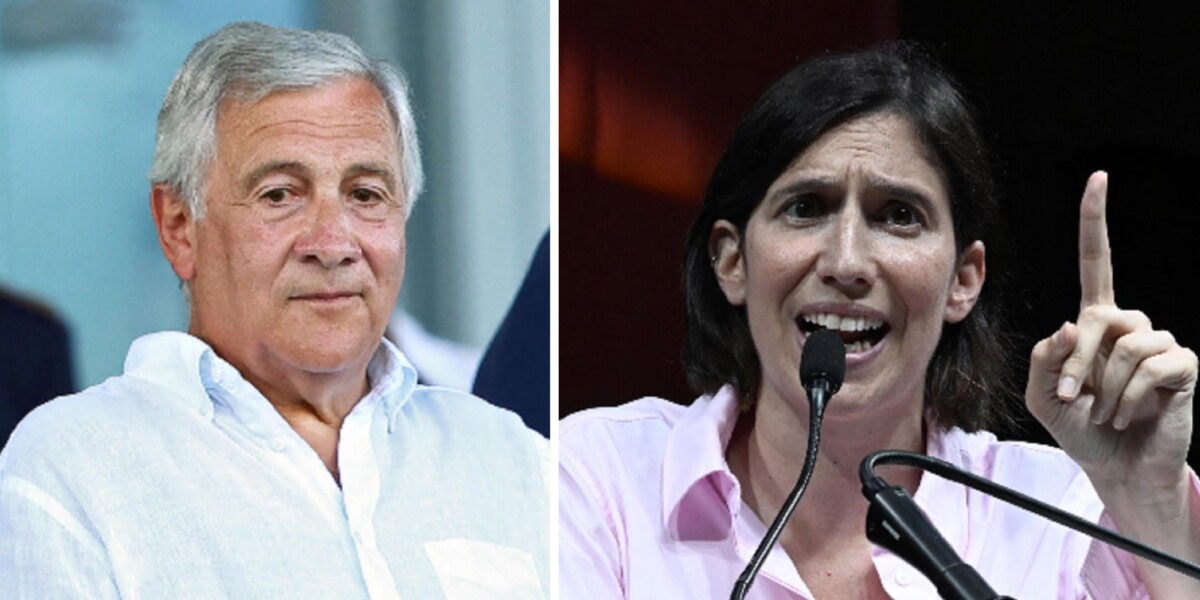
The conflict over the high cost of fuel shifts to extra profits – profits higher than the normal profitability of a company, favored by exceptional circumstances such as a sharp rise in prices – and divides the government and the opposition a few hours before the Council of Ministers on excise duties. The secretary of the Democratic Party, Elly Schlein, wants to tax them; deputy prime minister Antonio Tajani rejects the hypothesis; Codacons calls for a stable mechanism.
Schlein: «A glimpse into the real life of the country»
«Six months after the start of the war in the Persian Gulf, the energy crisis is once again a stark emergency that millions of Italian families and businesses deal with every day. We are talking about a real economic blow that is affecting the real life of the country.” He writes it in a letter to Corriere della Serathe secretary of the Democratic Party, Elly Schlein.
«In recent months – he adds – the price of gas has more than doubled, the cost of oil has risen to 90 dollars a barrel, petrol at the pump has steadily broken through the threshold of 2 euros per liter and diesel has now surpassed the historical record reached in March 2022. With very serious repercussions on the cost of living, goods and food. All this translates into one word: unsustainability. For those who have to combine lunch with dinner the situation is unbearable. It is also the case for small and medium-sized businesses, which lose competitiveness and risk closing their doors.”
«Faced with such a difficult situation – continues the Dem leader – the government is literally navigating by sight, as demonstrated by the recent extension of just 48 hours of the mini discount on the excise duty on diesel: a mockery. With the winter season now upon us, buffer measures are no longer enough to protect the country. The truth is that huge resources will be needed, which we must go and get exactly where they are found: by taxing the extra profits accumulated by large energy companies in a fair and effective way. Giorgia Meloni has the courage to make those who have become rich even in this heavy crisis pay more.”
«The government should move from words to deeds and immediately tax the extra profits to finance the extraordinary interventions necessary to give Italy new breath» concludes Schlein.
The historical reference is to the week of March 14, 2022, when the national weekly average of diesel reached 2.154 euros per liter. Today the average self-service on the ordinary road network is 2.137 euros, while the motorway average is 2.208 euros: the latter figure exceeds that threshold, despite referring to a different survey.
Tajani: «It reminds me a lot of the Soviet Union»
«I believe that we can also work by discussing and comparing ourselves with the industrial world, especially in the hydrocarbon sector. I am very against any hypothesis of extra profit, of taxes. When I hear the word taxes I get hives. It is right that a comparison, a contribution is given, as we have done with banks and insurance companies. There must be an agreed discussion in a difficult moment also by companies in the sector. But I don’t want to hear the word extra profit, which reminds me a lot of the Soviet Union.” Thus the Deputy Prime Minister and Foreign Minister Antonio Tajani, arriving at the Rimini Meeting.
Codacons: a structural mechanism is needed
«The numbers demonstrate how quickly a fuel flare-up can translate into a blow for millions of motorists. We cannot continue to chase every emergency with extensions, bonuses or social cards. Mobile excise duties must be accompanied by a mechanism on extra profits that allows resources to be found when price increases become exceptional and to be used to reduce the cost of fuel”. Codacons states this in a note.
«The resources – underlines the association – should come primarily from large companies in the oil and energy sector and, in the presence of actual extra profits, also from other highly profitable sectors, starting from banks and insurance companies». Codacons then reiterated that “the measures must be universal, because the high cost of fuel directly affects all motorists and, through transport and distribution, produces effects on the entire community”.
Extra profits, what they are and why they divide
Extra profits indicate profits that exceed the ordinary profitability of a company and which are favored by exceptional external circumstances: in the case of energy, a sudden rise in international prices which inflates revenues without a corresponding increase in costs, for the same activity carried out. Those who propose to tax them argue that it is an undeserved gain, produced by a crisis that affects families and businesses, and that it should be partly redistributed.
However, the dispute also concerns the definition. According to Forza Italia, extra profit is not a legal category and distinguishing “normal” profit from “exceptional” profit is an arbitrary operation: such a levy would end up affecting the company result as such, discouraging investments. In the majority the positions do not coincide: the League has said it is in favor of asking for a contribution from banks, insurance companies and energy companies, while the Azzurri maintain their refusal. It is one of the issues that continue to divide the majority.
On a European level, the issue has only been partially resolved. On 24 August the European Commission clarified that the taxation of extra profits is the responsibility of individual member states. The position came after the letter from six countries – Italy, Austria, Poland, Spain, Portugal and Germany – to the Irish Presidency of the Council of the European Union, in view of the informal Ecofin of 18 and 19 September. Translated: an intervention is possible, but the political responsibility falls entirely on those who adopt it.