

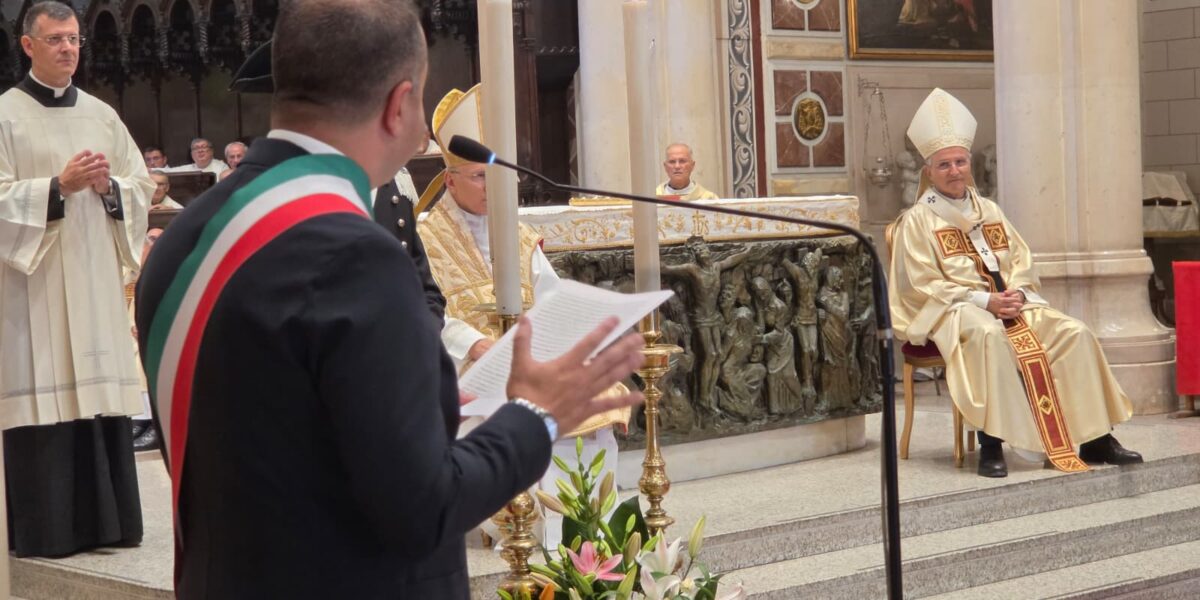
The full speech
Dear fellow citizens,
I would first of all like to address the grateful greetings of the city of Reggio Calabria to you, Most Reverend Excellency, who is presiding over this pontifical liturgy today. On behalf of the Administration and the entire citizenry, therefore, I would like to extend the warmest welcome to Monsignor Edgar Peña Parra in our community. Your presence here among us, on a day so deeply rooted in the history, faith and identity of the people of Reggio, honors us and makes this moment even more solemn; It makes us perceive the closeness of the Holy Father, and I ask you to bring him the affectionate and devoted greeting of this community, together with the request for his blessing for our beloved Earth. I greet our Metropolitan Archbishop, Monsignor Fortunato Morrone, the Reverend Metropolitan Chapter, the Clergy of the Church of Reggio and Bovia, the Archbishops and Bishops present. I greet all the authorities, civil and military, in particular His Excellency the Prefect of Reggio Calabria, Clara Vaccaro.
In greeting all of you gathered here today, I also want to address an affectionate greeting to the Bearers of the Vara, the shoulders on which Reggio rests its devotion, its history and its heart.
This year too, Reggio Calabria presents itself before its Lawyer and Mother, to make a gesture full of hope: the delivery of the votive candle, a sign that the people of Reggio have been renewing for centuries, from generation to generation, and which today, for the first time, I have the honor of carrying out as Mayor of this city. I do it with emotion, with a deep spirit of identity and with the burden of an important responsibility, which is that of the entire community that I represent. Indeed, I prefer to say we represent, in the plural, considering us all a small piece of a single entity. In front of our Patron Saint there is not a single man, there is not a single party: we are all there, the Administration, the institutions, the social forces, the associations, the many realities that make up our community.
These four days of Marian Feasts represent, more than any other moment, the time of unity. Unity of faith, of tradition, of generations, of sensations, of feeling. And we also find this same dimension of unity, respect and non-conflict on the political-institutional level: majority and opposition, despite their respective differences and roles, today place this flame together at the feet of the Madonna della Consolazione, a light that is consumed to illuminate. And it is perhaps the truest image of what every public service should be. Ours first and foremost.
Speaking of light, a beautiful light went out. This year, in fact, we place the candle with a deeply wounded heart, because precisely in the hours in which the city was preparing for the celebration, a tragic accident broke the life of one of our very young fellow citizens: Anthea Ranieri. Faced with pain like this, no words are enough. The community gathers around a single thought and relies on silence, prayer, respect and closeness towards family and closest friends. May the embrace of all of Reggio Calabria reach them today from this Cathedral. And our thoughts and prayers at this moment also go to Giovanni, who is struggling in a hospital bed. We ask our Patroness to be what her name says: Consoler; aware that consolation does not erase pain, but prevents pain from winning over hope.
Looking at the Sacred Effigy, we citizens also contemplate her, first of all as a Mother. And motherhood, even before a feeling, is a responsibility: it means guarding, watching over, taking care of those who are most fragile, not abandoning anyone. These feelings, mixed with great emotion, which I personally had the opportunity to experience, for the first time ever, during the coronation, a moment of profound trust in which I handed over under her maternal mantle and to her loving gaze all the responsibility to which I was called for our City.
For centuries the people of Reggio have turned to her, especially in moments of greatest trial, certain of finding a gaze that welcomes and protects. And from the awareness that motherhood is responsibility, a commitment is born for us: in fact, as the Mother takes care of her children, so we are called to take care of Reggio, its spaces, its neighborhoods, the people who live there, its potential and its problems. Because we love a city with devotion, as we love a mother: with gratitude for what she has given us and with the responsibility of giving her back what we owe her.
This cure must start where the city suffers the most. In this sense, I would like to dedicate a thought to people with disabilities and their families. A city is truly a city for everyone when no one is forced to ask permission to live in it, cross it, meet, participate. When accessibility is not an exception, but a normal condition of daily life. Because no one should feel on the edge of their city, neither emotionally nor logistically.
And inevitably, if we talk about fragility and hardship, my thoughts cannot help but go to the outskirts. In this regard, I would like to remember the example given by our archbishop, Monsignor Morrone, who wanted to start his ministry in the suburbs of Reggio, precisely in Arghillà. It was June 2021, and a few hours after his entry into the diocese he chose to meet the inmates of the prison and the parish community of that neighborhood. It was a sign that the city has not forgotten, and which gave everyone direction. Even the Administration that I have the honor of leading wanted to pay particular attention to Arghillà from day one, because, like you, Your Excellency, we are convinced that a community is measured by how it takes care of its edges… The future of our city passes through there no less than through the historic centre.
A value that must permeate the entire city is certainly legality, which is not just respect for the rules, but is the foundation of civil coexistence and the freedom of a community. A city is more solid when legality becomes daily culture, when respect for rules goes together with respect for people and when institutions, with their example, build communities. The institutions have a great responsibility: to be present, credible, close to the people; administer with transparency and a sense of duty, so that every citizen can recognize themselves in the institutions and once again have trust in them. In this task, obviously, we are not alone. It is a collective, daily work that we carry out in close synergy with the police forces: to the State Police, the Carabinieri, the Financial Police, the Penitentiary Police, the Local Police, the Fire Brigade, the Coast Guard, to all the men and women who work in the service of security every day, I address my infinite gratitude.
But the culture of Legality also affects another sphere of our daily life: for this reason I would like to express, on behalf of the City, heartfelt thanks to the priests of our Archdiocese and the parish communities, who every day are a defense of humanity, often precisely where the institutions struggle to reach. And with them I thank the lay people, the volunteers, the associations, who translate the faith into being there every day: a canteen, an after-school club, a listening center, a welcome. These are examples of civic commitment that comes from faith and which enriches everyone, believers and non-believers: for this reason I feel the need to say thank you.
During this year the Reggio Church greeted two priests who were extraordinary witnesses of this commitment: Monsignor Antonino Iachino, vicar general and for many years director of the diocesan Caritas, a man who dedicated his life to the poor and the least with the patience of someone who knows how to stop in front of those in need, without ever being in a hurry; Monsignor Filippo Curatola, Don Pippo for everyone, rector of the Seminary, parish priest of the Cattolica and for thirty-five years director of Avvenire di Calabria, who told the life of our land with an eye always turned to the truth and the common good. The gratitude of the entire Reggio community goes to both of them. The legacy of Don Pippo, then, reminds us that culture is a driving force for change: a city grows when it thinks, when it compares, when it knows how to discuss with respect even in differences. This is why I look with hope to the San Paolo Auditorium, which for many years in Reggio has been a place of cultural and political debate: I hope that it will be back in operation soon, and I wish to assure this diocesan community of the full availability of the Municipality to collaborate with the Archdiocese so that this hope becomes reality.
We are gathered today in a Cathedral which, in two years, on 2 September 2028, will celebrate the centenary of its consecration. We must remember that this temple was born from the rubble of the 1908 earthquake: our fathers, in a wounded and bent city, had the courage to rebuild, and to do so while looking into the distance. They wanted a building capable of resisting, the largest anti-seismic reinforced concrete construction that Italy had at the time. This Cathedral is the symbol of the rebirth of Reggio, but we know well that reconstruction is not a work that is done once and for all. Reggio needs continuous reconstruction: of its spaces, its services, but – even before that – of its social and moral fabric. It is a task that we must face with the same courage as our fathers, with trust, hope, enthusiasm, without ever letting ourselves be overcome by resignation. Rebuilding also means serving the common good. Two great figures of the Reggio Church precede us on this path: Monsignor Giovanni Ferro, pastor of this Archdiocese for twenty-seven years, who personally went to look for the poor on the streets, and who today civil memory also counts among the Righteous of civil society; and Don Italo Calabrò, to whom Monsignor Ferro entrusted those latter, and who people already consider a saint. We hope to soon see them both elevated to the honors of the altars, because their example teaches us that legality is freeing people from blackmail, restoring dignity, building opportunities, delivering a future, so that no one is forced to seek in illegality what a healthy community should guarantee to everyone.
Excellencies, fellow citizens, all faithful, in delivering this candle, I perform, on behalf of the City, an act of trust. I entrust the institutions and administrations of this territory to the Madonna della Consolazione, so that they govern well, with honesty, humility and a spirit of service. I entrust to her all our young people, who with pleasure I saw gathered in the joy of the celebration during the prayer vigil, during which they perhaps handed over their dreams and hopes to the Mother of Consolation, so that they can find here not only their roots, but also the reasons and opportunities to build their future, our future. I entrust the elderly to her, so that they are never left alone; those who have lost their job or cannot find it; the prisoners, so that they can start again; the families of Arghillà and all our suburbs. I entrust Reggio Calabria to you, our lawyer, so that under your maternal gaze our city can rise again every day.
We entrust the future of this city to our Patroness. A future that cannot only be expected, but that we must have the courage to build. Reggio has a new season ahead of it: the university, infrastructure, tourism, the ability to attract investments and new opportunities. But behind every project, behind every work, behind every administrative choice, there are people, families, young people who ask their city for one more reason to stay, to return, to build tomorrow here.
We entrust this hope to Our Lady of Consolation and, together with it, our commitment. Because a city doesn’t really grow when only its streets and buildings change: it grows when its citizens’ confidence in their own tomorrow grows.
Just as this candle will burn before you, our commitment is to burn in the same way, with fidelity, for the good of our people.
Long live Mary!