

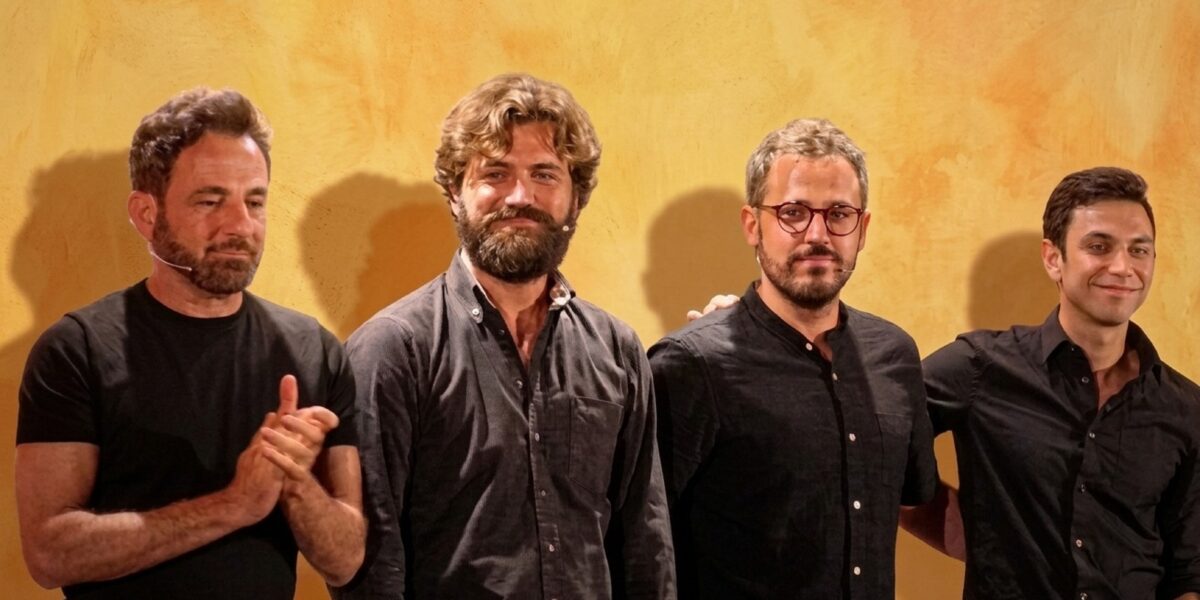
Leaving the abyss to rediscover the horizon: a typically human aspiration, of which Dante’s genius already indicated the way in the fourteenth century with the journey to Purgatory, the mountain in the middle of the ocean, where pain is not eternal condemnation, but a path of redemption through memory, music and poetry. One year after «L’infernu» Giampiero Cicciò brings the second cantica of the «Divine Comedy» to the Sala Sinopoli of the Vittorio Emanuele with the show «Lu Purgatoriu», the inaugural event of the 2026-27 theater season.
On stage the same actor from Messina, also curator of direction and dramaturgy, with William Caruso and Eugenio Papalia, and Marcello Conti on the piano. Four appointments (24-27 September, 1-4 October, 8-11 October and 15-18 October) for as many readings of the famous canticle, in the Sicilian translation by the Peloritan poet and critic Tommaso Cannizzaro. We talked about it with Ciccio.
Four appointments at the theater with four different shows. Need dictated by the vastness of the song or by something else?
«The division into four stages responds to a precise plan. The four appointments, each with three different songs from Purgatory, are marked as four stations of an inner ascent: from the shores of the landing after Hell, with the light and the sea, to the summit of the mountain. Through a progressive rhythm, we give the audience the opportunity to breathe and make time flow again for Dante. There is also the theme of transience, just like on earth. It is the sense of becoming and transformation that distinguish this wonderful song.”
Is the choice of reading in Sicilian a way to make our vernacular a noble language in the classical sense?
«Already Cannizzaro, when he published his translation of the ‘Divine Comedy’ in 1904, did not carry out a merely local operation, but wanted to return the work to the people who only spoke our language to pay homage to History. In fact, Italian poetry and the illustrious vernacular were born thanks to the Sicilian School; and this translation gives Dante a substance, a visceral expressiveness that resonates deeply within us Sicilians.”
Atone for a sin before contemplating the light of Paradise: a significant message in our times marked by the sins of some powerful people towards the human race…
«If Dante hurls the corrupt powerful into Hell, Purgatory is the canticle of redemption. Yes, there is a powerful civil invective – think of the everlasting cry ‘Ahi servi Italia, di pain hostel’ – but it is above all the work of empathy. The message is clear: face the arrogance and injustices of power by rediscovering the saving power of human bonds, the value of forgiveness and the ability to raise our gaze again.”
What is the show’s strong point?
«I would like it to be in the evocative power of the display. Together with two very talented actors, Eugenio Papalia and William Caruso, with whom I shared the vision and direction of this choral tale, and thanks to the compelling sound architecture of Marcello Conti’s live piano, we recreate a dimension where words and music intertwine to make every breath, every emotion of the journey resonate. We would like the audience to leave the theater with the awareness that understanding Purgatory means understanding ourselves.”
What can you tell us about your future projects?
«I will be among the protagonists of ‘The Madness of King George’ by Alan Bennett, a co-production between Teatro di Roma, Piccolo Teatro di Milano, Teatro della Toscana and Emilia Romagna Teatro, directed by Massimo Popolizio. I am happy with this third collaboration with Popolizio: working with him makes you feel protected, he is a rare talent in Italian theater today. And then in April, at the Spazio Diamante in Rome, there will be the eighth edition of the inDivenire Festival, created by Alessandro Longobardi, for whom I have been the artistic director since 2017 and which has become a central event in my work and in my life”.
Dates, times and songs
The show, included in the «Sala Sinopoli storie» series, is divided into four parts for a total of twelve songs. Part I, from 24 to 27 September, cantos I, II and V; Part II, from 1 to 4 October, cantos VI, IX and XI; Part III, from 8 to 11 October, cantos XVI, XXI and XXIV; Part IV, from 15 to 18 October, cantos XXVI, XXX and XXXIII. Thursday, Friday and Saturday at 6pm, Sunday at 11am.