

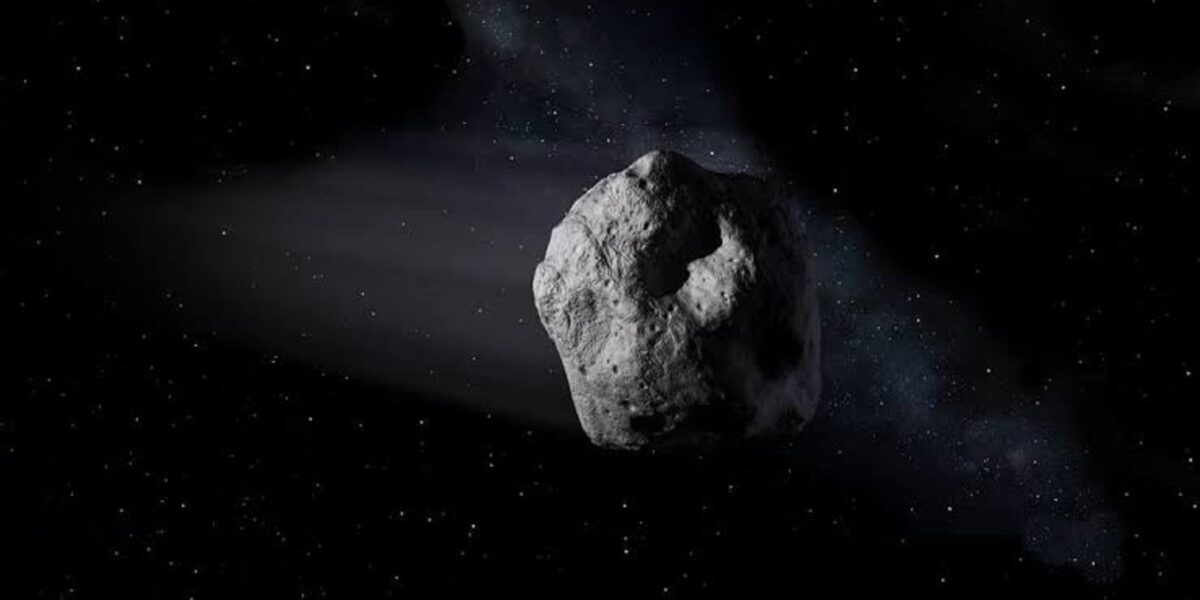
It will arrive on Halloween, but it won’t do any scary tricks on us: the asteroid 2025 UK9, with a diameter of just 3-7 metres, will pass close to the Earth around 3.35am on Saturday 31 October, reaching the minimum distance estimated at around 315 thousand kilometers (a value lower than the distance of 384 thousand kilometers that separates the Earth from the Moon). It will only be the appetizer of a much more interesting show that will be staged on November 2, with the passage of another larger asteroid that will also be visible from Italy.
The little Halloween asteroid
Of the two asteroids expected in the next few days, “2025 UK9 is the one that promises the closest passage, even if it is very modest in size”, astrophysicist Gianluca Masi, scientific director of the Virtual Telescope, explains to ANSA. “There is still some uncertainty about the time of the flyby, and also about the exact value of the minimum distance from Earth, because so far this asteroid has been observed little.”
Discovered on October 28, 2025 by the Mt. Lemmon Survey/Catalina Sky Survey program of the University of Arizona, this cosmic stone “was followed for only a couple of days: the orbital arc traveled in such a short period did not allow us to calculate exactly the position in which it would then find itself a year later”, points out Masi.
On November 2nd the passage of 2002 VE68
There is much less uncertainty about the other asteroid, called 2002 VE68, which will greet Earth at 8.10pm on November 2. «It has a diameter between 200 and 450 meters and will pass just over 600 thousand kilometers away, again calculated from the center of the Earth», continues the astrophysicist. Even this flyby shouldn’t represent a danger, but just an excellent opportunity to appreciate the show in the sky.
«Close to the moment of minimum distance from Earth, the asteroid will be observable at our latitudes: it will be very high in the sky, in the constellation of Andromeda, but it will not appear particularly bright. For this reason – concludes Masi – it will be observable with amateur instruments only through photographic recordings”.