

Google Discover

Preferred Sources
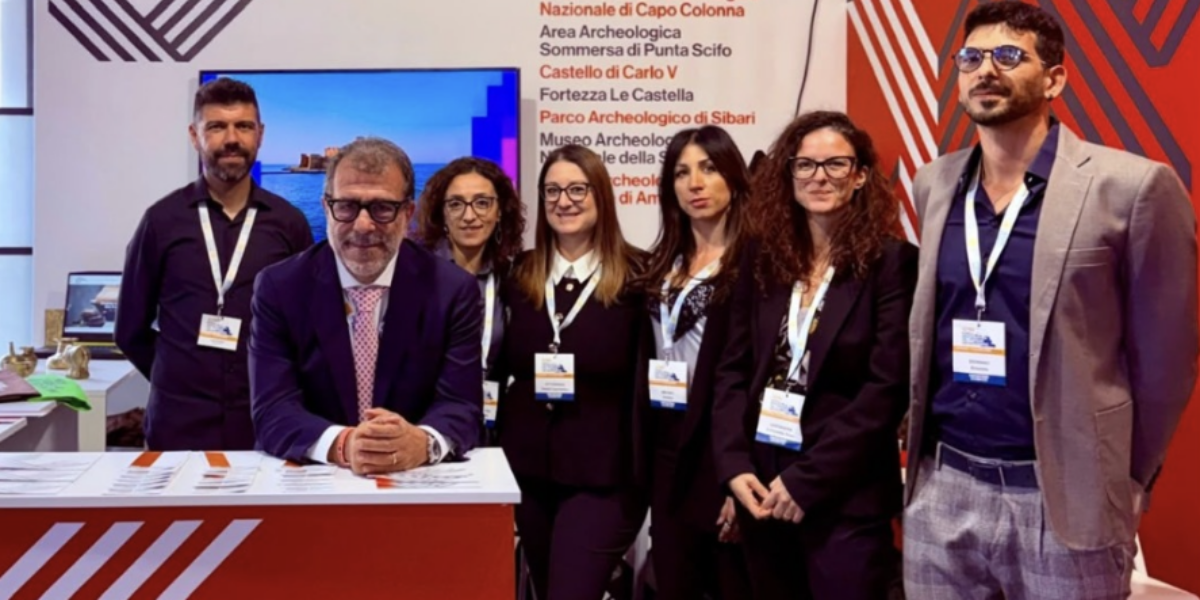
Local transport, accessibility and collaboration with the territory: the future of the archaeological parks of Crotone and Sibari, protagonists of the XXVIII Mediterranean Archaeological Tourism Exchange of Paestum, passes through these objectives. During the four days of the event, hosted in the spaces of Next, the former tobacco factory, the institute’s stand welcomed visitors, operators, scholars and school groups, while the director Filippo Demma participated in the tables dedicated to the management and valorisation of the heritage.
«The key words of our work continue to be sharing and accessibility, the latter understood not only in an economic or cognitive perspective, but above all in physical and logistical terms», underlined Demma. For the director, promotion must be accompanied by the ability to guarantee connections and build a sustainable and experiential tourism offer.
Ministerial support for fundraising
Among the events, the conference on the “Fundraising Project of the Ministry of Culture”, a pilot initiative promoted by the Department for the valorisation of cultural heritage, by the Central Institute for the economic valorisation of heritage and by Ales.
The Parks of Crotone and Sibari illustrated their strategies in discussion with ministerial representatives, including Alfonsina Russo, Fabio Tagliaferri, Alessio De Cristofaro and Carolina Botti. The Calabrian institute was selected to benefit from the operational support of experts appointed by the ministerial structure.
Le Castella, Capo Colonna and research in Locri
Demma and the architect Antonio Abbruzzese presented the restoration and refunctionalization interventions of the Le Castella Fortress, in Isola Capo Rizzuto, illustrating the work carried out to combine conservation and cognitive and sensorial accessibility.
The new archaeological investigations were instead at the center of the conference promoted by the Tourism Department of the Calabria Region, conducted together with the director of the Locri Park, Elena Trunfio. The results were reported by young researchers from the University of Bologna involved in the excavation of Locri directed by Demma.
At the round table organized by the European University Center for Cultural Heritage of Ravello, opened by president Alfonso Andria and coordinated by professor Fabio Pollice, the director then illustrated the new project for the valorization of Capo Colonna. In comparison with the managers of other autonomous sites in the Centre-South, space is also given to the public-private partnerships already consolidated in Sibari and being applied in the Crotone area.
«Networking and strengthening connections»
In the evaluation of the participation in Paestum, Demma indicated mobility as one of the issues to be addressed: «The real challenge for the future of our major attractors lies not so much in advertising promotion», but in the ability to «network the territory to guarantee the accessibility of the sites through an improvement of local transport». Finally, the director thanked the Minister of Culture Alessandro Giuli and Alfonsina Russo for their support, recalling the link between protection and development: «The inclusion of our Institute among the national pilot experiences for fundraising and the comparison of new management models demonstrate that the Crotone and Sibari Parks are today an innovation laboratory at the service of Magna Graecia and the entire country».