

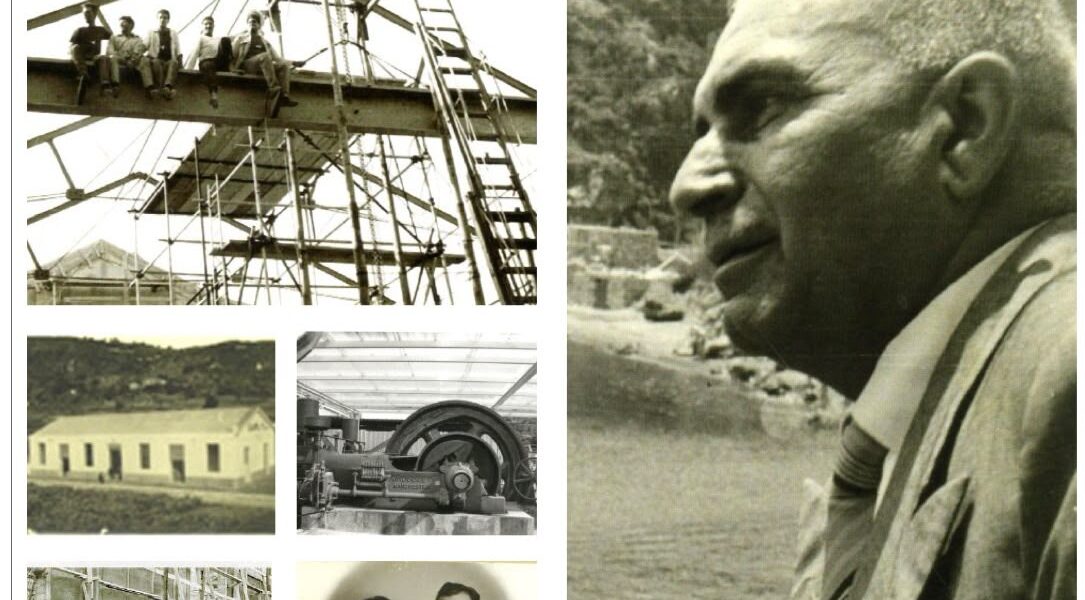
His name and surname are linked to an epochal fact: having brought light and electricity to Lipari. What everyone takes for normal and granted, such as pressing a switch and seeing a chandelier light up or inserting the cable into a socket and charging a mobile phone, has a narrative behind it in the Aeolian archipelago. It is that of Bartolo Zagami, who founded the Lipari Electric Company (SEL) in 1926, but which actually began much earlier, on 28 December 1908, when Messina and Reggio were devastated by an earthquake and a tsunami. Zagami was 8 years old and was in Alicudi. The book “Dream, Passion, Reality – The life of Bartolo Zagami in the history of Lipari” begins here, written by Silvia Campantico and published by the Aeolian Study Center. Alicudi, «a rock in the middle of the timeless sea», we read in the volume, with 800 inhabitants almost completely isolated, off the trade routes and reached by a ship once a week. The memories of that miserable reality generated in Bartolo Zagami “feelings of fear and rejection”, so much so that after leaving the island he never wanted to go back, “not even for a brief visit to his home”. His brother Salvatore was in Messina during the earthquake, his father Bartolomeo went to the shores of the Strait to look for him. The son, rescued, was then miraculously found alive in a Palermo hospital after about a month. In 1909, the Zagami family moved to Messina, moved by hope and confidence in the future. He bought two of the barracks built in via della Croce Rossa and contributed to the reconstruction of the city.
In 1917, Bartolo Zagami, who attended the engine section of the Nautical Technical Institute, was called to the front, in the Bersaglieri Corps. Luckily for him, the war ended before he was called to fight. He graduated in Messina with top marks and was admitted to the Naval Academy of Livorno, then he embarked as an engineer officer of the Regina Marina on the Battleship Duilio. After three years, he returned to Messina again and passed the public competition to become an employee at the Customs. But, even though he was first on the list, he refused the position. In the meantime, on 8 September 1923, in Lipari, he had met Iolanda Saltalamacchia, who would become his wife.
Meeting, challenge and project
That very day, the two spent a day of celebration in Quattropani. «The exchange of a glance – it is said in the book – was the beginning of a great love that lasted a lifetime». They married on 18 December 1926 and from their union Maria, Rosa and Bartolomeo were born. Returning to that day, while the men were playing cards and at first darkness it was necessary to turn on the lamp, Bartolo Zagami said to Mr Saltalamacchia: “Aren’t you ashamed to be on such a beautiful island with a lamp?”. “You put it if you’re so clever,” was the reply. «Yes, I put the light on in Lipari», replied the young man, taking up the challenge. The challenge turned into a dream and the dream into a project. Returning to Messina, he expressed his desire to his father, asked him to lend him the money, but was refused. He borrowed one hundred thousand lire from a paternal aunt who emigrated to America, necessary to start the work. Studies and research followed for the construction of a power plant in Lipari. Already in 1923, a small power plant had been installed in Santa Marina Salina. Oil lamps and candles were expensive and only some areas of Lipari were equipped with public lighting. Bartolo Zagami found partners: Carmelo Biscotto and the brothers Giuseppe and Angelo De Luca.
The creation of Sel
On 29 April 1926, Sel, the Lipari electricity company, was established. Subsequently, Bartolo Zagami bought the members’ shares and from 1948 he was the only one to lead it, while from 1957 he was supported by his son Bartolomeo. The Municipality granted without compensation the right to occupy free of charge the soil, the above ground and the subsoil it owned in the streets and squares for the distribution of electricity, on the condition that transit in those areas was not prevented or hindered. The planned lighting consisted of 346 lamps (282 in Lipari and 64 in Canneto). On 3 January 1926, Iolanda Saltalamacchia laid the first stone for the construction of the power plant in the Marina Lunga area. And on September 26th the light was turned on. In just 9 months, the power plant that produced electricity, the distribution networks and some domestic systems were built, ready to bring progress into homes. Zagami also thought about strengthening production. A third engine was transported from Milazzo with a steamship that made daily connections with the Aeolian Islands. To transfer it to land, a wooden slide was built and the load was hauled by oxen and men to the Marina Lunga power station. «The power plant, conceived and built with simplicity, represented one of the first examples of organized enterprise on the island».
When the Second World War broke out, Zagami was called up to arms and the entire family moved to Messina, then to Acquedolci and Rodia. The father-in-law left a boat from Lipari with a crew of five to reach the beach of Rodia. So, together with their family members, they undertook the crossing to return to Lipari with a simple rowing boat. Despite the harsh conditions caused by the war, the power plant transformed Lipari from an unknown island to a tourist destination and industrial site of international importance. The demand for electricity also increased from private users. From 1955, it was necessary to supplement the existing equipment with other 500 horsepower engines. In 1959, the electrification of the hamlets was considered, starting from those of Pianoconte and Acquacalda, to cover the whole of Lipari. Zagami developed the idea of a new power plant with two engines of 1500 horsepower each. The Lipari power plant thus became an important entrepreneurial reality.
On 27 December 1965, Bartolo Zagami was appointed Commander of the Order of the Republic (“he was so sober that he hadn’t told anyone that he was going to the award ceremony”, as highlighted in “Dream, Passion, Reality”) and on 14 June 1967 the Messina Chamber of Commerce awarded him a diploma and a gold medal for having contributed to the economic progress of the island. Three years after the birth of the new power plant, another 2000 horsepower engine was installed and around 1970 it was expanded to be able to integrate another one. «Every two years a thermoelectric unit was added until reaching approximately 27,000 hp. The convenience of using the first household televisions was experienced in the Aeolian Islands. All this thanks to the “lord of light”, to whom, moreover, in 2009, the Municipality of Lipari dedicated a street, following input from the Board of Directors of the Rotary Club. The book then says that «despite the passing of the years, he maintained his constant commitment as an administrator, a role he shared with Dr. Bartolomeo Zagami”. Another example of his talent was the creation of an ice factory, which before the 1950s was transported in blocks from Milazzo and sold retail. But it often arrived loose and turned into water in the summer. So, Zagami built a factory near the power plant. Ice production continued until 1963, when the plant closed its doors.
The illness came and he spent the last years at home because he was very ill. He suffered from a bone disease. Commendatore Bartolo Zagami died on 30 September 1989 and the funeral was celebrated on 2 October. The workers of the power plant dedicated the following words to him: «The workers and collaborators of the Lipari electricity company mourn the passing of the unforgettable master of life comm. Bartolo Zagami and in memory of his goodness, affability and great availability, join moved to the pain of the doctor. Bartolino and all his family members.” In the volume dedicated to him we read verbatim: «The man of light had gone, but Lipari no longer remained in the dark».
The man with the jasmine in his mouth
Bartolo Zagami had a passion for roses and jasmine, which he also cultivated in the courtyard of the power station. When he went to Messina, he brought with him suitcases full of flowers which he partly sent to churches and votive chapels. «Taste it, feel how sweet it is». Her granddaughter, Vera Zagami, thus remembers her grandfather Bartolo, who invited her to taste the nectar from the base to the stem of the jasmine. In that gesture, the grandfather contained his essence: testing himself, doing, living firsthand, taking on challenges. Again the granddaughter, in the final part of the book, writes: «He had his lights and his shadows like each of us, but it is precisely the immense light that emanates from special people that makes you appreciate even his shadow. He knew how to keep the helm in all the storms that hit the family, he was the point of reference for children and grandchildren with few words and many, many examples. For me he will remain the man with the jasmine in his mouth, my interlocutor in moments when I need an attentive silence that almost becomes advice.”
The 100 years
Today marks the centenary of the Lipari electricity company (26 September 1926 – 26 September 2026). In addition to its historical value, Sel still represents a fundamental resource for the territory today, as the only large company on the island of Lipari that guarantees stable work for 50 direct employees, in addition to the important local satellite industries.