

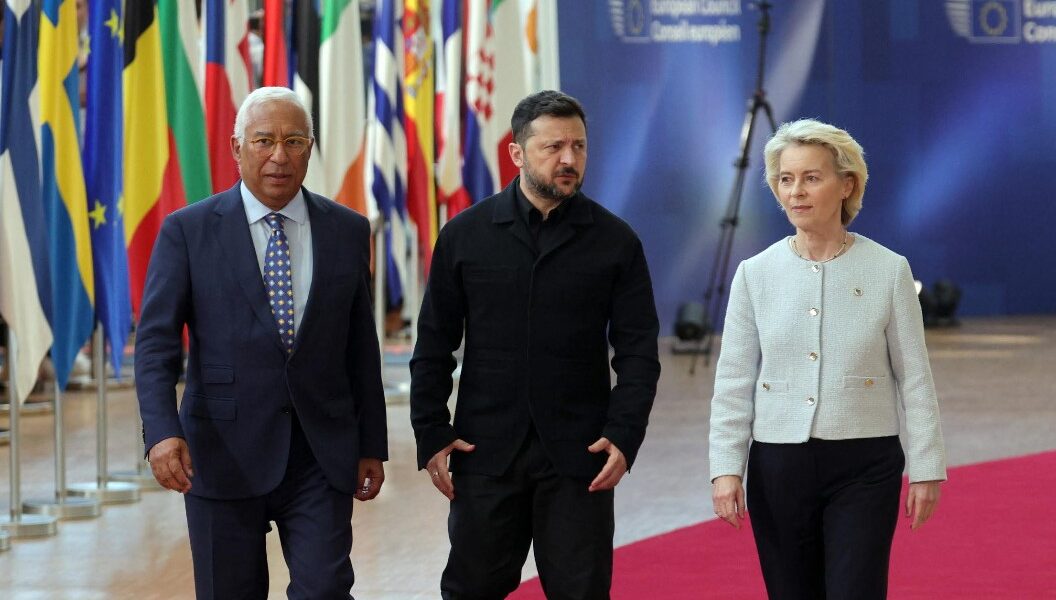
A day of historic turning points, vitriolic declarations and new strategic alliances on the Brussels-Kiev axis. The European Council marks a political point of no return: Ukraine has officially opened the first negotiating cluster for membership of the European Union. A technical step, but with enormous political value, because it was approved unanimously for the first time by all 27 member states. The end of Kiev’s negotiating isolation coincides with the new European political scenario: for months the Ukrainian dossiers had been frozen by Hungary’s veto or approved with the acrobatic formula of 26. Today, thanks to the recent internal electoral defeat of Viktor Orbán, Europe is rediscovering itself as united.
“Unanimity is a great result”
The moment was marked by a joint press point in Brussels which saw Ukrainian President Volodymyr Zelensky flanked by the President of the European Council, Antonio Costa, and the President of the EU Commission, Ursula von der Leyen. «The first cluster group for membership has been opened, thanks to all the leaders for the unanimity. Unanimity is a great result”, began Zelensky, visibly satisfied. «Today we will discuss the next five clusters, historical steps for Ukraine». Strong applause also came from Ursula von der Leyen, who openly congratulated the Ukrainian leader by relaunching the timetable: «We hope that other clusters can open during the summer. When Ukraine keeps its commitments, we must also keep ours.” The president of the Commission then outlined an optimistic assessment of the conflict on the field: «The tide is changing. Ukraine is holding the line, it is even partially reconquering some territories, it is experiencing a very positive phase.”
Very high tension: “If Ukraine burns, Moscow will burn too”
If the European diplomatic front smiles, the military climate remains incendiary. On the sidelines of the summit, Zelensky used harsh words to comment on the recent sensational Ukrainian drone attack that hit the Moscow oil refinery. A raid that the Kiev leader claimed as a direct response to the Russian bombing of the Kiev Caves Monastery, one of the most important historical and religious monuments in the country.
“If Ukraine burns, Moscow will burn too,” Zelensky warned firmly. «If Putin does not want to end this war and wants to continue it, we will not stand by and watch, we will react. At the European Council and the G7 we will talk about air defense and how to push Putin to dialogue for a ceasefire.”
The military axis with Germany against ballistic missiles
Adding to the long-term security of Ukrainian defense is an important industrial and military agreement signed in Brussels, on the sidelines of the meeting of NATO defense ministers. Germany and Ukraine have laid the foundation for the joint development of an advanced air defense system against ballistic missiles. The German Defense Minister, Boris Pistorius, confirmed the signing of the protocol, underlining how the field experience acquired by the Ukrainian units is now an added value for the West: «Several German companies are interested in this project. It can represent an important contribution to security in Europe and Ukraine,” Pistorius explained. “Our partnership is not a one-way street, and hasn’t been for a long time.”