

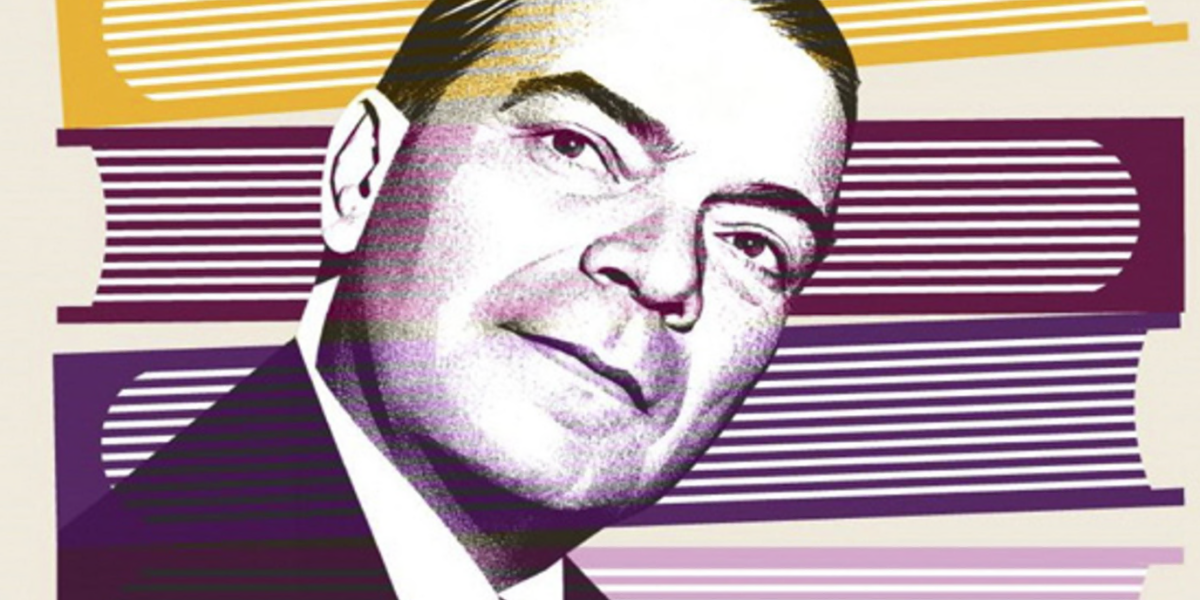
It is the year of Corrado Alvaro: a Calabrian and European author, who somehow needs to be brought home and yet taken out. His multiple activities, his outlook, the strength and relevance of his ideas will be at the center of the conference «The anthropologies of Corrado Alvaro. Writing from within, writing from afar”: tomorrow and Thursday, scholars and writers, journalists and artists will discuss this topic at the University of Calabria, in a conference organized by the Dea “Lombardi Satriani” Center of the Department of Political and Social Sciences, with the patronage of the Calabria Region. Among the speakers Giulio Ferroni, Massimo Onofri, Vito Teti, Pasquale Tuscano, Mario Sechi, Fulvio Librandi, Francesca Tuscano, Franco Baldasso, Annarosa Macrì, Filippo La Porta; and then the writers Angela Bubba, Domenico Dara, Demetrio Paolin, Olimpio Talarico and the director Michelangelo Frammartino. The idea is to look at Alvaro from a broad and transversal perspective, involving, alongside the most authoritative voices of criticism and anthropology, also writers and artists. In this sense, the presence of Ascanio Celestini will be particularly precious: tomorrow evening at the Tau (Teatro Auditorium Unical) «A closed fist will be performed, with free admission. Fragments of a restless discourse”, a show written for the occasion, with music by Ettore Castagna.
We talked about it with two of the organizers, professors Vito Teti and Fulvio Librandi.
Prof. Teti, why can Corrado Alvaro also be considered an anthropologist? And how can we define this “writing from within, writing from afar”, which are the perspectives that, today, dramatically question us, in our search for the meaning of places, of living, of defining what and where we are?
«Corrado Alvaro, together with Silone and Pavese, and like Pasolini, is one of the greatest anthropological narrators of the twentieth century. His works and his writings constitute, for anthropologists, a precious mine of sources and knowledge on the cultures, environments and landscapes in which his characters act. Alvaro is careful and punctual in capturing words, sounds, noises, languages of a popular ethos that he always describes with an anthropological posture. But Alvaro is an anthropologist in the most meaningful sense of the term: he is interested in the behaviors and values of men more than the plot itself, and his works are rich in anthropological reflections and considerations. We must still remember the traveler-anthropologist Alvaro, whose travel books are true ethnographic works, and the “small” works in which he deliberately becomes a demologist and ethnographer. The anthropological gaze allows Alvaro the transition from mythos to reality, from childhood to the present in which he writes, and thus manages to be simultaneously external and internal, far and close to the world he narrates and inhabits. In this period in which we are busy defining, moment by moment, “where we are” (as Latour said), Alvaro is surprisingly contemporary and profound.”
Prof. Librandi, in the title of the conference anthropology is in the plural: «The anthropologies of Corrado Alvaro». Why?
«With the term “anthropologies” we do not only refer to the documentary scope of Alvaro’s texts, and we do not in any way want to close this writer into a disciplinary enclosure. The term, used in the plural, aims to recall the plural vocation of these studies, designed to bring together different perspectives; in our case, the ways in which Alvaro looked at his worlds. The writer from San Luca recounted real places and places of memory, and he did so in many registers: as a narrator, as a poet, as a journalist, as a traveler, as a translator, as a man of theater and cinema. In all of them, telling was a way for him to understand. This is why we wanted a conference with many voices: literary historians and critics, sociologists, anthropologists, writers, journalists, film historians, directors. This is the specificity of the Arcavacata meeting: seeking, among different perspectives, reasons for convergence and spaces for hybridization.”
Prof. Teti, Alvaro was a writer, essayist, playwright, screenwriter, journalist: how many Alvaros are there, and in what do they find a powerful unity that we can point to as an example of reflection on reality and planning for change?
«Alvaro has the fortune of experiencing the end of a solid and well-defined world and of witnessing the birth of a globalized civilization dominated by technology. He is suspended between two “ages”, between the world of fathers and the world of children, country and city, South and North, and often presents himself with many faces also in life, in “character”, as well as in writing. The painful awareness of belonging to two worlds – the first, where he cannot and does not want to return; the second, which he does not accept and in which he does not recognize himself – makes him an original author, who moves between pain and hope. Whatever form of writing he adopts, Alvaro is always interested in people, their anxieties, their contradictions and the contexts within which they are “forced” to act or those where they choose to live. At the center there is always the character-person who tries to assert a presence in the world. Perhaps restoring centrality to the “person” (with their weaknesses and fragilities, their anxieties and uncertainties), far from the mythologies of technology and always with a “village” in the memory, is one of the main “lessons” that Alvaro gives us.”
Prof. Librandi, what “grammar of Calabria” can Alvaro give us today? And how can we make it a European legacy?
«A grammar that serves to tell the future. There is a passage from People in Aspromonte that I often find myself commenting on with my students. Faced with a disappearing civilization, Alvaro, who has a visceral, albeit tormented, relationship with his land, writes that “there is no point in crying”: those who were born there must obtain as many memories from it as they can. It is a phrase that still surprises: it does not ask for nostalgia or regret for the past, it asks for it to become a nursery of new things. Memories, like grammar, are tools: they help us understand what in that world deserves to be carried forward and what can be let go. This applies, for example, to the Calabria of the countries that are emptying: it is not saved by regret, nor by an identity to defend, but by the ability to see, in the crisis, not only what ends but above all what is transformed. And it concerns everyone: those who stay, those who leave, those who arrive, those who return. As for the European legacy, Alvaro contracts a debt with the land of his childhood and repays it in the books he writes throughout his life. Meanwhile he crosses worlds: he lives in Rome, Paris, Berlin, he writes from Russia and Turkey. He recounts the distant, and often measures it with eyes that were formed in the South: in Türkiye, in the nomads and shepherds, he recognizes the same human events of his Calabria. It is the most profitable way of talking about identity. The fullest sense of this word lies in growing through addition, never through rejection of the other. Alvaro nourishes his past and feeds on it, and it is precisely this loyalty that de-provincializes him, that makes him a citizen of the world. What is Europe today, if not a necessary tension between a memory that is more common than we perceive and a future that is already in the facts? Our boys and girls already live it: they are, without contradiction, Calabrian, Italian and European together.”
We expect a lot from this conference: a trace, an indication, a route, or many, so that Alvaro is always more than everyone else. From inside, from afar.