

“But what does the future mean?”
Ligabue entrusts this question to the voice of a child who will never know the answer. “When are you coming to pick me up?” it is one of his most painful pieces, in which the narrator is one of the children involved in the massacre of the kindergarten in Dendermonde, a small community in Belgium. In a few minutes, an attack inside the “Fairytale Land” nursery transforms a place dedicated to the carefree nature of children into a scene of sudden and unimaginable violence.
It’s the early morning hours of January 23, 2009, and a young man named Kim De Gelder wakes up, covers his face in white makeup and fills his backpack with objects, including three kitchen knives, a hatchet and a fake gun. He takes his bicycle and leaves the house. Ligabue imagines that in the meantime, in a house not far away, it is a child who wakes up and throws a tantrum, like all children.
“My mother who insisted that I eat breakfast / and she knows that in the morning my stomach closes / I pretended to be tired, I pretended to be sick / she doesn’t fall for it anymore and I don’t avoid kindergarten anymore”
The singer-songwriter imagines the thoughts of a child on an ordinary morning, as he tries to convince his mother not to send him to kindergarten, just to stay with her. And all that remains is to think: if only that day he had convinced her. Instead, his mother takes him to nursery school, and sings him a song in the car, in an attempt to put him in a good mood before leaving him there, like every morning, unaware of the fact that she will never see him again. Shortly after 10 in the morning, De Gelder enters the structure on a bicycle, through an automatic sliding door. He is a twenty-year-old boy, very thin, with a white face, black-rimmed eyes and red-dyed hair. He begins to wander the corridors, apparently without finding anyone, so much so that he is one step away from giving up his ferocious intent and leaving. Then, he runs into an educator, Rita Van Geyte. He approaches her with a knife hidden behind his back and says “I have a question, can you help me?”.
“And the teacher seems much more nervous today / I don’t know if it’s our fault or if she feels who knows what”
The story of the little protagonist of the song continues, who notices the teacher’s agitation, almost as if he had a premonition of what would happen shortly thereafter. The unfortunate meeting between De Gelder and Rita Van Geyte is followed by a rapid and devastating escalation, which begins in the kindergarten kitchen. Here the attacker attacks the teachers, wounding them with a knife. One of them, Marita Blindeman, loses her life. But the author of this horror doesn’t stop and heads towards the games room.
“And then it was like when they turn off the light / and the teacher screamed as if with another voice / if we don’t stay calm maybe the black man will come / I vomited first and now he’s really here”
Here, eighteen children are playing peacefully, innocent and happy, as any child deserves to be in what should be an environment of leisure and growth. A growth that was brutally denied to two of them: Leon Garcia-Mannaert, eight months, and Corneel Vermeir, nine months. This is where the refrain comes in, the moment in which the child’s voice stops telling and starts asking. A series of naive and innocent questions, which are repeated until they become unbearable because they will never receive an answer.
“When are you coming to get me? / When does school end? / When will we go home together again? / When are you coming to get me? / Give me your word / Come a little early, surprise me”
That surprise won’t come, school won’t end. And that question will remain suspended, like the voices of Leon and Corneel, torn from life on a morning that should have been like all the others. Ligabue doesn’t explain, he doesn’t comment, he doesn’t look for meaning where there isn’t any. Entrust everything to the voice of a child, to his absolute trust that someone will come for him.
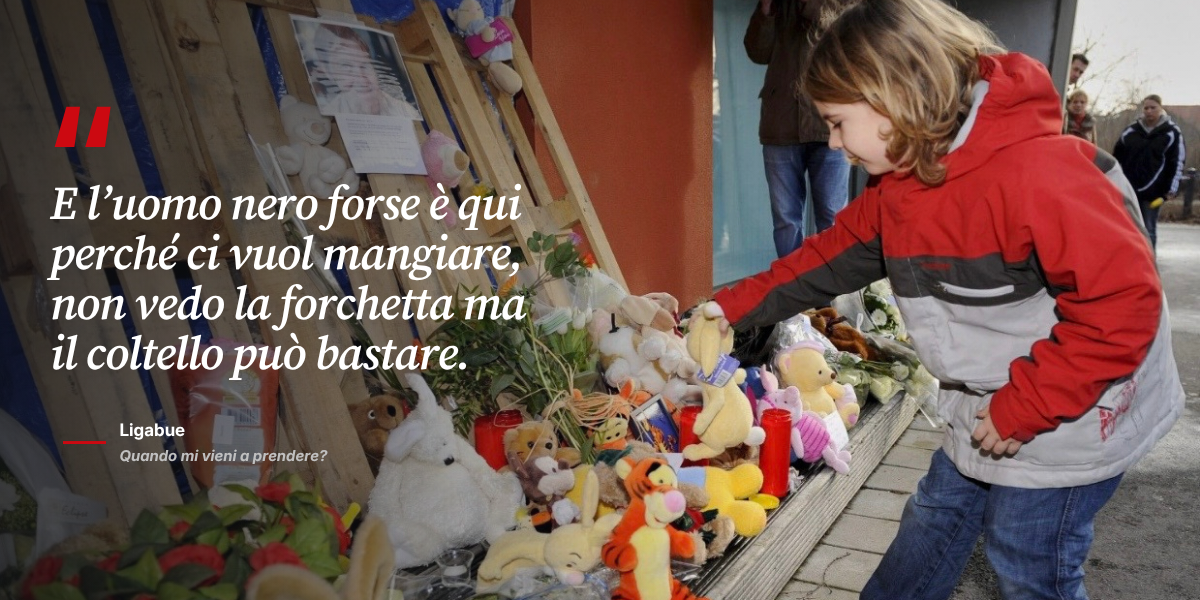
“And maybe the black man is here because he wants to eat us / I don’t see the fork but the knife may be enough (…) / and the teacher is now lying down, sleeping / my friends are screaming, someone is laughing / there are the sirens and they are getting closer / what enormous games that the black man can organize / my friends are now just screaming / and all of them together it’s really me who is watching”
These images describe the central moment of the attack, in which terror dominates: the children screaming, the teacher on the ground, the sirens approaching. A small but devastating detail: in the midst of chaos, he is the center, everyone looks at him. He doesn’t know it yet, but it’s the last time they’ll be able to see him. About an hour after the attack, De Gelder was arrested in the town of Lebbeke, while he was heading to another kindergarten. He had with him a list of other structures to hit. The final toll is devastating: three people lose their lives, Marita Blindeman and the two children, Leon and Corneel, while ten children and two teachers are injured, some very seriously. Investigations reveal that De Gelder was a young Belgian with a history of depression, psychotic episodes and suicide attempts. Psychiatrists evaluate him as suffering from a personality disorder with psychopathic traits, but considered capable of understanding and will at the time of the events. In 2013 he was convicted and sentenced to life in prison, only to be transferred to a high-security forensic psychiatric system.
Justice has taken its course. But no sentence brings the victims back to life, no sentence answers that question left hanging in the air. “When are you coming to pick me up?” it’s a song that doesn’t console, it does something more difficult and necessary: it gives a voice back to those who haven’t had time to grow.