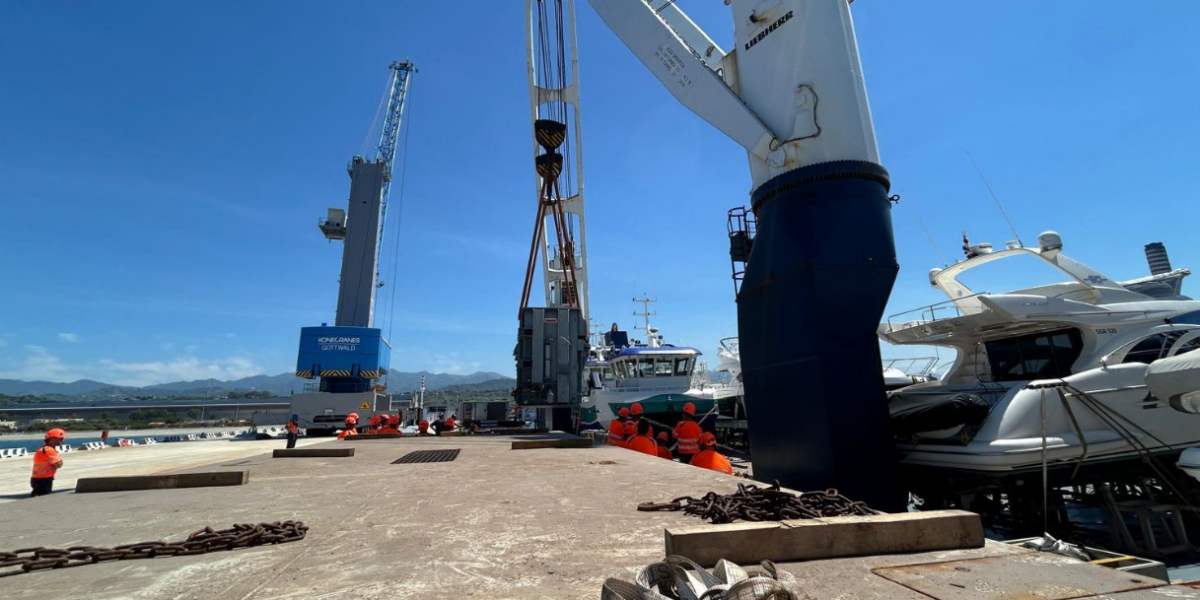
The true effect of the Giammoro pier, which only came into operation last May, will not be measured only in the number of ships that dock, containers handled or goods that pass through the quay. The most important game, and also the one that most affects the territory, will be played a few hundred meters further on, inside and outside the gates of the industrial area: how many new investments will the Giammoro hub be able to attract, how many companies will be able to settle in, what services will be created and above all how many jobs can be created directly and through related activities. In this sense, there could also be benefits for the relocation of the approximately 40 workers from the former steelworks who are at high risk of dismissal after having rejected alternative hypotheses.
The entry into operation of the terminal and the start of international connections have in fact changed the prospects of an area which for decades has been identified above all with the steel industry. The presence of an international operator such as the Danish Maersk today introduces a new variable: Giammoro can become not only a departure and arrival point for goods, but a logistics platform capable of connecting the Sicilian production system to national and international markets. It is a transition that could have significant consequences on the entire Valle del Mela. Maersk has started services at Giammoro by inserting the terminal into its network and connecting it with Cagliari and international routes. A choice that has a precise industrial significance: bringing a logistics capacity directly to the territory which until now, for many Sicilian companies, required the use of other ports and therefore further land transfers. And the technical characteristics of the new terminal seem to broaden the field of possible activities. Maurizio Miduri, director of Duferco Terminal Mediterraneo, highlighted how the pier is also equipped for the handling of fruit, a segment which until now had not found an adequate structure in the area.
But above all he recalled its multimodal nature: the terminal is connected to the railway, while the motorway is just four kilometers away. A set of conditions which, in the manager’s intentions, can make Giammoro a true logistics hub serving businesses. The project therefore does not only concern container traffic. The terminal was designed for a diversified movement of goods and this significantly broadens the possible prospects. Containers, general cargo, bulk and special cargoes can fuel a growing demand for services and, consequently, create space for new entrepreneurial activities. The first effect could concern road transport. More goods moved means a greater need for connections between the terminal, local companies, distribution centers and destination markets. But around port traffic there is a much broader supply chain: freight forwarders, maritime agencies, customs operators, logistics companies, handling companies, depots, warehouses, vehicle maintenance, specialized workshops, security services and IT activities for the management of goods flows. This is the point on which Giammoro’s real challenge focuses. A port, alone, does not create an economic system. It does this when a network of companies develops around the port capable of using the infrastructure and transforming the passage of goods into added value. At full capacity, the terminal has been indicated with a direct employment capacity of approximately 50 employees. But if traffic were to consolidate and increase, the employment effect could extend far beyond the perimeter of the port concession. Drivers and logistics operators will be needed, but also technicians, maintenance workers, mechanics, handling workers, administrative staff, experts in customs procedures and figures specialized in supply chain management.
And then there will be all the so-called related activities: from catering to business services, from industrial supplies to maintenance, up to professional activities linked to the growth of commercial traffic. The decisive step will be to understand how much of this new demand will be able to be satisfied by local companies and workers. One of the most interesting opportunities also concerns cold logistics and, more generally, the agri-food sector. The possibility of moving refrigerated containers can become an important element for Sicilian companies, allowing them to organize the export of products destined for national and foreign markets more efficiently. Miduri’s reference to the possibility of moving fruit also acquires particular weight in this perspective: it is not just a question of moving goods already produced, but of creating the logistical conditions so that new sectors can use the port.
The issue, however, is to understand how much of this value will actually remain in the area. It is the central question that accompanies this new phase. If the containers arrive in Giammoro to be immediately transferred elsewhere, the local economic effect will inevitably be more limited. However, if logistics platforms, warehouses, processing activities, services and new businesses grow around the terminal, the port will become a true multiplier of development.