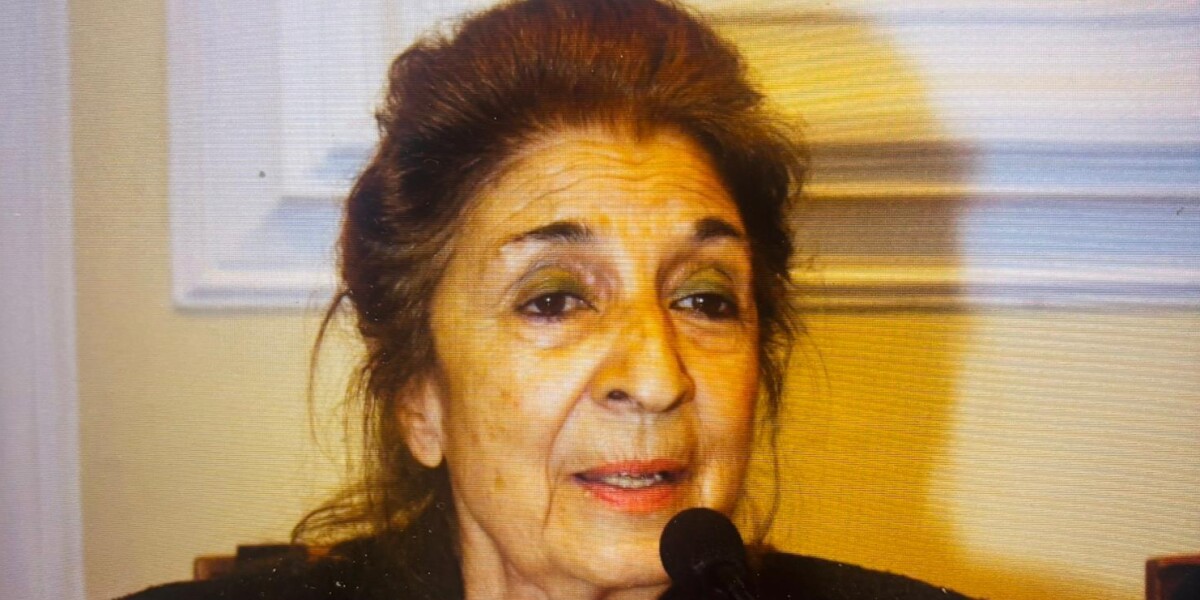
Great and recognized art historian, militant and passionate critic, but also explorer in the field (even in the Tirone district of Messina, for example), often looking for paintings and sculptures forgotten in small churches in Sicilian villages and then saved through restorations that she herself had requested.
Teresa Pugliatti, who left us at the age of 92 in the middle of the other night, was this and much more as evidenced, for example, by the two pianos that stood in the house in Panicastro, near Patti, which until 2022 she had shared with her late life and art study partner Luigi Ferlazzo Natoli, former dean of the Faculty of Economics and Business at the University of Messina and art critic of this newspaper. After a fractured femur he was in the “Don Orione” rehabilitation facility.
She, as evidenced by her surname, was born “noble” in the cultural sense of the term, being the daughter of Salvatore, a distinguished jurist and cultured humanist, an expert in literature and painting, who in his time was the magnificent rector of the University of Messina. A relationship of which she was proud, but which – as she said – caused her to receive unsolicited benefits and misplaced envy. A relationship which, in any case, had taken her straight into the world of art (her moving stories about her father who had promoted Antonello’s great exhibition in Messina in 1953) until she graduated in her city as a student of Alessandro Marabottini.
The fact is that to perfect her status as a full professor she was “forced” to emigrate to the University of Palermo, where she taught until her retirement. The quality, even human, of her teaching is demonstrated by the volume “Writings on the history of art in honor of Teresa Pugliatti” which her students dedicated to her in 2007.
With a frank character which, under the elegance of her manners, sometimes led her to sharp judgments and counter-current opinions, Pugliatti, among other things, clearly and almost alone contested the attribution to Antonello of the two-faced tablet recently stolen from the Messina Museum. After all, he had dedicated one of his over two hundred essays to his illustrious fellow citizen. “Antonello da Messina. Rigor and emotion”, published by Kalos in 2008, examines the geometric and spatial rigor of the painter and his innovative use of perspective, making a very precise reference to Piero della Francesca. An idea that was then captured in the (very beautiful) exhibition that the Mart of Rovereto dedicated in 2013 to the author of the Polyptych of San Gregorio, so much so that it was highlighted in the catalog without (so I remember) mentioning Teresa Pugliatti. Of his intense non-fiction production, at least some key works should be mentioned, such as the two volumes of “Sixteenth-Century Painting in Sicily”, published by Electa Napoli and dedicated one to the western part of the island and the other to the eastern one. And again the two most recent volumes “Symbolism in European painting. From the Pre-Raphaelites to Art Noveau”, published by Magika, where, in addition to theorising a critical link between the Mannerism of the sixteenth century and the Symbolism of the late nineteenth century, he had backdated the beginning of the latter current precisely to the Pre-Raphaelites.
An indisputable international scope which has never prevented Pugliatti from taking a personal interest in Messina’s artists. I remember her commitment, with competence mixed with great passion, as curator, in the early years of this century and together with Ferlazzo Natoli, of exhibitions in the Monte di Pietà and in the Atrium of the University. And I also remember her as the author of over forty “Profiles of the Artists” in Ferlazzo Natoli’s book “Contemporary Art in Messina (1980 – 1997)”, published by Intilla. He noticed how the painters and sculptors of our city had not stopped in their research. And he asked himself: “But does the city know?”, a question that is still contemporary today. The result was a series of very well-argued notes, in which critical acumen never put sentiment aside, and written with a Vasari-like, biographical and critical criterion, therefore always pleasant to read.
Finally, it should be remembered that in 2020 he donated his personal library (over 25 thousand volumes) to the cultural center of the University of Messina.
The funeral will take place tomorrow Monday, at 4 pm, in the church of San Giuseppe, in via Cesare Battisti.
Gazzetta del Sud’s condolences to his family and in particular to his sister Paola.