

There are two of the many significant sentences left by Man Ray in his writings, which more than the others seem to enunciate an artistic creed to which the American photographer (but also painter, sculptor and more) (Philadelphia, 1890 – Paris, 1976) has always adhered. The first is: «I paint what cannot be photographed and I photograph what I do not wish to paint»; the second is: «I simply try to be as free as possible in my way of working, in the choice of subject. No one can impose rules or guide me. They can criticize me later, but it’s too late, the work is done. I tasted freedom.”
Above all, it should be seen in this way, as a hymn to artistic freedom, the retrospective that the Palazzo Reale in Milan is hosting until January 11th. Entitled “Man Ray. Forms of light”, the exhibition is promoted by the Municipality of Milan – Culture, is produced by Palazzo Reale and Silvana Editoriale and is curated by Pierre-Yves Butzbach and Robert Rocca: three hundred works including vintage photographs, drawings, lithographs, objects and documents.
The exhibition itinerary covers the artist’s entire creative and human parable. We begin with the “Self-portraits”, in which Man Ray enjoys questioning his own identity. The next section is fundamental, “Muse”, dedicated to the women who were close to him in life and in front of the lens (from Kiki to his wife Juliet Browner), followed logically by “Nude”, treated, as the curators say, as «abstract forms, symbolic fragments and compositions of light».
“Rayografie” collects examples of the technique in which objects are engraved directly on the plate, and of the other, the so-called solarizations, which tell of his constant hunger for research. “Fashion”, then, confirms his ability to be himself even when he worked on commission (with Coco Chanel and Elsa Schiaparelli, among others), thanks to the quality of always going beyond what his contemporaneity dictated. The “Multiples” follow, together with the “ready-mades”, which tell of his adherence to Dadaism and his absolute indifference towards the concept of uniqueness of the work of art. Finally, “Cinema”, to which he dedicated himself solely by aiming for pure experimentation, even though he considered it minor compared to the interest he had in all the other arts.
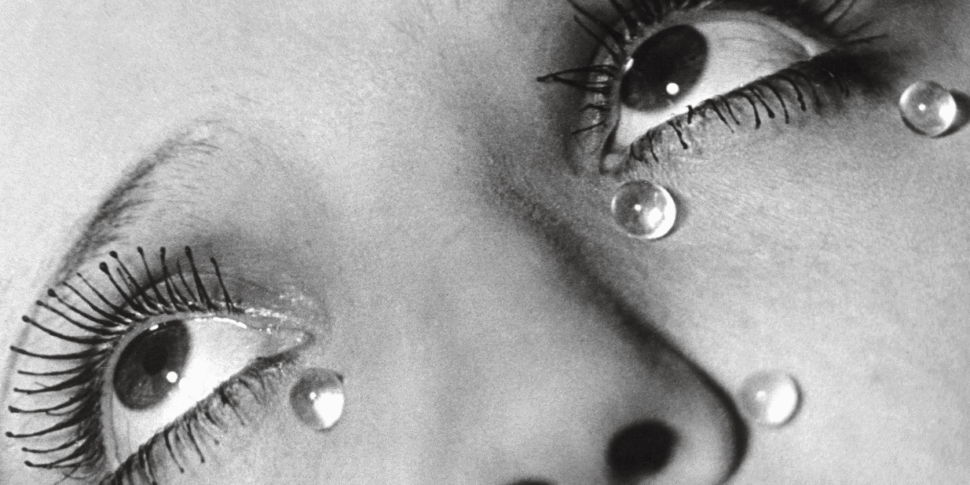
Man Ray (under the pseudonym “Ray of Light” he replaced his real name Emmanuel Radnitsky, born to a Jewish family of Russian origins), working in the USA, but above all in Paris, was therefore a great researcher, capable of creating his own personal iconography in everything he faced and experienced, although often starting from classicism or famous artists (in addition to Ingres, whom he himself cited, I often see references, in the nudes, to Canova’s sculptures and their harmony). Black and white photographs such as “Le Violon d’Ingres”, “Noire et blanche” and “Larmes” (Tears) are integral parts of our collective imagination and one of the many points of arrival, a consequence of the intense association with the European avant-garde and with figures such as Marcel Duchamp and André Breton, among many others.
Yet it also happened that a “rebel” photographer like Man Ray left us “acontro” the dynamic demonstration of how human stories intersect with History, thanks to an admirable series of portraits of fundamental figures of the last century. How is it possible that the artist who, together with Duchamp, believed that “the idea of a work prevails over the work itself”, dedicated himself to portraits, which in some way should be an objective representation? Leaving aside the deformations to which he was prone in his many self-portraits, the meeting with celebrities who competed to be photographed by him (a hotel room had been transformed into a studio), allowed Man Ray – who never wanted to use retouching – to delve deeper into the idea of a psychological portrait (forgive me for being bold, but I believe that between these portraits and those painted by Antonello da Messina there are many points in common).
The list of characters that we find in the exhibition is impressive: in addition to the aforementioned Duchamp and Breton, there are Paul Éluard, Francis Picabia, Giorgio De Chirico, Salvador Dalì, Pablo Picasso, Henri Matisse, Ernest Hemingway, Jean Cocteau, Virginia Woolf, Gertrude Stein, Igor Stravinsky, James Joyce and many others. «The eye of the great hunter – commented Breton -, patience, the sense of the pathetically exact moment in which, in the expression of a face, the balance between dream and action is created».
But it is women who remain the queens of Man Ray’s lens, a symbol of the possible and the impossible, often the image of a thought, sometimes of a dream or even of both an intellectual and emotional vision. His Parisian atelier was described (by Patrick Waldberg) as an “arsenal of the imagination”, where in a small space there was a real and imaginative sample of the unnecessary: forest screen, endless spiral, tree-shaped clothes rack, cyclopean metronome, iron with nails, magnetic chessboard, bread baguette “covered in sky-coloured nail polish”. Yet then everything he used to create was “sacrificed” to the main concept, that of light. «Everything – he wrote – can be transformed, deformed, eliminated by light. Its flexibility is exactly that of a brush.” This is why in reality Man Ray never finished “painting”: aiming the lens, guided by the strokes of light.