

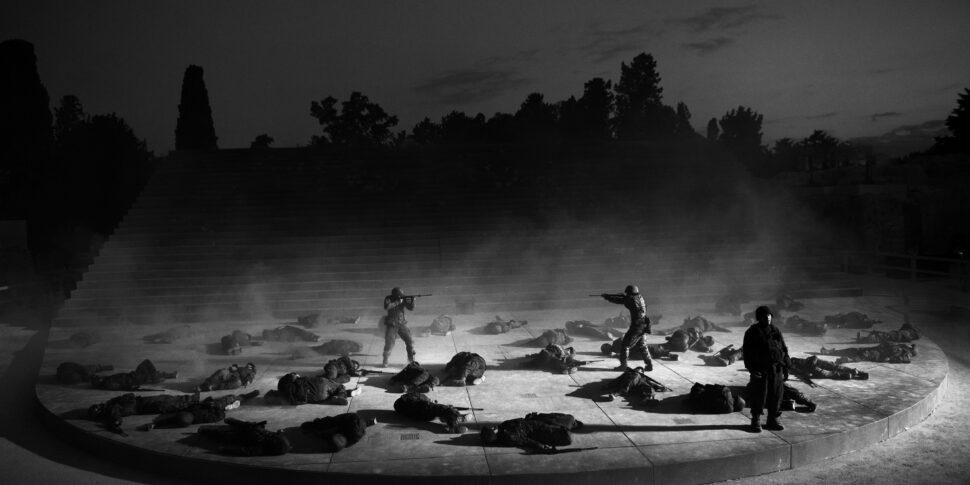
Where were we, Saturday evening, at the ancient theater of Syracuse? In Gaza, in Beirut, in Kiev. In Thebes. And what time were we in? An ordinary day in 1941 in Europe, yesterday in Ukraine, in Nigeria, in Libya. In 1978 in Argentina, in 1970 in Greece. Or even tomorrow, who knows where. We were inside a black and white photo of Rome, the Open City, with Italians shooting together with the Germans on the Italians, and soldiers carrying bodies, and squares filled with deaths, with absences. At the beginning of his “Antigone” Robert Carsen performs the usual miracle: he takes us into all the worlds we know, into the most painful of today, and at the same time abstracts and universalizes and leads back to what is not historical but perennial, such as the “tremendous human”.
Perhaps the most famous line of the most famous tragedy, the magnificent and terrible knot for generations of translators: Francesco Morosi, the precious talent that Inda, farsighted as always, has secured, translates “there are many terrible things: none are more terrible than man”, preserving, of that word-abyss (deinontremendo), the oxymoron figure, the marvelous intertwined with the fearful, with that which, literally, makes one tremble. Like the sacred. Like Antigone. Like the final act of the Theban trilogy that Carsen – awarded last Saturday with the 2026 Golden Aeschylus – staged for Inda on the stones of Syracuse.
The entire first part is punctuated by the shuffling of the soldiers, and we suffer the story of the war as the body of the city endures it, we spectators who are on a staircase that is twin and mirror the one also this time on stage by Radu Boruzescu, but this time wounded and pierced by bullets. And yes, we too tremble before those war scenarios. And we would give anything to be reassured by Creon, the sovereign of the restoration after the fratricidal war, who speaks the language of the restorers: “defend”, “respect”, “secure”. That Creon and the brutalist concrete staircase are the constant elements in the three tragedies (with Oedipus Rex in 2022, Oedipus at Colonus in 2025), one of the recurrences that Carsen has woven by recalling his own choices: not self-quotations but lintels of meaning in the wonderfully unitary architecture of the cycle.
Paolo Mazzarelli is Creon for the third time, and even better, this time, he summarizes and pulls the strings: the tragedy is his as much as Antigone’s – the niece who persists, against his edict, in burying her brother Polynices who had attacked Thebes -, the tragedy of a power that cannot stand the test of facts, which collapses into its own inadequacy. Attention, not for lack of reasons – which Sophocles is magnificent in distributing them and making them the living flesh of the conflict – but for lack, finally, of listening and humanity and respect for that “sacred” which yesterday was called “divine law” and today we call ethics and empathy and conscience and universal justice (and international law, too). Paolo Mazzarelli, so composed and precise (also someone who works in depth, by excavation and subtraction) is particularly effective in rendering the conviction that crumbles, the authority that degenerates, loses the meaning of things, loses composure, finally founders in the irremediable: it is he, chased by the darkness, who closes the tragedy in the darkness, climbing the ladder which is no longer a symbol of ascent and power, but bowed by pain.
But we the audience – silent choir that with its silence feeds the scene, where silence is an important part of the sound, atonal and percussive and obsessive and physical and full of pauses (Cosmin Nicolae says it very well, in the scene notes) – we are absolutely with Antigone, the adamantine girl who has no hesitations, who responds to the highest, or most profound, law of pity for the deceased, of love for those dear to us, in the most beautiful and broadest sense of love not as a blood duty but as philia (there is another rather rare and much quoted word from this text: symphileo, when Antigone says: «I was not born to share hatred but love». And find it, something more revolutionary…). Camilla Semino Favro – firm, tight, clear – is a very pure Antigone, not the rebellious heroine (as she is often iconized by modernity) who opposes the violence of a regime with the violence of her radical opposition, but she who, moved by love, speaks another language that is not that of Creon, and thus breaks it. With a mirror-image and opposite gesture to Oedipus’s undressing at the top of the staircase (as we had seen in 2022: one of the shocking peaks of Carsen’s direction) Antigone also undresses herself, strips herself of life, descends, dressed in white, towards death – the staircase is also the border and passage between worlds, the ridge and place of the “crossings” that this cycle of representations tells us about.
«You are on the edge of fate, Creon», shouts Graziano Piazza’s superb Tiresias, also returning to Carsen’s saga of the Labdacids, with the same impetuous clarity of the blind prophet and seer we remembered, much loved by the public. Creon tries to reject him harshly, as he had done shortly before – in one of the bitterest dialogues ever, of great and concentrated strength – with his son Haemon (the good Gabriele Rametta), but soon that truth that he does not want to see will become light, and for him it will be darkness.
Carsen manages, in his work “per via di levare”, within an almost bare scene, to give us a theater of pure words, stripped and brought back to the very heavy atomic nucleus of meaning and gesture. As always, the choir scenes are masterful, this time, as in «Oedipus Rex», in deep black (the costumes are by Luis Carvalho, the movements by Marco Berriel): choir that becomes a swarm and a flock, with a collective voice that blends in with the others in the greenery behind and around the theater (at the premiere, disturbed, or perhaps attracted, by the warrior drum an owl had sung for a long time, counterpointing the words: this spontaneous dramaturgy is also the magic of Syracuse).
The performers are all excellent, from Mersila Sokoli’s trepid Ismene to Ilaria Genatiempo’s first glossy Euridice (a Melania alongside the king-“president”) and then disheartened, from Pasquale Di Filippo’s guard to Dario Battaglia’s messenger; as always, honorable mention goes to the choir leader Rosario Tedesco, to the choir members, Elena Polic Greco – a certainty – and Maddalena Serratore, to the Theban choir (Andrea Bassoli, Guido Bison, William Caruso, Gabriele Crisafulli, Elvio La Pira, Emilio Lumastro, Roberto Marra, Marco Maggio, Matteo Nigi, Giuseppe Oricchio, Jacopo Sarotti, Sebastiano Tinè), without forgetting the students of the Academy of Inda, reserve and sowing of talents, and the “women of the people” (Giusi Lisi, Chiara Casella, Lucia Imprescia, Alessandra Fazzino, Roberta Nanni, Tiziana Italia): open applause for practically everyone, before the interminable final ovation.
The theater – and Antigone, this Antigone, forcefully reminds us of this – is always resistance, a construction of the human that opposes any deconstruction of the human (whether it be a spear or a bomb, barbed wire or Big Brother’s camera). When he manages to make us feel it in such a clear and powerful way we are consoled and encouraged. Always looking for that philia that makes us human.