

«We are a bit like the chisellers, the goldsmiths, the silversmiths, who take a precious raw metal and make it beautiful, adorning it with anthologies, but without ever betraying. Translating is not betraying, but empathetically connecting with the person in front of you, be it a writer, an actor, a scientist or a manager. Because you have to be very careful to leave the translator’s ego aside, I leave my identity at home and try to take on as much of the sensitivity of the person I translate as possible.”
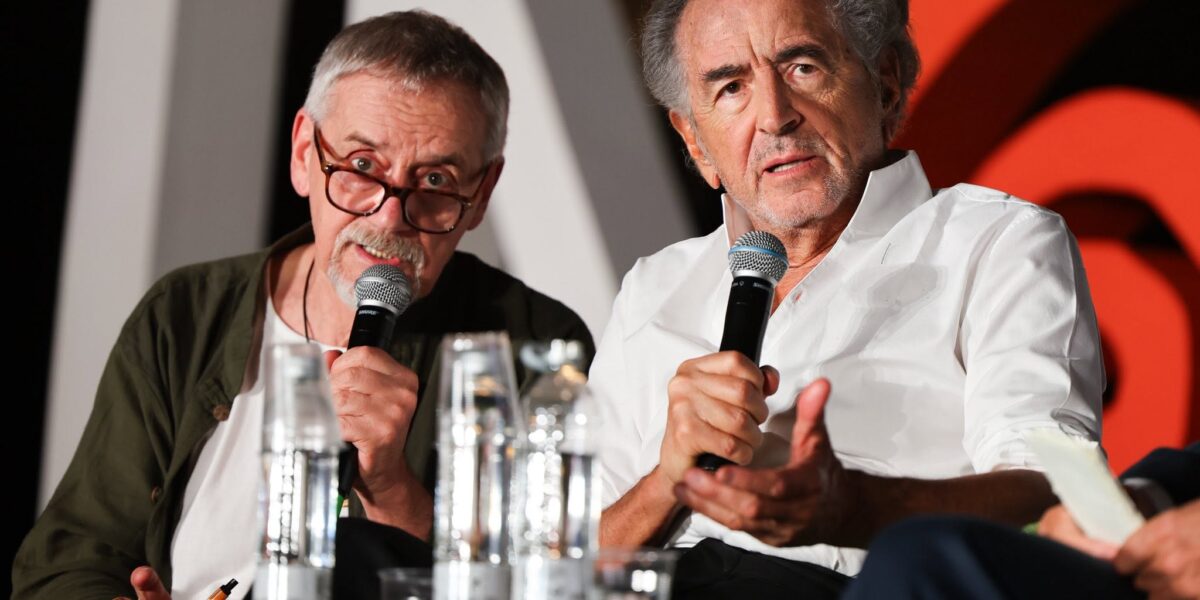
Always very generous, even in our conversation at Taobuk 2026, is Paolo Maria Noseda, whose ambassadorial word takes the world a little further, with his work as an interpreter. Not only an interpreter specialized in literary translation, well known internationally, but also a speech coach, ghost writer, teacher and much more, as his very long curriculum vitae boasts. A thinking voice, Noseda promotes human exchanges with his fluent translation that vibrates in conferences, conventions, festivals and television studios (he is the official voice of the foreign guests of Fazio’s “Che tempo che fa”) resonating, very recognisably, in a magnificent crossroads of notes: the notes of the human voice with its sounds and rhythms, to which Noseda gives expressiveness and perfect diction as an added value. In Taormina he joined the philosopher Bernard-Henri Lévy, the Nobel Prize winners Esther Duflo and Abdulrazak Gurnah, the writers Jonathan Coe and Jan Brokken, the artist Anish Kapoor,
Paolo, what is the voice with which you dress others for your life?
«My voice is my instrument, which I have tirelessly cultivated for 43 years with constant study. But every time I have to prepare for an interview, for a conference, for a conference, for a festival I don’t rely exclusively on my voice. It is the sound instrument of all the preparation that lies behind my work and which is profound because you have to read up, learn constantly, try to find points of empathy with the people to translate. Only in this way is it possible, through the instrument of the voice, to give the public what it wants, that is, the understanding of a character, his posture and his stature”.
If the voice is the sound instrument, knowledge of the Italian but also foreign language must be profound
«I teach at Ca’ Foscari and I always tell my students that if they want to study foreign languages, the first thing they need to know, deeply, is their mother tongue. My education is classical, I studied Greek, Latin, history and I am very grateful to those who advised me on these studies, knowing those disciplines is important because it allows us to understand a civilization, to go to the root of the words because we are bridges between the civilization that we have to translate and the one that receives the message of our translation. I was very fortunate to have excellent teachers, having teachers is very important; I still have teachers that I follow because you never stop learning. The masters today are writers, poets, because one of the greatest challenges is the translation of poetry which is very difficult.”
What languages are you proficient in?
«I deal with English, French, Spanish and German. And Italian of course, because when I live abroad Italian becomes a foreign language and therefore not only do we have to know the history and geography of a country but its idiom, with the linguistic characteristics specific to that community, the proverbs, the sayings, the idiomatic expressions of the people, of the people, because our translations must always take a context into account.”
And for your work you also deal with sectorial languages
«These are what we call microlanguages. I often attend conferences of doctors, engineers and chemists; every sector, industry, commerce, fashion has its own microlanguage. This has allowed me over the years to broaden my field of work and to now carry out consultancy activities, in all languages. In fact, one of my jobs is to help people express themselves, to prepare their speeches, to organize the contents, or to help a speaker write a speech so that it is intelligible to a certain category. This is what is called public speaking, speaking effectively in public.”
Among the characters you met, including writers and artists, who remained in your heart the most?
«My work has a great advantage, you really manage to establish relationships, even deep ones, with writers, actors, artists all; on my part there is always a lot of respect, commitment and attention, because often these creative people are, rightly, jealous of their work, and when they present it they want their words to reach the public intensely. At “Che tempo che fa”, half an hour of interview is used to win over an audience, to make you known and if I mistranslate the words of the guests, many of whom are international, the messages are completely misled. It often happens to me that actors or writers, at the end of a work, tell me that even if they don’t understand Italian, they understand from the audience’s reaction that their message has arrived. Here, this is my duty.”
Any names of those who have remained in your heart the most?
«Of course there are people with whom you become friends, Patti Smith for example, Bono of U2, Emmanuel Carrère, Paul Auster, Abraham Yehoshua, David Grossman, and also Susan Sontag who was a great writer and only wanted me when she came to Italy to present her books. But Giovanni Caccamo is also a great friend of mine, I worked with him for the speech at the United Nations, when he launched his “Word to Youth” project. Often a deep bond is created, it is a matter of sensitivity, of trust to remember the theme of this edition of Taobuk, as with Jan Brokken, a great man, not only a writer, but also a musician, a painter, with whom we did many tours together and became friends to the point that he asked me to talk about Naples, Venice; I am in fact present with one of my stories in the Naples chapter of his latest book “La melancholy of the traveller” (Iperborea, translator Claudia Cozzi) premiered at Taobuk 2026″.
You often have the impression that, through experience and sensitivity, you already know, while listening and translating, what the authors are about to say. Does this help you with immediate translation?
«The fact that people perceive this is due to a technical expedient, because I do lip reading, which is why when I work I need a monitor if I’m on television or, if in person, I always want to look at the person I translate. In the second case and I am talking about simultaneous translation, we must stay next to and always a little behind the person. And in order not to lose words, to understand exactly the meaning that that person is giving to the sentence, I read lips, so I can grasp what that handful of seconds before means in such a way as to translate almost in real time.”
If you don’t write in the simultaneous class, what technique do you use when you take notes?
«When doing consecutive translation, therefore when using a notepad for notes, all of us interpreters have developed our own system over the years to be able to remember even very long pieces. I remember that with David Grossman we once exceeded 25 minutes of speech. Of course, you need mnemonic training, but also your own tricks; for example, I mainly write down the things that I fear I won’t remember, or that I’m not sure I can remember. But the most important thing is the connections of the logical thread of the discourse: that is, the subject, the predicate and the consequent parts. By highlighting them in my notebook I can reproduce all the ideas, I know exactly what logically comes from one sentence after another.”
Have you studied mnemonics?
«Our work is memory, I did it at university where I learned the rudiments and learned the system of taking notes. Then each of us personalizes it, but memory must also be cultivated daily. Regarding simultaneous, there is always a lot of preparation work before the meeting. Today we are greatly helped by social media, videos, technology; I always watch videos of the characters I translate to understand the style, inflections, tones, or frequency of the words used. We all have words in our vocabulary that we love more than others, so I take those words and keep them in my mind. I study the way a person expresses themselves, there are those who are more concise, there are those who are more verbose, there are those who use certain adjectives, there are those who are a bit sparing with words.”
Often, as you repeat, you have to deal with people who speak English but are not English speakers
«Exactly. Often we have to act with a lingua franca which is English. When a German, a Frenchman, a Belgian, a Spaniard or an Italian speak in English, everyone has their own way of doing so, with mistakes that are commonly made and which I try to eliminate in the translation, improving it. I’ll give you an example: I worked a lot with Orhan Pamuk, Nobel Prize winner for literature, but he is Turkish and when he uses English it is clear that the level of sophistication of the English cannot match his wonderful Turkish, so I try to make that English the best I can, knowing him, having read his books. It’s a level higher than mere translation.”
Do you also translate books?
«Yes, I have translated several books, and I wrote my book which is “The voice of others” (Sperling & Kupfer), and it was a fantastic tool for understanding the great work, the effort that goes into a book: a process that never leaves you until the end of the book. When we need to translate living characters we turn to them directly, but when they are no longer around we turn to experts, to critics to understand, to convey their thoughts correctly.”
Of course, translation in Italy has reached a very high level
«Yes, it is necessary to highlight this very important work that makes world literature known to us. Citing the person translating is a must. I think for example of Daniel Pennac who always generously quotes his translator Yasmina Mélaouah, who makes his books ironic but profound so wonderfully. Without her Pennac would not be so loved. Ours is a work of “transcreation”, as we say. But, in this regard, I want to remind you that today there is the problem of defending the quality of translation from the intrusiveness of artificial intelligence. I have to say that I am not against the use of technology and AI. When I started working computers didn’t exist and when they arrived it was wonderful for me. Therefore, it is even more useful now that technology allows us to delve deeper and know better, but as I always tell my students, we must rely on technology and AI with discernment, always filtering it through study. Of course, today there is the fear of losing one’s job, because it is enough to use AI to have translations into all the languages of the world, but there is a deeper level, human knowledge is always needed.”
Is there anything that makes you discover new things today?
«I teach a multi-ethnic English course in the faculty of Linguistic Mediation and I am very happy to meet Chinese, Jordanian, Arab and obviously Italian students. And my students are also very happy to be in a multi-ethnic environment. Something that excites me on a human level and allows me to put into practice every day the challenge that languages are and constitute.”