

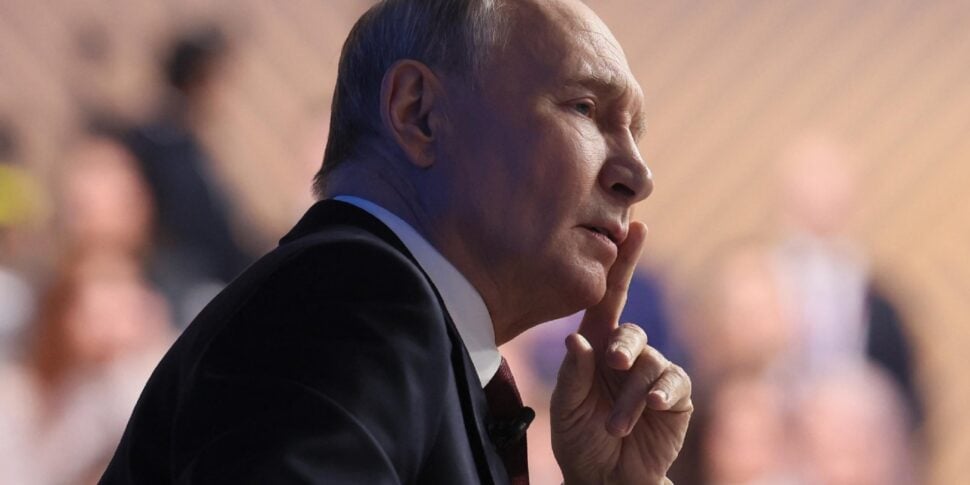
The open letter sent by Volodymyr Zelensky to Vladimir Putin will not bring the end of the conflict in Ukraine closer. The Russian president responded with irritation to the Ukrainian president’s decision to “bring contacts between the two enemies into the public sphere”, saying that “at the moment there is no reason” for a summit meeting. Such a meeting, requested in Zelensky’s letter, will only be possible when a solution to stop the conflict has been reached through the work of the respective delegations, said the head of the Kremlin, reiterating a position already expressed several times.
Zelensky’s response was not long in coming. “Unfortunately, the Russian side is choosing war again – said the Ukrainian leader – Everyone heard today’s response. A weak response. It simply does not want to end the war.”
Putin, speaking from the stage of the St. Petersburg International Economic Forum (Spief), also said that Russia’s objectives in what he calls the “special military operation” remain “unchanged.” And he recalled that he himself had outlined them in a speech to the Foreign Ministry in June 2024: withdrawal of Ukrainian troops from regions claimed by Russia and Kiev’s refusal to join NATO.
The European plans
The initiative that France, Germany and the United Kingdom would have launched to seek a negotiated solution with Moscow, in agreement with Zelensky, also seems to be off to an uphill start. A move that was first reported by the Bloomberg agency and which seems confirmed by a meeting announced for Sunday in London of the leaders of the E3 countries: the British Keir Starmer, the German Friedrich Merz and the French Emmanuel Macron.
The latter stated that “it is time” to “look to the future” and “reorganize a dialogue to build ceasefire and peace”. For his part, Merz said he welcomed “with great favour” the “dialogue proposal” put forward by Zelensky and added that “on the European side there is no lack of willingness to dialogue”https://gazzettadelsud.it/articoli/mondo/2026/06/06/putin-nessuna-ragione-per-vedere-zelensky-e-at tacca-lue-the-starmer-moscow-alarm-may-attack-nato-in-2030-a7a0df12-9943-426d-9da4-e91af347b719/.”This what is missing is the availability of Vladimir Putin”, commented the chancellor.
Trump’s position
On the American side, however, while Donald Trump’s mediation is blocked, distracted by the conflict in the Persian Gulf, the House approved a bipartisan measure to provide new aid of up to 8 billion to Ukraine and impose sanctions on Russia’s energy and financial sectors, in stark contrast to the president’s approach. The measure also saw the support of 18 Republicans, but now must pass the Senate, where its future is decidedly uncertain.
However, neither the prospect of new American aid to Kiev nor the European diplomatic initiative seems to be able to soften the Kremlin. “The European elites – said Putin – are causing chaos in which they try to attract more and more countries”. As for Zelensky’s letter, the Russian leader defined it as an “improper” initiative, saying he felt authorized at this point to reveal a confidential episode. Three weeks ago, he said, a Russian businessman told him he had been invited for an interview in Kiev by Zelensky, and he told him to go. When he returned, the entrepreneur brought Putin a proposal for a direct meeting, which the Kremlin head had already rejected. According to the Russian president, the fact that Zelensky returns to propose a summit with an open letter has the sole purpose of “stop the offensive” of Moscow’s troops on the ground.
Only one sign of hope has emerged in the last few hours in this discouraging scenario. Russian Human Rights Commissioner Yana Lantratova said she had had a first meeting with her Ukrainian counterpart, Dmitry Lubinets, with whom she agreed to develop cooperation. The meeting, writes the Tass agency, took place on the border between Ukraine and Belarus. And meanwhile Moscow and Kiev have carried out a new exchange of prisoners, 185 on each side.
Starmer raises his tone: Moscow can attack NATO ‘in 2030’
Within 4 years Russia “could attack NATO”. This was stated today by British Prime Minister Keir Starmer, once again raising the tone of the threat attributed to Moscow against the backdrop of the war in Ukraine and accrediting the 2030 deadline to assessments “of our intelligence services and those of other allied countries”. The Labor prime minister then evoked the repeatedly announced objective of increasing military spending as “urgent and priority”: committing his government to publishing a new “fully financed” ten-year defense investment plan before the NATO summit on 7 July in Turkey.