

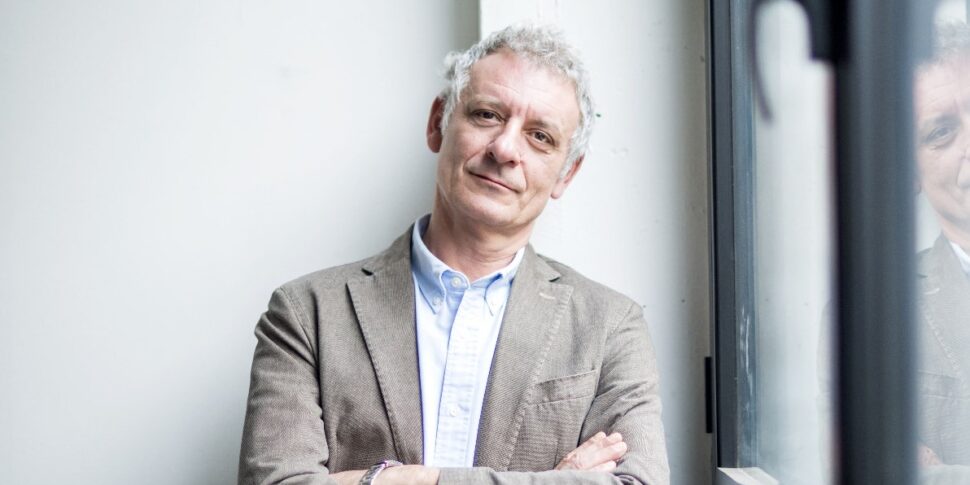
The banality of common evil, not only of the crime, but of the indifference, of cynicism, one thing, this, “which has become structural towards those who do not do it, of the type that” worse for him “, as if poverty were a fault”. So he says Alessandro Robecchi, brilliant writer, screenwriter, journalist, television and radio author (among other things of Fratelli di Crozza) who on Monday in Piazza IX April at 19 will converse on the theme “Between noir and social denunciation” with Anna Mallamojournalist of the South Gazzetta and author for Einaudi of “With the dark I see it” (which will be presented on the same day at 5 pm at the Palazzo dei Duchi di Santo Stefano).
A figure of robechi, also for “The killer heel” (Sellerio) in which Carlo Monterossi, the detective by chance of his novels, takes place a couple of killersthe blonde and the one with the tie, two characters they already like (“Many – says Robecchi – said to me: but look a little bit of strangeness, I find myself cheering for two killers”) with their adventures of “work”, between comedy and grotesque, between misunderstandings, cynicism and hilarious jokes.
After Monterossi, a couple, the blond and the one with the tie
«Let’s face it, the two do the killers for work. Black humor can be fun, and I wanted to play on the fact that the two have a company, an Srl and therefore they must be careful of costs, benefits, budgets. And then, above all, play with the genre. After a dozen noir I know the rules quite well enough to get out of it. Usually in yellow the dead is at the beginning and the story develops to find the culprit and instead here it seems that killing someone is a formality, as if it were an easy thing, while things can go wrong. Here, I wanted to tell these crooked things a little seen from the point of view of the murderer and not of the team ».
Set in your Milan, increasingly black and of the same substance that the money is made
«It is my beloved city, where I was born and alive. So, let’s say so, I can afford to “hate it”. A city where those who win are fine, while others struggle to survive, a city with London prices and salaries from Burkina Faso, that is Italian. And what was once the middle class or the small bourgeoisie now arrange. A city that exports Milanese because they cannot afford it and matters millionaires and therefore “Londrizza” is “. And since there is a current of thought that claims that this is modernity, I would like to contest this thing ».
What a bad thing sarcasm reflects the narrative voice. And then, what a bad thing when the sense of humor is missing …
«The first is obviously antifrastic, instead sarcasm, humor, irony save our life. It means that we have a critical ability that makes us laugh, on certain occasions, of reality or to make the sneer, and that finally, with the glasses of the satire, we see, because the problem is that people do not see what is around, which is satisfied with its position without “seeing”. That’s why we must tell it, also through two killers who have a disenchanted eye on society and however they see the distortions, the difficulties, the differences, in a historical moment in which it is difficult to see them or pretend not to see them ».