

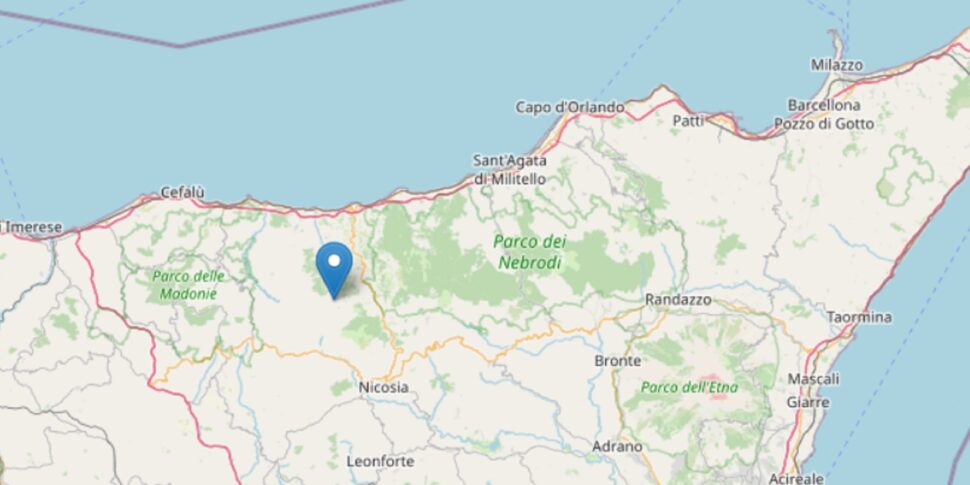
At 7.03pm today, Saturday 21 March 2026, the seismic sequence changed face: the epicenter moved abruptly from the open sea to the Messina hinterland, in the area between Castel di Lucio, Pettineo and Mistretta, on the eastern Madonie mountains. In a few minutes the INGV Seismic Room in Rome recorded a flurry of close tremors: magnitude 3.7 at 7.03 pm (4 km south of Pettineo), magnitude 4.1 at 7.04 pm (2 km south of Castel di Lucio, depth 26 km), magnitude 3.0 at 7.04 pm (5 km south of Mistretta), magnitude 3.3 at 19:06 (2 km north of Castel di Lucio) and magnitude 3.2 at 19:15 (4 km north of Castel di Lucio). A new provisional estimate from INGV reports a further event between magnitude 2.9 and 3.4 at 7.15pm, still in the Messina area.
Five tremors in twelve minutes, all concentrated in a narrow radius, with hypocenters between 21 and 27 kilometers deep: a picture that leads the sequence to directly hit the inhabited centers of the province, a few kilometers from Castel di Lucio, Mistretta and Pettineo.
Updating
A sequence that doesn’t stop
The earthquake at 7.04pm is not an isolated incident. Since this night, the sea north of Sicily has never really calmed down: it all started just before 3am, when two strong tremors – magnitude 4.6 and magnitude 4.3, just three minutes apart – woke up the inhabitants of the Aeolian Islands and the Tyrrhenian coast up to Palermo. In a few hours the INGV seismographs had already counted 15 events. The one tonight in Castel di Lucio says that the earth is not finished yet.
An area used to shaking
This is not something unusual for this area. In the last month alone, around thirty earthquakes had already been recorded between the sea north of the Aeolian Islands and the Messina hinterland. The strongest — magnitude 3.6 — arrived on March 14, a week ago.
Historical memory is even more eloquent. In May 1957 two strong tremors hit the area one day apart. In 1980 a 5.7 magnitude earthquake seriously damaged Alicudi, with effects that the island’s inhabitants still remember. More recently, in 2009 and 2025, other tremors above magnitude 4.5 affected the same district.
Then there is a peculiarity of this area that makes it unique in Italy: under the Aeolian Islands, the earth’s crust sinks deep due to an ancient tectonic movement that is still active. This explains why earthquakes here can originate at exceptional depths — in 2004 a tremor was located 255 kilometers below sea level, something rare in the Mediterranean.
Experts classify this area among the areas with the highest seismic danger in Italy.
How much was heard
>According to INGV calculations, the strongest shock this night – that of magnitude 4.6 – produced a level of ground shaking comparable to the IV-V degree of the scale used to measure the physical effects on places and people. In concrete terms: tremor clearly felt, objects oscillating, some cracks in the most exposed cases. Hundreds of people have reported the phenomenon through the portal Did you feel the earthquake?confirming a widespread perception along the entire northern coast of Sicily.
What to do in case of an earthquake
In seismic crisis situations, prevention and knowledge of correct behavior can make the difference. Civil Protection reminds you of some fundamental rules:
If you are indoors: take shelter under a table or sturdy piece of furniture, or position yourself under a beam or near a load-bearing wall. Stay away from windows, mirrors and furniture that could fall.
If you are outdoors: move away from buildings, trees, streetlights and power lines. Look for an open, safe space.
After the shock: do not use the lift and, before leaving the house, turn off the gas and water taps and turn off the main light switch.