

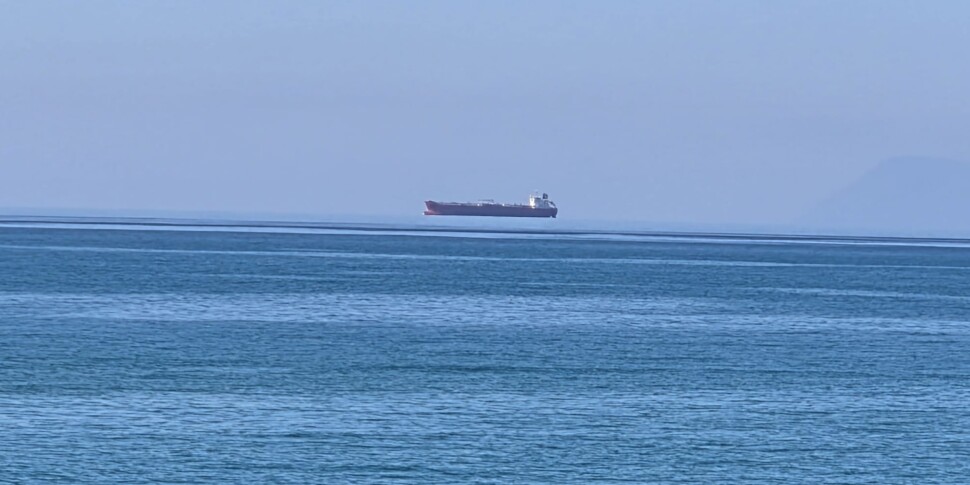
The people of the Straits know very well what it is. At least those who know its traditions and legends. But if you happen to witness it, it is always a spectacle, on the border between myth and reality. It happened today in the early afternoon and those who were enchanted by it were those who were on the Tyrrhenian coast, in particular in the Rometta Marea area (stormed for Easter Monday). Those who were lucky enough to be on the beach and to strain their eyes in those few seconds were able to capture the “Fata Morgana”, the rare refractive phenomenon that determines real “mirages”, optical illusions in which objects take on unusual, unreal shapes and positions. In this case, what was involved was a ship in transit towards the port of Milazzo, which for a few magical moments seemed to be suspended on the water on the horizon, giving rapt gazes just enough time to immortalise it. The phenomenon is well known and described in scientific literature, but no “material” explanation can undermine its suggestion and beauty.
The “witch” between mythology and literature
The Fata Morgana is a mythological figure linked to Arthurian legends. In the narratives she is one of the main antagonists of King Arthur, Guinevere and above all of the wizard Merlin. The legend of the Fata Morgana is also widely spread throughout the area of the Strait of Messina: it is said that during the early medieval barbarian invasions, in August, a barbarian king who arrived in Reggio Calabria saw Sicily on the horizon and wondered how to reach it, when a very beautiful woman (precisely the Fata Morgana) made the island appear a stone’s throw from the conquering king. The king threw himself into the water, convinced he could get there with a couple of strokes, but the spell was broken and he drowned. Another version says that in 1060 Fata Morgana proposed to help the Norman leader Roger of Altavilla to free Sicily from Muslim domination: Roger saw her get on a white and blue chariot that mysteriously appeared, pulled by seven white horses with blue manes.
The mirage scientifically described
In optics, the Fata Morgana or fatamorgana is a complex and unusual form of mirage that can be seen within a narrow band above the horizon. The phenomenon is also known abroad by its Italian name, because it is a phenomenon frequently observed in the Strait of Messina and handed down by the Normans. It refers to the fairy Morgana, who induced visions of fantastic castles in the air or on earth in sailors to attract them and therefore lead them to death. This phenomenon, which can be observed on land or at sea, in polar regions or in deserts, distorts the object (or objects) on which the mirage acts so much as to make them unusual and unrecognizable. It can involve any type of “distant” objects, such as islands, coasts or boats. The subject is shown evolving, in positions different from the original ones, in a vision that can move seamlessly from compression to elongation. The phenomenon occurs in several places around the world. It inspired numerous poetic works, whose authors provided imaginative explanations of the phenomenon.
For further information: how the rare optical phenomenon occurs
The optical phenomenon occurs when light rays are bent by passing through layers of air at different temperatures, under conditions of thermal inversion, in which the transition between layers is characterized by a sharp thermal gradient, with the formation of an atmospheric conduit. In fact, in clear weather conditions, it can happen that a layer of much warmer air overlies a layer of colder air: in this case, the difference between the refractive indices can give rise to the formation of an atmospheric duct which acts like a refractive lens, producing a series of both straight and inverted images. For the Fata Morgana phenomenon to occur, the existence of thermal inversion is not sufficient, but the simultaneous formation of an atmospheric conduit is also required, and this accounts for the relative exceptional nature of the optical phenomenon. It is therefore an effect due to the particular distribution of the refractive index of the Sun’s light in different layers of air and therefore in some ways similar to a mirage. For the phenomenon to occur, the thermal inversion must be strong enough that the curvature of light rays within the inversion layer is stronger than the curvature of the Earth. Under these conditions the rays create arcs. The observer must be inside or below the atmospheric vent to see the Fata Morgana. The phenomenon can be observed from any altitude: from sea level to the tops of mountains, or even from an airplane. It is generally visible even to the naked eye.
When the two Calabrian and Sicilian coasts “touch”
The phenomenon of the Fata Morgana can occur with different intensity, in some cases from the Calabrian coast you can see Sicily closer than normal with distorted images reflected on the sea or on the ground; essentially the distance seems to be a few hundred meters and one has the impression of observing an unreal city in the Strait that changes and vanishes in a very short time; sometimes you can briefly distinguish houses, cars and even people. This phenomenon is visible, due to the particular light conditions, only in the morning and only from the Calabrian side of the Strait. This all happens when tiny droplets of rarefied water on the surface of the sea act as a magnifying glass.