

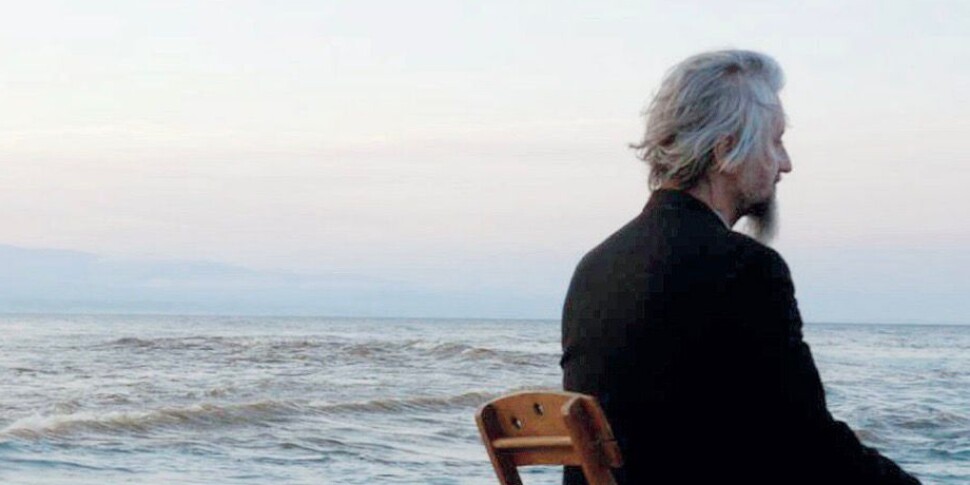
A work on the side of the least, choral, poetic and political together, which breaks down the boundaries between theatre, fiction and documentary cinema to talk about migration, identity, memory, languages and horizons. Above all to narrate the South, ours, and all the Souths of the world. «The hidden sea», Luca Calvetta’s first feature film, in theaters after the preview at the Ischia Film Festival 2024, can be defined as a film of encounters: between places and cultures, between men in dialogue with each other and with themselves. But also a work in dialectics with other cultural products, which in the various stages of the presentation tour – a great success throughout Italy, with sold-out dates in Naples, Rome and Pisa – dialogues with other arts, other artists, other works with similar themes, for a joint reflection. After the much applauded stage at the Cineteatro Comunale of Catanzaro, on Tuesday (6.30 pm) Calvetta will be at the Lux cinema in Messina, to present the film and discuss with the Reggio Calabrian, Gazzetta journalist and writer, Anna Mallamo, winner of the 2025 Super Mondello Prize with the novel «Col dark me la vedo io» (Einaudi). A cross-reference between perspectives, experiences and points of view, therefore, consistent with the structure of the film which finds its specific interaction model in dialogue.
«The basic idea is that an independent film like this is not just a work of art – the director tells us – but a meeting space between those who create culture and in some way resist that historical phase of abuse, oversimplification or even lies in which we live. I hope it becomes an experience of stimulation and awareness for the public.”
Loosely inspired by Antoine de Saint-Exupéry’s beloved “The Little Prince”, the film’s plot partly reproduces its structure. A boy with an unknown identity (the young poet Mohamed Amine Bour, debutant), perhaps a castaway who arrived on the Calabrian coast, under the guidance of a narrator inside and outside the scene (Ascanio Celestini) undertakes a journey between places and encounters, absorbing stories and maxims about existing, which mix with personal memories, nightmares, imaginative suggestions. In the background, the land of Calabria – in the locations of Serra San Bruno, Soverato, Badolato, Reggio Calabria, Roghudi Vecchio, Gioia Tauro and Lamezia Terme – another character in the story, which becomes, in the director’s portrait, a metaphor for all the South of the world.
But can the fairy tale translate such a strongly realistic narrative objective as that of describing a place?
«The basic idea was to carry out a reversal – Calvetta tells us – by manipulating and subverting the same fairy tale to give voice to the last, to those on the margins; and I’m not just talking about characters, but also about places, of Calabria in particular. Not only did the physical and geographical boundaries need to be broken down, but also the symbolic ones between genders.”
Was “The Little Prince” therefore functional to the story of the South?
«The fable was mainly used to tell the story of a metaphysical South that has no names in the film precisely because it wants to have a universal value. Too often Calabria and the South are locked into a one-dimensional narrative, usually linked to crime. The shadows always remain, but they fade together with a thousand other colors. There is therefore a South that is contaminated, united with many voices, from Mahmoud Darwish, a poet who sings of Palestinian exile, to the verses of Pier Paolo Pasolini. Many voices that together try to show the plurality of our souls.”
Like all of Calabria, isn’t the sea just a physical place?
«Just as the South is a crossroads of different dimensions that must all be represented, the sea, the Mediterranean, is the scene of many tragedies linked to emigration; but also a symbolic and interior space, in which a thousand voices overlap and collide. A place of memories and losses, and also of dreams and hopes.”
The film aims to break down boundaries at various levels, even between languages. In fact, cinematographic, theatrical and video art languages coexist…
«Exactly. Form and content had to be coherent to open the horizon and give back to the least, as Ascanio himself says in the film, words that they never had. So making a poetic and political gesture at the same time.”
Why is it important to tell the latest at the cinema today?
«If we observe current events, we see how in various dimensions, including international ones, we are witnessing the prevalence of force, without any legal or political justification; a sort of law of the jungle, in which the strongest or most violent prevail. It is therefore important to give those who have no voice the opportunity to reclaim their existence. The idea is that the film allows many figures, and probably each of us, to enter history and claim their freedom, their position in the world against all force and abuse.”
In the cast, with Bour and Celestini, also the Locrian Marco Leonardi, the Cosenza actors Anna Maria De Luca, Carlo Gallo and Carmelo Giordano, the French actress Nadia Kibout; and, for the first time at the cinema, three Calabrians: the rapper Kento (Francesco Carlo), the writer Gioacchino Criaco, from Africo, and the model Josephine Faraci.