

The counter has been running for eight weeks and gives no respite. Mark a round figure: half a billion euros a day. The cost of the energy blaze triggered by the conflict in the Middle East and the closure of the Strait of Hormuz, in the warning of Ursula von der Leyen, risks leaving deep scars on the continental economy “for months, if not years”.
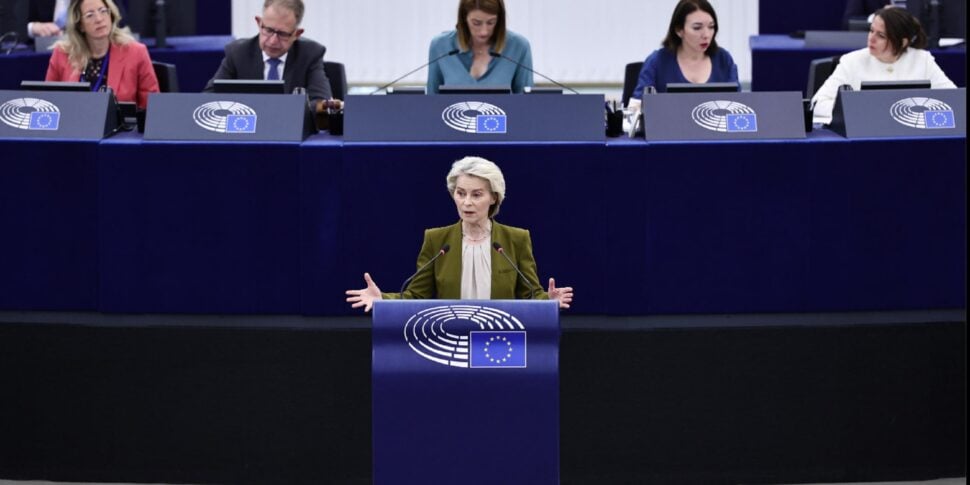
In Strasbourg, shortly before launching the new framework on state aid, the president illustrated the figures of a “harsh reality” to MEPs. In just two months, EU spending on fossil fuel imports has grown by over 27 billion, making “accelerate renewables” and “cut dependence” even more urgent.
The available funds – around 95 billion still on the table out of the 300 allocated for energy – “must be used”, insisted the German, relaunching the line already indicated to the leaders in Cyprus. Not without a note of irony that betrays the short circuit: “I know I’m speaking to the wrong audience,” he said with a smile, aware that it is the countries that decide.
Where, however, the reflection is that of the emergency and the pressure on the EU is multiplying: from the separation of energy expenditure from the Stability Pact invoked by Giorgia Meloni and Pedro Sanchez, to a common tax on the extra profits of large companies, with Paris having already invited TotalEnergies to redistribute them “in one way or another”.
Faced with a crisis that has pushed oil beyond +50% and gas up to 85%, with cascading repercussions on fertilizers (+61%) and diesel (+21%), Brussels has once again taken up the – now structural – lever of state aid.
The new temporary framework, awaited for weeks, extends governments’ margin for action, allowing – until 31 December 2026 – to cover up to 70% of the extra costs linked to high energy, fuel and agricultural inputs. A high threshold that reflects the gravity of the moment and directs support towards the most exposed sectors – agriculture, fishing, transport and energy-intensive industries – where, observed the EU antitrust manager, Teresa Ribera, “this aid can make the difference between survival or closure”.
But beneath the surface of the common response the risk of asymmetries resurfaces, with countries with greater budgetary space – Germany in the lead, grappling with the return of inflation to 2.9% in April – better equipped to support their companies. For this reason, Brussels can only insist on discipline: any type of intervention must be “targeted”, warned von der Leyen, inviting the Twenty-Seven “not to repeat the mistake” of the last crisis, when over 350 billion was dispersed in generalized measures, burdening public accounts without truly protecting the most vulnerable. The balance on which Europe is moving involves supporting the economy without reigniting demand for gas and oil.
“We don’t want to increase gas consumption”, highlighted Ribera, tracing the perimeter within which national pressures move – and collide. Italy, with the bill bill, has put forward the hypothesis of compensatory interventions on the price of electricity produced from gas, which is still being examined by the EU.
But the line of Palazzo Berlaymont remains firm: each measure must remain within a common framework, consistent with existing instruments, such as indirect compensations linked to the ETS. “Each country has its own mix and there is no one-size-fits-all solution,” admitted von der Leyen, giving a glimpse of the almost impossible mission of keeping the Twenty-Seven together without fractures.
Its strategic compass remains – once again – oriented north, with its eyes turned to the Swedish model. A low-emissions system, built on renewables and nuclear, which demonstrates a greater capacity to absorb shocks. There, «when the price of gas increases by 1 euro per MWh, the bill increases by only 0.04 euro». A figure that measures the distance from the much sought after energy independence.