

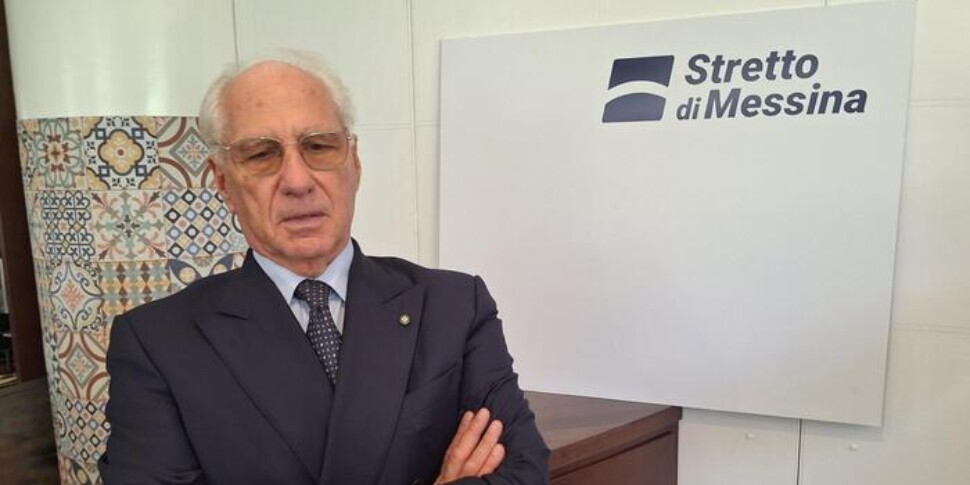
Pietro Ciucci was reconfirmed as CEO of the “Sretto di Messina”. On the eve of the conversion into law of the commissioners decree (tomorrow it will be examined by the Chamber), which restarts the procedures of the Bridge, after the stop imposed by the Court of Auditors, and in the midst of new controversies and conflicts, he gave an interview to our newspaper.
How do you respond to the very precise observations of senator for life Elena Cattaneo?
«A premise is necessary. All the actors involved have been well aware of the exceptional nature of the Bridge over the Strait of Messina for decades and this is demonstrated by the caution of the project specifications, the tests and analyzes that go far beyond what has ever been done for a bridge, the professionalism and verification procedures implemented for the feasibility studies, the preliminary and preliminary projects, the definitive project. This is great progress on solid foundations. Further geo-seismic investigations are typical of the executive design phase and therefore do not influence the approval process of the current project which, please note, is a definitive project”.
The doubts of Senator Cattaneo, whose approach was and is absolutely scientific, “secular”, not ideological or politicized, seem, however, to have foundation. Or not?
«Undoubtedly the repeated specific technical observations made deserve an equally detailed response. As regards the seismic aspect, the Bridge project foresees maximum accelerations exceeding 1.5 g and not 0.58 g as is erroneously stated. On the company’s institutional website there is a document drawn up by the designers in which the project spectrum of the work is compared with the spectrum recorded during the earthquakes in L’Aquila and Amatrice. It is clear that at the frequencies of interest for the Bridge the acceleration values considered in the project are much more conservative than those recorded and therefore the observations in this regard are not true. The Strait Bridge project has extensively analyzed the issue of project accelerations. Ground acceleration is not in itself a significant parameter, as are the accelerations relating to the dominant periods of vibration of the various components of the structure (towers, anchor blocks, deck, cables). The project earthquake, used to size the Bridge, is significantly more precautionary than what is foreseen by the regulations, as confirmed in the studies updating the definitive project of 2024″.
As has often happened in all these years, the problem of faults returns. Senator Cattaneo asked for further information on the topic.
«The points of contact with the ground of the Bridge over the Strait of Messina on the basis of the geo-seismic-tectonic studies carried out, were identified avoiding positioning on active and capable faults, as well as on seismo-genetic faults, i.e. faults capable of generating seismic shaking. The presumed Cannitello fault is not an active fault but is a marine terrace which, moreover, did not record movements in 1908. Regarding the “composition of the soil, soft and poor” which seems to recall the phenomenon of liquefaction, it is remembered that the “jet grouting” envisaged by the tower project must be considered as an integral part of the foundations, not merely as an intervention to mitigate the liquefaction phenomenon. This should not lead one to believe that in the absence of these interventions there would be a generalized liquefaction, which has already been ascertained not to be the case, and that the stability of the Bridge is entrusted to the success of that intervention. The project includes substantial “jet-grouting” interventions with the aim of further improving the seismic performance of the foundations and also allowing for excellent behavior of the foundations to be obtained, under the effect of the static actions, together with a notable safety margin”.
And the “failure to comply with the recommendations of the Scientific Committee”?
«The Scientific Committee unanimously issued a favorable opinion. The observations, which partly reflect those of the previous Scientific Committee, are not to be understood as contradicting the expression of a positive opinion, but concern aspects to be explored in greater depth during the executive planning, linked to the evolution of technical knowledge and materials and to regulatory evolution in all areas of interest”.
Why does this project and this work continue to arouse fears, perplexities and opposition on multiple fronts?
«Many human works and enterprises have met with skepticism and strong criticism regarding their technical feasibility. The news, just to stay in the infrastructural field, reminds us of the doubts about the Brooklyn Bridge, the “Golden Gate” and, more recently, the Italian case of the MOSE. All unique works with dimensional leaps and challenges, engineering-wise, superior to those of the Bridge which, on the contrary, does not envisage any significant differences compared to the consolidated experience in the construction of bridges. Bridges overcome obstacles. For Messina it is necessary to overcome 3300 meters. For the current world record, the Dardanelles Bridge in Türkiye, it was necessary to overcome 2023 metres. In China, making use of the studies carried out for the Bridge over the Strait of Messina, they are building a suspension bridge with a span of 2300 (“Zhangjinggao Yangtze River Bridge”). The way to approach the problem is through engineering and its rational design methods. On the other hand, if we relied on past experiences, no new engineering experiences would have been made.”
Is it an old and obsolete project, as many people continue to say?
«The bridge project has already been entrusted to the best and most up-to-date knowledge which, already during the definitive design, has established that the work is capable of overcoming the worst possible scenarios. It is the result of extraordinary work, carried out by a large international team, in which the most authoritative scholars and major global players in the design of suspension bridges participated.”