

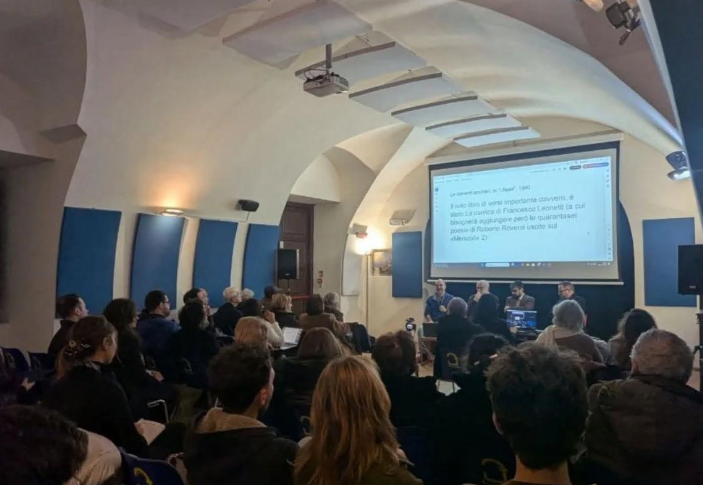
More than thirty meetings, forty guests including scholars, journalists, writers, artists, and all in the last two months of 2025. A balance enriched, naturally, by the hundreds of presences of a varied and attentive audience, inside the beautiful monumental Cloister of the former Convent of San Domenico, in Lamezia Terme. We are talking about the exhibition dedicated to Pier Paolo Pasolini, a long manifesto of events – seminars, insights, talks, books, screenings – curated down to the smallest detail by Carlo Fanelli. Professor at the University of Calabria – in that Department of Humanistic Studies which, as was said at the inaugural event in October, grasped the potential of an opportunity to bring “academia out of the academy” – Fanelli expressed great satisfaction with the success of the event, as well as with the good organizational practices put in place thanks to the institutional collaboration with the Lametino Library System and a long series of local associations which, in various capacities, gave their contribution.
Professor, how have you lived these two months?
«They were two very intense months, of diversified meetings in which we hosted Pasolini scholars of international level, such as Paolo Desogus, Stefano Casi, as well as very high profile intellectuals who brought us closer to his figure in an empathetic way, such as Dacia Maraini, Angela Scalzone, one of the actresses of “Salò”, Saverio Vallone who told us about his father’s footballing friendship with Pasolini, and again Claudio Dionesalvi who told us about Pasolini’s social football made a beautiful story, and many more. In short, an absolutely positive balance sheet: we are collecting a heritage that we don’t want to be lost, and in fact the meetings are all available online on YouTube.”
Is there already an idea to continue the project?
«Yes, starting tomorrow I will set out to publish a volume that accounts for this series of meetings. There will be news in the coming months, I believe it is essential to fix this idea in a volume which, although it was not intended to be purely academic from the beginning, deserves a very specific continuity: these interesting moments of reflection deserve continuity and to be fixed in a volume, precisely, with a more academic slant”.
A lot has already been said about Pasolini’s relevance today, and some initiatives in other parts of Italy have shown how much people still want to feel like they “own” him…
«He’s always been a bit of a pushover. Everyone has their Pasolini, unfortunately, whereas Pasolini is one and only one. If anything can be said, it can be said of his coherence in his desire to contradict himself, his so-called “syneciosis”, the co-presence of an opposition that was always present in his thought. Of course, it takes a long time to clear him as “conservative” or pseudo-fascist from here… It says a lot about the cultural dimension with which, unfortunately, we have to enter into a relationship, it is the dimension expressed by the Government and by those who find themselves managing Culture. However, the misappropriation of Pasolini’s memory and thought was truly something that should not have been done. We, in our own small way, have tried to have our say publicly. Some, like Paolo Desogus, have personally exposed themselves in conferences in Rome which were also conceived in contrast to that operation. In another meeting, for example, we heard the beautiful report by Silvia Gutierrez who spoke to us about the improper use of Pasolini’s images, images to which thoughts are attached that do not belong to Pasolini. In short, a drift…”.
Collaborating with Fanelli for the entire duration of the event, dealing with the organizational aspects, the journalist Maria Chiara Caruso also said she was extremely satisfied: «It was not a commemorative act, but a real reminder of Pasolini’s truths, to the awakening of political, social and citizen consciences. The initiative brought together intellectuals and scholars from all over Europe, and being part of it was a great privilege.” Caruso, who has been collaborating with the Lametino Library System for over ten years, has no doubts: «When we talk about Pasolini the civil commitment becomes greater, because it is essential to make it known to the new generations, his is the story of a soul that still cannot find rest. An intellectual we still need.”
Thus, the director of the Lametino Library System himself, Giacinto Gaetano, reiterated how the good practices of collaboration with the University of Calabria, and with the Department of Humanistic Studies, have been a harbinger of ideas, actions, reactions throughout the cultural humus of the territory: «A collaboration that has already been in place for some time has been consolidated, we were and are convinced that Pasolini’s thoughts and works must still speak today, in our present, even more so due to what is happening in the last months. We still have to think about the legacy he left us.” And in Lamezia, also thanks to the Library System, the excitement does not die down with Pasolini. «We are thinking – concludes Gaetano, revealing a nice preview – of a series of events dedicated to Goffredo Fofi, another fundamental intellectual, who recently passed away, who was also very close to our city».